
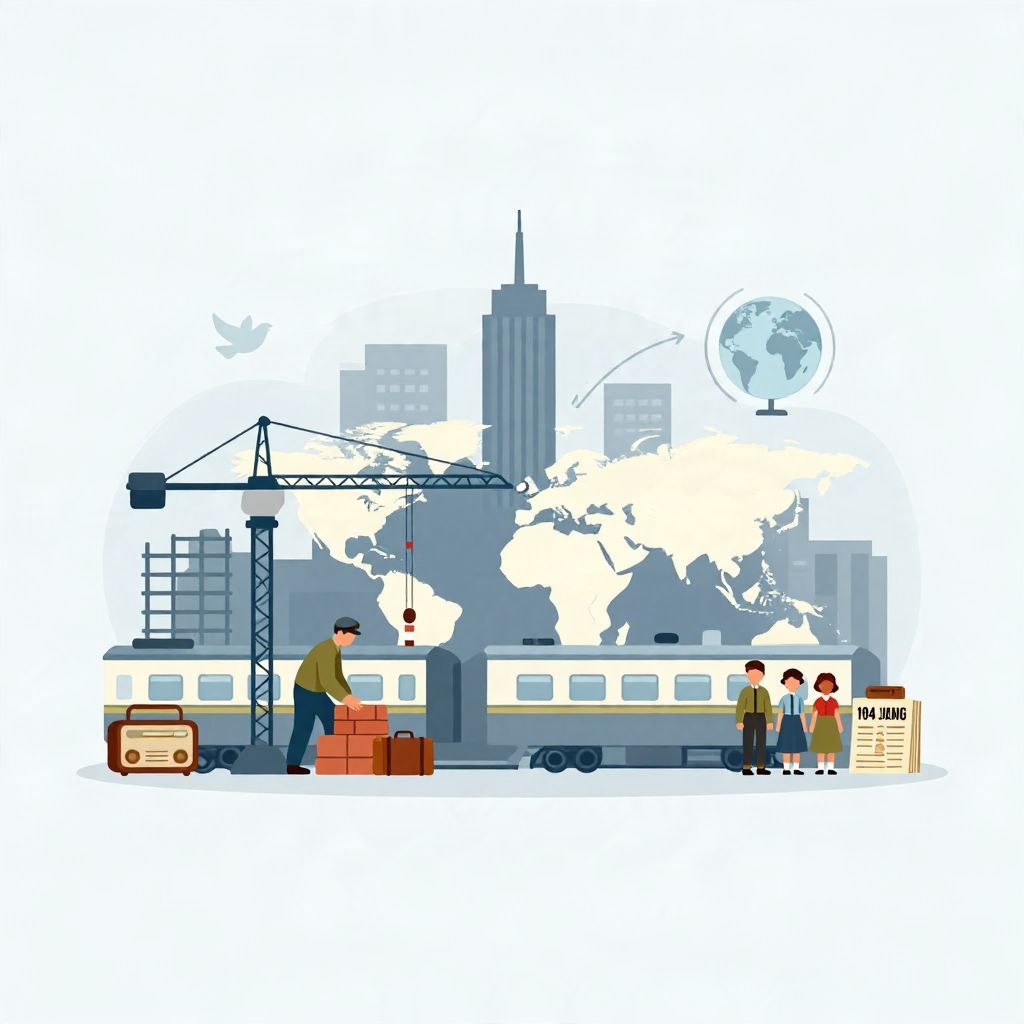
What happened in 1946? It was a year of transition, when the world moved from wartime to a new and uncertain peace. The Second World War had ended in 1945, but its political, social, and economic consequences shaped nearly every major event of 1946, from peace treaties and war crimes trials to decolonization, labor unrest, and the first signs of the Cold War.
Across Europe, Asia, Africa, and the Americas, governments were rebuilt, borders were debated, and millions of people struggled with displacement, shortages, and reconstruction. At the same time, 1946 saw the creation of new institutions, major independence movements, and cultural changes that helped define the postwar world.
What happened in 1946?
In 1946, the world entered the post-World War II era. The year brought peace settlements, the start of the Nuremberg trials, the first steps toward the United Nations’ work, growing tension between the United States and the Soviet Union, and major political changes in Europe and Asia. It was a year of rebuilding, but also of new conflict and uncertainty.
The postwar settlement begins
One of the defining features of 1946 was the effort to turn the end of war into a lasting peace. The Allied powers began negotiating treaties with former Axis states, while occupation governments tried to stabilize defeated countries. These arrangements were uneven and often tense, especially in Germany, Austria, Italy, Japan, and Eastern Europe.
Peace treaties and occupation
Formal peace was still incomplete in 1946. The war was over, but the legal and political aftermath was not. Germany remained occupied and divided into zones controlled by the Allied powers. Japan was under American occupation, where reforms were introduced under General Douglas MacArthur’s authority. In Europe, the status of former Axis allies such as Italy, Hungary, Romania, and Bulgaria was being settled through postwar diplomacy.
The year also saw the beginning of the long process of rebuilding destroyed cities, transport systems, and industries. Food shortages, housing crises, and refugee movements affected millions. For many people, 1946 felt less like a celebration of peace than the beginning of a difficult recovery.
Why 1946 mattered to the early Cold War
1946 is often seen as one of the first clear turning points in the Cold War. Wartime cooperation between the United States, Britain, and the Soviet Union was breaking down. Disputes over Eastern Europe, Germany, reparations, and political influence became more visible, and each side increasingly viewed the other with suspicion.
The growing divide between East and West
In Europe, Soviet-backed governments were consolidating power in several countries, while Western leaders worried about the spread of communism. Winston Churchill’s famous “Iron Curtain” speech came in 1946, reflecting the growing belief that Europe was splitting into rival spheres of influence. The phrase was not a formal policy, but it captured a real and accelerating division.
In the United States, concern about Soviet expansion helped shape a more hard-line foreign policy. In the Soviet Union, leaders saw Western actions as a threat to their security after the devastation of the war. The result was not immediate open conflict, but the foundations of a decades-long geopolitical rivalry were being laid in 1946.
Major events of 1946 in a timeline
The year included a wide range of developments across continents. A brief timeline helps show how broad and interconnected the changes were.
- January 1946: The first meeting of the United Nations General Assembly took place in London.
- February 1946: The “Long Telegram” from George F. Kennan helped shape U.S. thinking about Soviet policy.
- March 1946: Winston Churchill delivered his “Iron Curtain” speech in Fulton, Missouri.
- April 1946: The League of Nations was formally dissolved, marking the end of the interwar international order.
- May 1946: The International Military Tribunal at Nuremberg continued the prosecution of major Nazi leaders.
- July 1946: The United Nations began to take on a more active international role, while postwar negotiations continued.
- August 1946: India’s independence movement intensified, and political unrest grew in several colonial territories.
- September 1946: European recovery remained slow, with shortages and inflation affecting daily life.
- November 1946: Political tensions and labor unrest continued in many countries as societies adjusted to peace.
- December 1946: The postwar order was still unsettled, but new international institutions were becoming more established.
The Nuremberg trials and war crimes accountability
One of the most important developments of 1946 was the continuation of the Nuremberg trials. These proceedings were designed to hold leading Nazi officials accountable for crimes committed during the war, including crimes against humanity, war crimes, and aggressive war planning. They were a landmark in international law, even though they were also criticized by some as “victor’s justice.”
Why Nuremberg mattered
The trials were significant because they established the principle that political and military leaders could be judged for crimes under international law. They also created a public record of Nazi atrocities, including the Holocaust. At the same time, the trials raised difficult legal and moral questions: how to prosecute crimes on such a scale, how to define responsibility, and whether the Allies themselves were fully consistent in applying justice.
By 1946, the Nuremberg process had become one of the clearest symbols of the postwar effort to combine punishment, documentation, and legal reform.
1946 and the United Nations
The United Nations, founded in 1945, began operating in earnest in 1946. Its first General Assembly met in London, and its institutions started to shape the new international order. The UN was intended to prevent another global war through collective security, diplomacy, and cooperation on humanitarian and economic issues.
A new international system
The UN did not replace national interests, but it gave countries a forum for negotiation and debate. In 1946, the organization also began to develop agencies and programs focused on refugees, health, education, and reconstruction. The hope was that international cooperation could address the causes of instability that had helped lead to war in the first place.
Still, the UN’s early years were constrained by the emerging Cold War. Its effectiveness depended on cooperation among the major powers, and that cooperation was already weakening by the end of 1946.
Decolonization and independence movements
Another major theme of 1946 was the weakening of European imperial power. The war had exhausted Britain, France, the Netherlands, and other colonial empires, while anti-colonial movements gained strength around the world. In many places, people who had fought in the war or contributed to wartime production now demanded political rights and self-rule.
Asia and the colonial world
In Asia, the aftermath of Japanese defeat created political openings and instability. In India, the push toward independence accelerated. In French Indochina, Dutch Indonesia, and other colonial territories, nationalist movements pressed harder for self-government. Some of these struggles would soon turn into full-scale wars of decolonization.
1946 did not end empire, but it made clear that the old colonial order was under severe strain. The postwar world would increasingly be shaped by demands for national independence and political equality.
Political change in Europe
Europe in 1946 was marked by elections, coalition governments, occupation, and ideological conflict. Many countries were trying to rebuild democratic institutions after fascism and war, but the outcome was uneven. In some places, democratic politics revived; in others, communist parties backed by the Soviet Union gained power or influence.
Germany and the divided continent
Germany remained at the center of European politics. It was occupied and administered by the Allies, but there was no agreed long-term solution yet. The country’s future became one of the main sources of East-West tension. Meanwhile, in countries such as Poland, Hungary, Romania, and Bulgaria, postwar politics were increasingly shaped by Soviet power and local communist movements.
In Western Europe, governments focused on reconstruction, rationing, and social welfare. These pressures helped strengthen support for state intervention in the economy and broader social reforms. The war had changed not only borders but expectations about government responsibility.
Life in 1946: shortages, recovery, and social change
For ordinary people, 1946 was often defined by hardship rather than grand diplomacy. Food rationing continued in many countries. Housing was scarce. Transport systems were damaged. Millions of displaced persons, prisoners of war, and refugees were still trying to return home or find new lives.
Everyday consequences of war
Families were separated, cities were ruined, and many economies were struggling to restart production. Women who had taken on new roles during the war sometimes faced pressure to return to traditional domestic life, while in other cases they remained essential to labor markets and public services. Veterans returned home to societies that had changed dramatically during their absence.
At the same time, the postwar period created expectations of a better future. Governments were more willing to discuss welfare, jobs, education, and public health. In that sense, 1946 was not only a year of recovery but also a year when many societies began imagining how to build a more stable peace.
Culture, science, and the early postwar world
1946 was also a year of cultural and scientific transition. Film, literature, journalism, and popular music began to reflect postwar anxieties and hopes. Scientific research that had accelerated during the war continued into peacetime, especially in medicine, aviation, electronics, and nuclear physics.
The atomic age and scientific change
The atomic bombings of 1945 had already changed global politics, but in 1946 the implications of nuclear weapons became more widely understood. Governments and scientists debated control, secrecy, and international oversight. The atomic age had begun, and it would shape diplomacy, military planning, and public fear for decades.
More broadly, wartime technologies were being adapted for civilian use. The postwar years would bring major advances in communication, transportation, and medicine, but 1946 was the moment when many of those possibilities first became visible.
Historical impact of 1946
The importance of 1946 lies in how clearly it marked the shift from world war to postwar order. It was not a year of peace in the simple sense. Rather, it was the year when the consequences of war became the central forces shaping international politics, domestic reform, and global conflict.
Its long-term impact can be seen in several developments: the rise of the Cold War, the creation of the United Nations, the growth of international law, the acceleration of decolonization, and the rebuilding of states and economies after unprecedented destruction. Many of the institutions and rivalries that defined the second half of the twentieth century were already taking shape in 1946.
In short, 1946 was the year the postwar world began to take form. It closed the chapter of total war, but it also opened a new era of division, reconstruction, and global change. If you want to understand the origins of the modern world, 1946 is one of the most important years to study. For more context, you may also find it useful to read about what happened in 1945 and the earlier wartime turning points of what happened in 1941.