
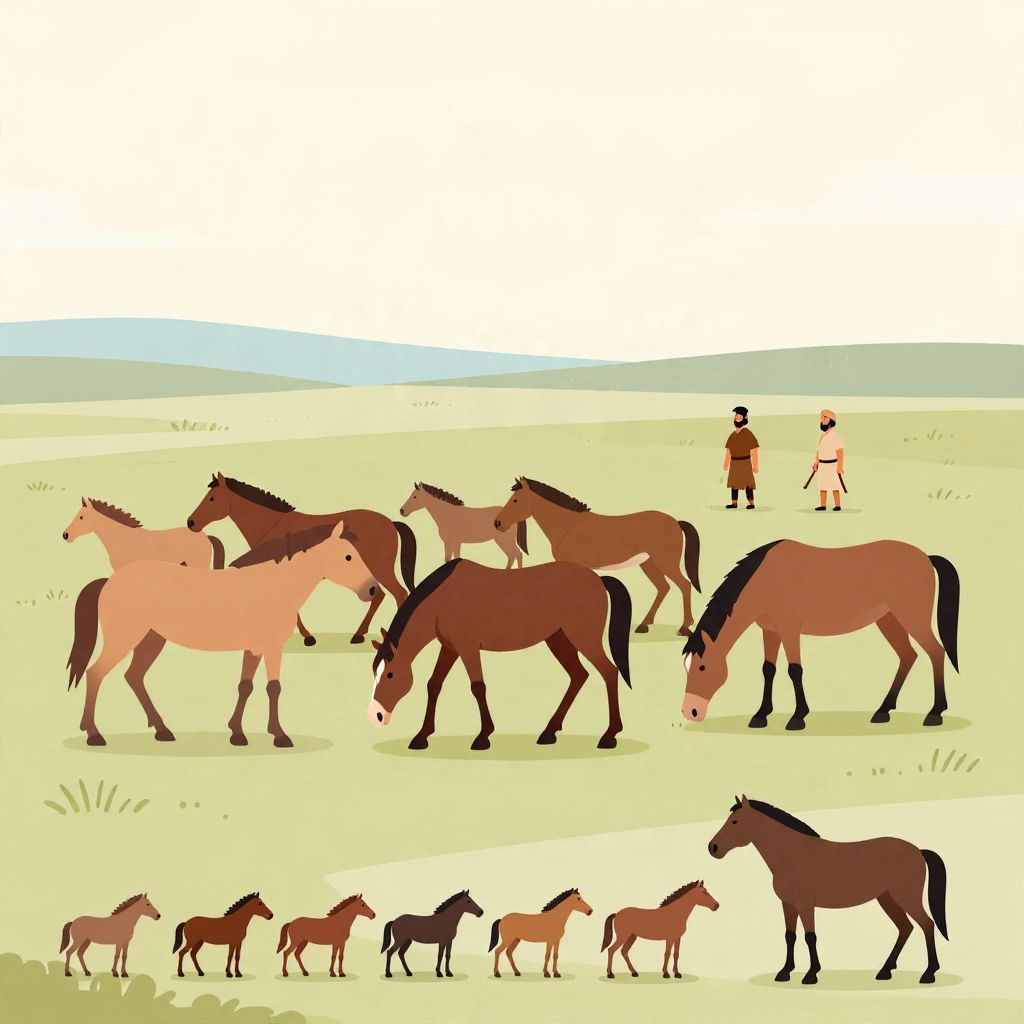
Where did horses come from? The short answer is that modern horses evolved in North America millions of years ago, then spread across the world through migration and, much later, human movement and domestication. The horse’s story is not a single origin point but a long evolutionary history shaped by climate change, extinction, and human use.
When people ask where horses came from, they usually mean both the animal’s deep evolutionary origin and the place where horses were first domesticated. Those are related but different questions, and the answer to each helps explain how horses became one of the most important animals in human history.
Where did horses come from?
Horses evolved in North America, where their earliest ancestors lived more than 50 million years ago. The modern horse, Equus ferus caballus, later developed from these ancestors and spread into Eurasia and beyond. Domestic horses were first clearly tamed on the Eurasian steppe, most likely around 3500–3000 BCE.
The deep evolutionary origin of horses
The horse family did not begin as large, grassland animals. Its earliest known ancestors were small, forest-dwelling mammals that lived in North America during the Eocene epoch, roughly 55 million years ago. Over time, changing environments favored longer legs, stronger teeth, and a body better suited to open terrain and grazing.
From forest browsers to grassland runners
One of the best-known early horse ancestors is Eohippus, often called the “dawn horse,” though that name is a simplification. It was much smaller than modern horses and had several toes rather than one hoof. As grasslands expanded, later horse relatives evolved traits that helped them survive in open country: speed, endurance, and teeth adapted to tougher vegetation.
This evolutionary process took millions of years and involved many related species, not a straight line from one horse to the next. Some branches died out. Others spread into Asia, Europe, and Africa after crossing land connections that existed during periods of lower sea level.
Why North America matters
North America is important because it was the original homeland of the horse family’s earliest development. Horses later disappeared from the Americas at the end of the last Ice Age, likely because of a combination of climate change, habitat shifts, and human hunting pressures. By the time Europeans arrived in the 15th and 16th centuries, horses were no longer native to the continent.
Where were horses first domesticated?
Most historians and archaeologists place the first secure domestication of horses on the Eurasian steppe, especially in areas associated with the Botai culture in present-day northern Kazakhstan, around 3500–3000 BCE. Evidence suggests these people kept and used horses, though exactly how early horse management became full domestication is still debated.
The steppe environment
The steppe was well suited to horse keeping. It was a vast grassland zone stretching across parts of modern Kazakhstan, southern Russia, Ukraine, and Mongolia. Mobile herding communities there depended on animals for food, transport, and status. Horses offered speed and flexibility in a landscape where movement was often essential.
Archaeological evidence from steppe sites includes horse bones, signs of herd management, and possible traces of bit wear on teeth. These clues suggest that horses were being controlled and used by humans, though scholars still discuss whether the earliest evidence proves riding, milking, or both.
What domestication changed
Once humans began breeding and managing horses, the animal’s role changed dramatically. Horses became useful for transport, warfare, communication, and labor. Over time, selective breeding produced animals with different sizes and traits suited to riding, pulling chariots, or carrying loads.
Domestication also changed human societies. Mounted travel increased the range people could cover, while horse-drawn vehicles made movement of goods and armies faster. In many regions, horses became symbols of prestige and power.
How horses spread across the world
After domestication on the steppe, horses spread rapidly across Eurasia. They reached the Near East, Central Asia, China, and eventually Europe, where they transformed military and economic life. Their spread was not instant, but it was far-reaching and historically decisive.
Horses in ancient civilizations
By the second millennium BCE, horses were appearing in the records and material culture of major ancient states. They were used in chariots in places such as Mesopotamia, Egypt, and parts of Anatolia. Later, riding became increasingly important, especially for long-distance communication and warfare.
In China, horses were highly valued for military power and imperial control. In the ancient Near East and later in classical and medieval Europe, they became central to cavalry, trade routes, and elite status. The horse was never just an animal; it was also a technology of movement.
Reintroduction to the Americas
Although horses originated in North America millions of years ago, they had vanished there long before the arrival of Europeans. Spanish explorers and settlers brought horses back to the Americas in the late 15th and 16th centuries. From there, horses spread widely, including into Indigenous societies, where they were quickly adopted and transformed local life in many regions.
This return is one of history’s great ironies: an animal that evolved in the Americas became extinct there, then returned through human expansion and reshaped the continent again.
What is the difference between wild horses and domestic horses?
Not all horses are the same historically or biologically. True wild horses are those that descend from wild ancestors and were never domesticated, while feral horses descend from domestic animals that escaped human control. This distinction matters because many famous “wild” horse populations are actually feral.
Przewalski’s horse
The best-known surviving wild horse is Przewalski’s horse, native to parts of Central Asia. It is not the ancestor of domestic horses, but a separate wild lineage closely related to them. Its survival has made it important in conservation history and in debates about horse evolution.
Feral horse populations
Modern feral horses, such as mustangs in North America or brumbies in Australia, come from domesticated horses introduced by humans. They are historically important, but they are not evidence of an unbroken wild horse tradition in those places.
Why the origin of horses matters in history
The history of horses is more than a story of animal evolution. It helps explain migration, trade, warfare, and the growth of states. Horses increased mobility in the ancient world and made possible new forms of power across vast distances. They also connected regions that might otherwise have remained isolated.
At the same time, the horse’s history reminds us that “origin” can mean different things. Biologically, horses came from North America. As domesticated animals, they emerged on the Eurasian steppe. Both answers are true, and both are essential to understanding how horses became so influential.
Timeline of horse origins and spread
- About 55 million years ago: Early horse ancestors appear in North America.
- Millions of years later: Horse relatives evolve larger bodies, longer legs, and grazing teeth.
- End of the Ice Age: Horses disappear from North America.
- About 3500–3000 BCE: Horses are first clearly domesticated on the Eurasian steppe.
- Second millennium BCE: Horses spread widely across ancient Eurasia.
- Late 15th to 16th centuries CE: Horses are reintroduced to the Americas by Europeans.
Conclusion
So, where did horses come from? Their deepest roots are in North America, but the horse we know today was shaped by long evolution and then domesticated on the Eurasian steppe. From there, horses changed human history across continents, and their story still reflects the movement of animals, people, and power. For related reading, you may also enjoy history of domestication and ancient civilizations and animals.