
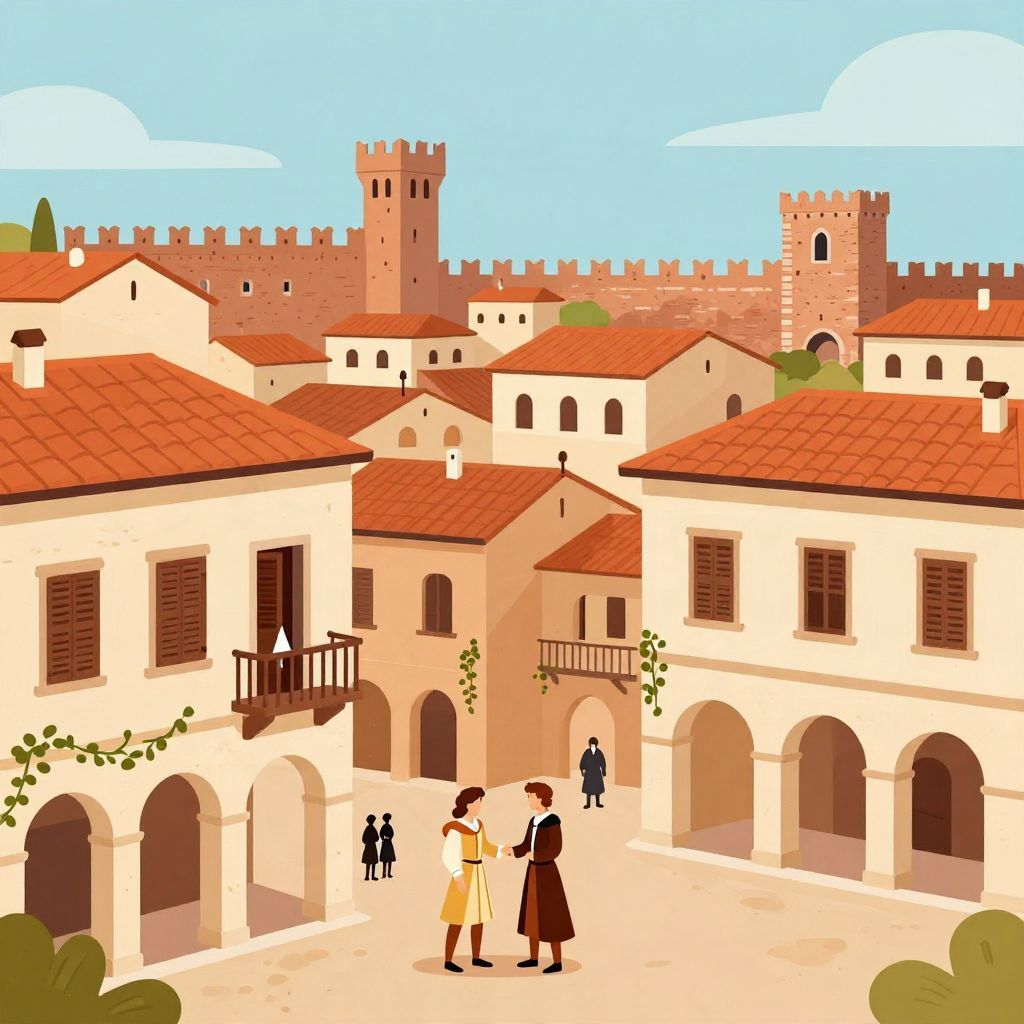
When people ask where Romeo and Juliet took place, they are usually asking about both the story’s setting and its historical background. The short answer is that Shakespeare set the tragedy in Verona, Italy, with key scenes also taking place in nearby places such as Mantua. The play is a work of literature, but it draws on Italian settings, social customs, and older stories that predate Shakespeare.
Understanding the location helps explain why the drama feels so vivid: it is rooted in a Renaissance Italian world of family honor, public conflict, and political tension, even though Shakespeare wrote it for an Elizabethan English audience.
Where did Romeo and Juliet take place?
Romeo and Juliet is set mainly in Verona, in northern Italy, during a fictionalized Renaissance-era past. Shakespeare places the feud between the Montagues and Capulets in this city, and he later sends Romeo into exile in Mantua. Verona is the play’s primary location, but the story is not a documentary account of a real historical event; it is a literary tragedy shaped by earlier Italian tales and by Shakespeare’s dramatic imagination.
Verona as the main setting
Verona is the city most closely associated with the play because Shakespeare explicitly names it in the opening lines. In the drama, the city is a place of narrow streets, public squares, private houses, and civic authority, all of which help create the sense that the lovers are trapped inside a tightly controlled social world. The setting matters: in a city where family reputation and public violence are intertwined, a private romance can quickly become a public crisis.
Mantua and the wider Italian backdrop
After Romeo kills Tybalt and is banished, he moves to Mantua, another real Italian city. Mantua functions as a place of exile, separation, and delayed communication. Shakespeare uses it to heighten the tragedy: Romeo is not far away, but he is cut off just enough that bad news reaches him too late. This geographical detail is one reason the play feels historically grounded, even though the plot itself is fictionalized.
Was Romeo and Juliet based on a real historical event?
The story is not known to be based on one verified real-life couple in Verona. Instead, Shakespeare adapted an earlier literary tradition of star-crossed lovers. The most important source was an Italian tale by Matteo Bandello, filtered through English retellings before Shakespeare wrote his version around 1595. So while the setting is real, the plot is best understood as a literary creation rather than a confirmed historical episode.
Earlier versions of the story
Shakespeare did not invent the basic narrative. Versions of the tale circulated in Italy before his play, and English writers had already adapted it. These earlier stories included feuding families, secret marriage, mistaken death, and tragic misunderstanding. Shakespeare transformed that material into a fast-moving stage tragedy with sharper poetry, more emotional depth, and a stronger sense of youthful urgency.
The difference between setting and history
This distinction is important. A story can be set in a real place without describing a verified event from that place’s history. Verona gives the play a believable geographic and cultural frame, but the feud between the Montagues and Capulets is not established as a real historical feud in the way that, say, a documented war or treaty would be. The city is historical; the lovers are literary.
Why Verona fits the story so well
Verona suits the play because it evokes the Italian city-states of the Renaissance, where noble families, local politics, and honor culture could overlap. Shakespeare’s audience would have associated Italy with passion, intrigue, and danger. That made Verona an effective setting for a story about impulsive love and violent rivalry. The city also offered an exotic but recognizable backdrop for English theatergoers.
Family honor and public violence
In the play, insults escalate quickly into sword fights. That pattern reflects a broader early modern fascination with honor, masculinity, and reputation. Shakespeare dramatizes a society in which family identity is so powerful that young people inherit conflicts they did not create. Verona becomes more than a location; it becomes a social system that pressures everyone inside it.
Religion, law, and social order
The play also shows the limits of authority. Prince Escalus tries to impose order, Friar Laurence tries to guide events, and the families continue to defy restraint. This tension between private passion and public law is central to the tragedy. Verona is therefore not just a picturesque Italian city; it is a stage for the breakdown of civic peace.
The historical background of Shakespeare’s Verona
Shakespeare’s Verona belongs to a literary Renaissance Italy, not to a carefully reconstructed historical year. Still, the play reflects ideas associated with the late medieval and Renaissance worlds: noble households, arranged marriages, street violence, and the importance of lineage. Shakespeare likely drew on a generalized image of Italian urban life rather than on detailed local history.
What the play gets historically plausible
- Italian city setting: Verona and Mantua were real cities with long histories.
- Noble family rivalry: Feuds among elite families were a familiar literary and historical motif.
- Social emphasis on honor: Reputation and public standing mattered greatly in many early modern societies.
- Private marriage and public consequence: Secret unions could create major family and legal conflict.
What is fictionalized
- The Montague-Capulet feud is not securely documented as a real Verona conflict.
- The exact timeline of the lovers’ story is dramatic invention.
- Several plot devices, such as the sleeping potion and the fatal timing of messages, serve tragedy rather than history.
How Shakespeare’s audience would have seen the location
For an English audience in the 1590s, Italy often represented sophistication, danger, and emotional intensity. Shakespeare used that cultural image to his advantage. Verona would have seemed both foreign and believable, allowing the audience to enjoy the drama at a slight remove while still recognizing its human themes: love, family conflict, youth, and loss.
Italian settings in Elizabethan drama
Shakespeare was not alone in setting stories in Italy. English writers often used Italian cities for tales of romance, intrigue, and moral danger. These settings gave dramatists a flexible stage on which to explore controversial subjects. In Romeo and Juliet, Italy helps create a world where private feeling collides with public expectation.
Why the setting still matters today
Modern readers and audiences continue to connect the play with Verona because the city has become part of its identity. Tourism, literary memory, and performance history have reinforced that association. Even so, it is worth remembering that the Verona of the play is a literary Verona, shaped by Shakespeare’s needs rather than by a historian’s map.
What is the historical significance of the play’s location?
The location matters because it helps explain why the story has endured. Verona gives the tragedy a clear sense of place, but it also symbolizes a broader world in which social structures can crush individual happiness. The city’s realism makes the emotional drama more powerful, while the fictionalized feud gives Shakespeare room to explore timeless themes.
Place as part of the tragedy
The lovers are not destroyed by fate alone. They are also trapped by geography: Verona’s streets, houses, and social boundaries keep bringing them back into danger. Romeo’s exile to Mantua creates distance, but not safety. The physical separation between the two cities becomes one of the mechanisms of tragedy.
The lasting cultural image of Verona
Because of Shakespeare, Verona is now inseparable from the play in popular culture. That association has influenced how people imagine the city, even though its real history is far richer and more complex than the story suggests. In this sense, Romeo and Juliet has given Verona a permanent place in world literature.
So, where did Romeo and Juliet take place?
Romeo and Juliet takes place mainly in Verona, Italy, with an important section in Mantua. The story is set in a fictionalized Renaissance Italian world, not in a fully documented historical event. Shakespeare used these real places to frame a tragic love story drawn from earlier Italian and English sources. The result is a play that feels historically grounded while remaining unmistakably literary.
If you want to explore the characters further, you may also like how old Romeo is and how old Juliet is.