
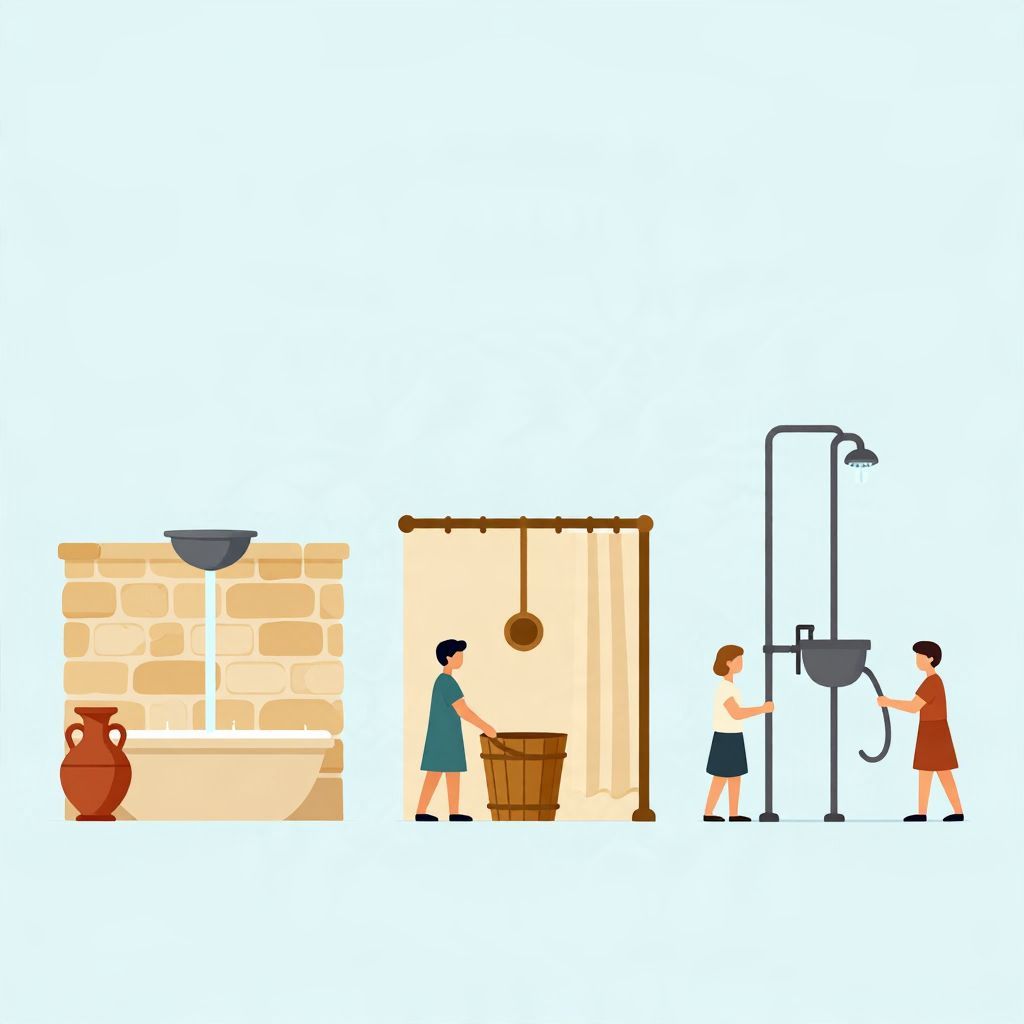
The shower feels like a modern convenience, but its history is much older than most people realize. There is no single “inventor” of the shower in the modern sense, because bathing under falling water developed in stages across different civilizations.
The short answer is that shower-like bathing existed in ancient times, while the modern shower emerged in 18th-century England and became practical and widespread in the 19th century. Its development depended on plumbing, pumps, water pressure, and changing ideas about hygiene.
When was the shower invented?
Shower bathing was not invented on one exact date. Early versions appeared in ancient Greece and Rome, but the first recognizable modern shower is usually traced to 1767, when English inventor William Feetham patented a mechanical shower. Later improvements in indoor plumbing and hot-water systems made showers common in the 19th and 20th centuries.
Ancient shower-like bathing before the modern shower
Long before indoor bathrooms, people found ways to wash with running water. In the ancient world, showering usually meant water poured or channeled over the body rather than a fixed household fixture. These were practical, communal, and often tied to bathhouses, ritual cleansing, or military life.
Greece and Rome
In ancient Greece and Rome, public baths were central to daily life for many urban residents. Some bath complexes used overhead water delivery or cascading water features that functioned like primitive showers. Roman engineering, especially aqueducts and bathhouse plumbing, made controlled water flow possible on a large scale.
These were not showers in the modern private-home sense, but they show an important point: the basic idea of bathing under falling water is ancient. What was missing was the combination of compact design, reliable pressure, and domestic plumbing needed for a true household shower.
Other early cleansing traditions
Across the world, people used buckets, basins, pitchers, and streams for washing. In many societies, bathing customs emphasized immersion, pouring water over the body, or washing at rivers and wells. The shower as a fixture was only one path among many to personal cleanliness.
The first modern shower: 1767
The clearest milestone in shower history comes in 1767, when William Feetham of London patented a mechanical shower. His design used a pump to draw water into a basin above the user, then release it downward through a nozzle or perforated outlet. It was an early attempt to create a reusable indoor shower apparatus.
Why Feetham’s shower mattered
Feetham’s invention was important because it moved showering from a vague bathing practice to a distinct mechanical device. The shower was still far from modern comfort: it could be awkward, and the same water was often recirculated. But it established the basic concept of standing beneath a controlled stream of water.
That said, Feetham’s shower was not yet a mass-market household appliance. It belonged to a world before modern sanitation, before dependable hot-water supply, and before bathrooms were standard rooms in homes. Its significance lies in being the first well-documented modern shower design rather than the first act of washing with falling water.
How the shower changed in the 19th century
The 19th century transformed the shower from a novelty into a practical fixture. As cities expanded, plumbing systems improved, and attitudes toward cleanliness shifted, showers became easier to install and more appealing to households, institutions, and public facilities.
Plumbing and water pressure
A shower needs more than a nozzle. It requires dependable water delivery, drainage, and enough pressure to produce a steady spray. These conditions became more common as municipal water systems developed and indoor plumbing spread in industrializing cities.
In the early 19th century, many homes still relied on pumps, cisterns, or carried water. As pipes, valves, and water-heating systems improved, the shower became less of a curiosity and more of a useful fixture. This is why the history of the shower is closely tied to the history of indoor plumbing.
Public health and hygiene
Victorian-era concern with cleanliness also helped the shower gain ground. Doctors, reformers, and public institutions increasingly linked bathing with health, discipline, and moral improvement. Showers were especially useful in settings where quick washing was practical, such as barracks, schools, factories, and hospitals.
Compared with long baths, showers used less water and took less time. That made them attractive in institutional settings first. Over time, as bathrooms became part of ordinary homes, the shower followed.
Important milestones in shower history
Because the shower developed gradually, it helps to view its history as a timeline of improvements rather than a single invention date. The following milestones show how the modern shower took shape.
- Ancient era: Bathhouses and water-pouring practices in Greece, Rome, and other societies create early shower-like bathing methods.
- 1767: William Feetham patents a mechanical shower in London, often treated as the first modern shower design.
- Early 1800s: Improved pumps and plumbing make shower devices more practical, though still uncommon in private homes.
- Mid- to late 1800s: Public health reforms and institutional bathing increase shower use in barracks, hospitals, and other shared spaces.
- Late 1800s to early 1900s: Indoor plumbing becomes more common, and showers begin appearing more regularly in homes.
- 20th century: Hot-water systems, bathroom standardization, and mass housing make the shower a normal part of everyday life.
Was the shower invented all at once?
No. The shower is best understood as a gradual invention. Different elements appeared at different times: falling water, mechanical delivery, plumbing, drainage, heating, and the private bathroom. A device may exist on paper or in a workshop long before it becomes practical for ordinary people.
This is why historians usually avoid naming one universal “inventor” of the shower. Instead, they distinguish between early shower-like bathing, the first patented modern shower, and the later spread of showers into everyday domestic life.
Why the exact answer depends on the definition
If you mean “when did people first bathe under falling water?” the answer is antiquity. If you mean “when was the first modern shower device patented?” the answer is 1767. If you mean “when did showers become common in homes?” the answer is mainly the late 19th and 20th centuries.
What made the modern shower possible?
The modern shower depended on several technological and social changes working together. None of them alone was enough. Together, they made showering efficient, comfortable, and widely available.
1. Reliable plumbing
Pipe networks, valves, and drains made it possible to deliver water where it was needed and remove it safely afterward. Without plumbing, a shower is little more than a bucket and a creative stand.
2. Water heating
Cold showers were possible long before heated ones became common, but hot water made showering much more comfortable and desirable. The spread of water heaters helped turn the shower into a daily habit rather than an occasional ordeal.
3. Bathroom design
Once homes began to include dedicated bathrooms, showers could be built into a permanent space. This changed the shower from an awkward apparatus into a standard household fixture.
4. New ideas about cleanliness
As hygiene became associated with health and modern living, people increasingly preferred quick, regular washing. The shower fit that new rhythm better than the long soak bath in many settings.
Shower history in the modern home
By the 20th century, showers had become a familiar part of domestic life in many countries, especially where indoor plumbing was widespread. They were valued for speed, convenience, and water efficiency, though bath tubs remained common too. In many homes, the shower eventually became the default way to wash.
Modern shower design continued to evolve with better showerheads, thermostatic controls, tiled enclosures, and accessible layouts. What began as a mechanical novelty became one of the most ordinary fixtures in the built environment.
Historical significance of the shower
The history of the shower reflects more than a change in bathing habits. It shows how technology, urban life, and public health reshape everyday routines. A shower may seem mundane, but it depends on a long chain of engineering and social change stretching from ancient bathhouses to modern plumbing networks.
In that sense, the shower is a small invention with a large history. It reveals how daily life is often transformed not by one dramatic breakthrough, but by centuries of gradual improvement.
So, when was the shower invented?
If you want the most precise historical answer, the modern shower was first patented in 1767 by William Feetham in England. But shower-like bathing is much older, and the version most people use today only became common after plumbing, water heating, and bathroom design advanced in the 19th and 20th centuries.
For more on the broader history of bathing technology, see when showers were invented and the related history of when indoor plumbing became common.