
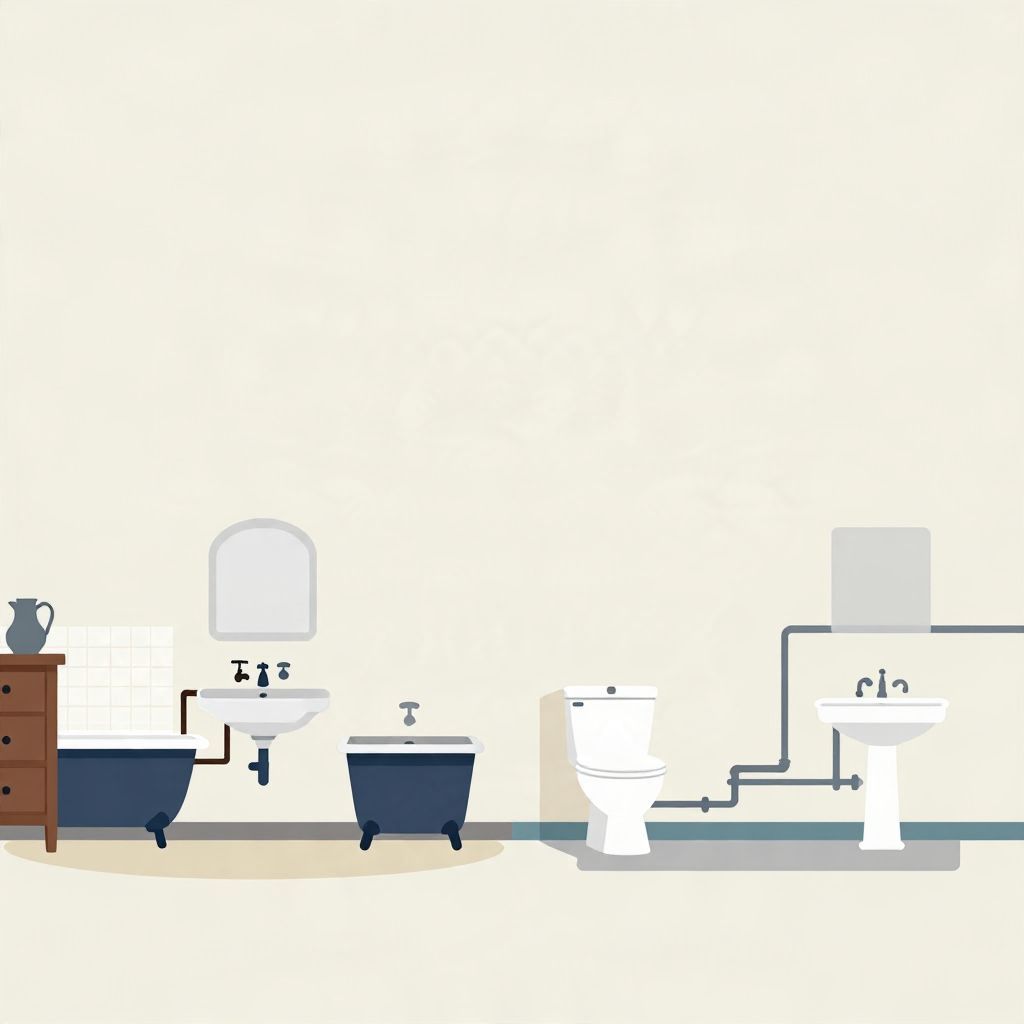
Indoor plumbing is so ordinary today that it can be hard to imagine a time when most homes lacked running water, sinks, baths, and flush toilets. The answer, however, depends on where you are asking about and what “common” means.
In the United States and much of Western Europe, indoor plumbing became common mainly in the late 19th and early 20th centuries, with broad household adoption accelerating between about 1890 and 1940. In poorer areas and rural regions, it often arrived much later.
When did indoor plumbing become common?
Indoor plumbing became common in many urban homes during the late 1800s and early 1900s, but it did not become nearly universal until the mid-20th century. Cities adopted water mains, sewer systems, and indoor bathrooms first; rural households often waited decades longer, especially outside major industrialized countries.
What counts as “indoor plumbing”?
The phrase usually refers to a home having piped water and plumbing fixtures inside the building, such as a sink, bathtub, and toilet. It is not just about a faucet: indoor plumbing depends on a wider public system of water supply, drainage, and sanitation.
Why that matters
A house could have a water pump, a privy, or a washbasin and still not have true indoor plumbing. For plumbing to become common, cities needed municipal waterworks and sewers, and homeowners needed the money and space to install bathrooms. That is why the change happened unevenly.
The short answer by date
The clearest historical answer is this: indoor plumbing became common in many middle-class urban homes between roughly 1890 and 1930, while it became widespread across the broader population in the 1930s to 1950s. In the United States, for example, many city households had indoor plumbing by the early 20th century, but a large share of rural homes did not.
A simple timeline
- Ancient world: Some elite homes and public buildings had sophisticated water and drainage systems.
- 1800s: Industrial cities expanded water supply networks and sewer systems.
- Late 1800s: Indoor bathrooms became increasingly practical in wealthier urban homes.
- 1890–1930: Indoor plumbing spread rapidly in cities and middle-class neighborhoods.
- 1930s–1950s: Mass adoption widened, especially in new housing and urban redevelopment.
- Mid-20th century and after: Indoor plumbing became the norm in most developed countries, though not everywhere at the same pace.
How indoor plumbing developed over time
Indoor plumbing did not appear all at once. It grew out of centuries of experimentation with water delivery, drainage, and sanitation. The modern home bathroom was the result of engineering, public health reform, urban growth, and consumer demand.
Ancient and early precedents
Long before modern plumbing, some ancient societies built impressive water systems. The Indus Valley civilization used planned drainage in some cities. The ancient Romans built aqueducts, baths, latrines, and complex sewer systems. These were not “indoor plumbing” in the modern domestic sense for most people, but they show that piped water and sanitation are very old ideas.
After the fall of Rome in western Europe, many urban water systems declined or disappeared. In medieval towns, people often relied on wells, cisterns, chamber pots, and outdoor privies. Wealthy households might have better arrangements, but plumbing inside the home was rare.
18th and early 19th centuries
As cities grew, sanitation problems became harder to ignore. Crowded streets, contaminated wells, and waste disposal issues contributed to disease and public concern. Early waterworks and private plumbing began appearing in some places, especially for the wealthy. But most homes still lacked piped water indoors.
At this stage, plumbing was often limited to a few fixtures or to elite residences, hotels, and institutions. The technology existed, but it was expensive, inconsistent, and dependent on local infrastructure.
The 19th-century turning point
The real breakthrough came with industrial-era urbanization. Cities needed reliable water for households, firefighting, factories, and public health. Engineers built larger municipal water systems, and cities began constructing sewer networks to remove waste more safely.
This period also saw major changes in attitudes toward cleanliness. Bathing, handwashing, and sanitary toilets became more strongly associated with health and respectability. By the late 1800s, bathrooms were increasingly seen not as luxuries but as desirable features of modern life.
Why indoor plumbing spread unevenly
Indoor plumbing became common first in wealthy urban areas because those places had the strongest combination of income, infrastructure, and political pressure. Rural homes, poor neighborhoods, and regions without strong municipal systems lagged behind. The spread of plumbing was therefore tied to class, geography, and state investment.
Key factors that accelerated adoption
- Municipal water systems: Cities had to pipe clean water into neighborhoods.
- Sewer construction: Waste had to be carried away safely.
- Building standards: New housing increasingly included bathrooms.
- Public health reform: Sanitation campaigns linked plumbing to disease prevention.
- Mass production: Fixtures became cheaper and more standardized.
- Electricity and modern housing: New homes were built with integrated utilities.
Why rural areas lagged
Rural households often used wells, outhouses, hand pumps, and outdoor water sources well into the 20th century. Installing indoor plumbing in isolated homes could be costly because it required pipes, labor, water pressure, and sometimes septic systems or access to sewer lines. As a result, the timeline for “common” differed sharply between city and countryside.
When did indoor plumbing become common in the United States?
In the United States, indoor plumbing became common in urban homes by the early 20th century, but it was not universal. Many city families had indoor water and toilets by the 1920s and 1930s, while rural America remained far behind. Broad national commonness came later, especially after New Deal-era infrastructure, postwar housing growth, and rural electrification.
Urban versus rural adoption
Large cities such as New York, Chicago, Boston, and Philadelphia were among the earliest places where indoor plumbing spread widely, because dense populations made water and sewer systems more economically feasible. Apartment buildings and row houses were especially likely to be connected to municipal systems earlier than isolated farmhouses.
By contrast, many rural homes in the United States still lacked complete indoor plumbing well into the mid-20th century. This gap narrowed gradually through public works, improved building materials, and rising household incomes.
Mid-century normalization
After World War II, indoor bathrooms became standard in much new housing. Suburban development, federal housing policies, and consumer expectations helped make bathrooms with toilets, sinks, and tubs a basic feature of the modern home. By then, the absence of indoor plumbing increasingly marked a home as old, remote, or impoverished.
What about Europe and other regions?
Western Europe followed a broadly similar pattern, though with differences by country and city. Britain, France, Germany, and other industrializing states expanded urban sanitation in the 19th century, with broad household adoption in the late 19th and early 20th centuries. As in the United States, rural areas often lagged behind cities.
Global differences
In many parts of the world, especially in less industrialized or colonized regions, indoor plumbing became common much later. In some places it spread mainly after mid-20th-century urbanization and state-led infrastructure projects. So while indoor plumbing is often treated as a 20th-century norm, its timeline is highly uneven across the globe.
How public health changed the story
Indoor plumbing was not just a convenience; it was a public health revolution. Clean water reduced exposure to contaminated sources, and sewer systems helped cities manage waste more effectively. These improvements were closely tied to lower rates of some waterborne diseases and to the broader modern idea that sanitation is a public responsibility.
From luxury to necessity
At first, indoor plumbing could seem like a sign of wealth or modern taste. Over time, it became understood as essential infrastructure. That shift in meaning is important: once public health officials, city planners, and ordinary families saw plumbing as necessary rather than optional, adoption accelerated.
Historical facts that help explain the timeline
A few broad facts explain why indoor plumbing took so long to become common:
- It required both private household fixtures and public infrastructure.
- It depended on reliable water pressure and drainage.
- It was initially expensive to install and maintain.
- It spread fastest where population density made infrastructure economical.
- Its adoption was shaped by class, region, and government investment.
That is why there is no single universal date. For some affluent city households, indoor plumbing became normal in the late 1800s. For many working-class urban families, it became common in the early 1900s. For many rural households, it arrived much later.
So, when did indoor plumbing become common?
Indoor plumbing became common in many places between about 1890 and 1940, first in cities and wealthier homes, then more broadly across the population. In the United States and Western Europe, it was a major feature of modern life by the mid-20th century, though not fully universal until later.
In historical terms, the rise of indoor plumbing marks the shift from older household sanitation to the modern urban infrastructure age. It changed daily routines, improved public health, and reshaped what people expected from a home. If you want to follow that story further, you may also be interested in when indoor plumbing was invented and when the toilet was invented.