
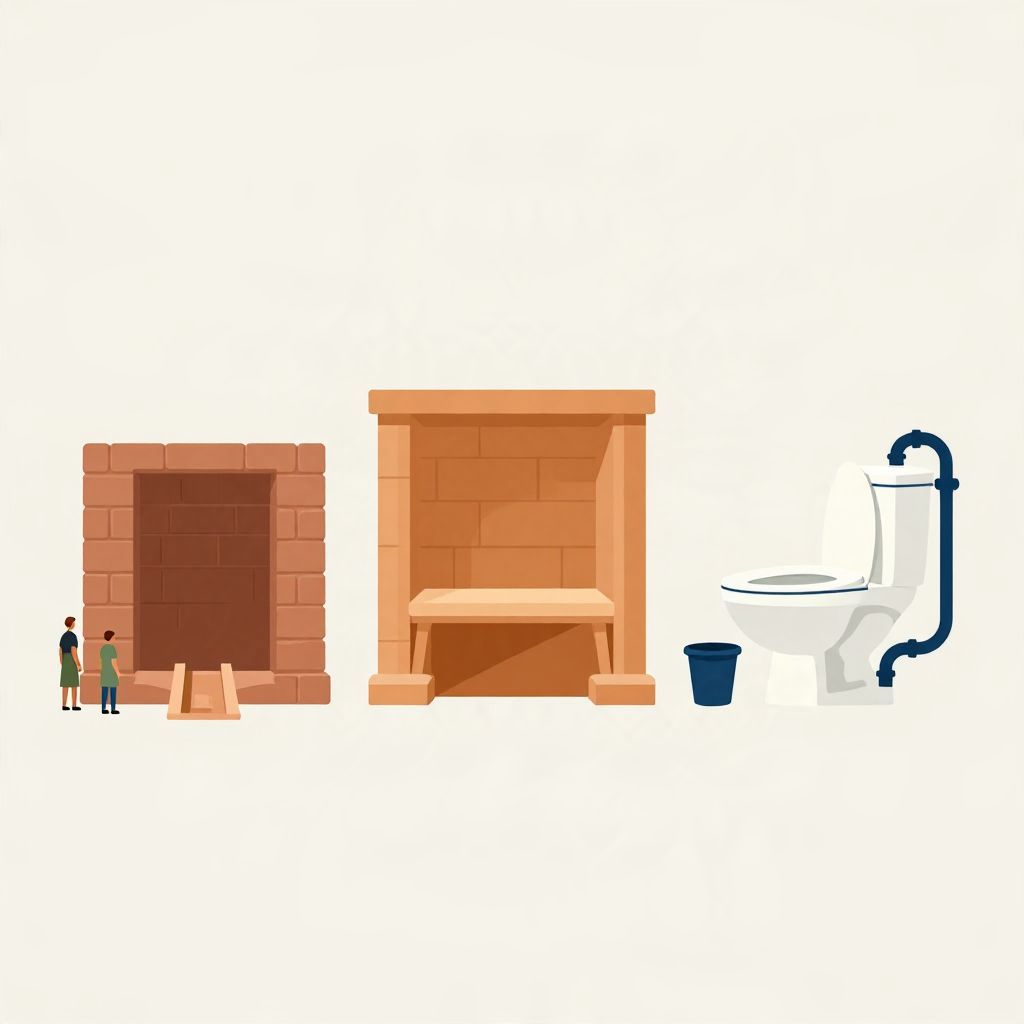
When was the toilet invented? The short answer is that no single person invented the toilet. Flush toilets emerged gradually, with early forms appearing in ancient civilizations and the modern household toilet developing in stages over many centuries.
If you mean the flush toilet most people recognize today, its key breakthroughs came much later, especially in the 16th century and then in the 19th century during the rise of modern sanitation. The history of the toilet is really a history of plumbing, urban life, and public health.
When Was the Toilet Invented?
The toilet was not invented on one exact date. The earliest known toilets date back to ancient Mesopotamia and the Indus Valley around 2500 BCE, while the first recognizable flush toilet was designed in 1596 by Sir John Harington. The modern toilet became practical and widespread in the 1800s, especially after improvements in plumbing, sewer systems, and sanitation.
The Earliest Toilets in Ancient History
Mesopotamia and the Indus Valley
Some of the oldest known toilet-like systems appeared in ancient cities more than 4,000 years ago. Archaeologists have found evidence of drainage systems, latrines, and waste channels in places such as the Indus Valley civilization and ancient Mesopotamia. These were not modern toilets, but they show that people were already trying to separate waste from living spaces.
In the Indus Valley, cities such as Mohenjo-daro and Harappa had remarkably advanced drainage arrangements for their time. Many homes appear to have had bathing areas and waste disposal connected to covered drains. This was an important step toward organized sanitation, even if it was not a flush toilet in the modern sense.
Ancient Egypt, Greece, and Rome
Other ancient societies also developed toilet practices, though not always with the same level of engineering. In Egypt, elite homes and tombs sometimes included simple toilet seats or waste containers. In Greece and Rome, public latrines became more common, especially in cities where dense populations made sanitation a practical necessity.
The Romans are especially famous for their public toilets. These were often long benches with holes cut into them, sometimes with running water beneath to carry waste away. Roman latrines were social spaces as well as functional ones, but they were still far from the private, water-flushed bathroom we know today.
The First Flush Toilet
Sir John Harington’s 1596 Design
The first known design for a flush toilet is usually credited to Sir John Harington, an English courtier and inventor, in 1596. He built a device for Queen Elizabeth I and described it in a satirical work. Harington’s toilet used water to wash waste away, which makes it a direct ancestor of the modern flush toilet.
However, Harington’s invention was not widely adopted. It was clever, but it was not yet practical for most homes because reliable water supply and sewage disposal systems were limited. In other words, the idea existed before the infrastructure did.
Why the Invention Did Not Spread Quickly
Early flush toilets were expensive and awkward to maintain. Without modern pipes, traps, and sewer networks, flushing waste away could create smells and hygiene problems rather than solve them. For that reason, chamber pots, privies, and cesspits remained common in Europe for a long time after Harington’s design.
This is one reason historians are careful when answering “when was the toilet invented.” The concept of a flushing device appeared in the late 1500s, but the toilet as a reliable household fixture came much later.
How the Modern Toilet Developed
18th-Century Improvements
In the 1700s, inventors and craftsmen began improving toilet design. One major step came from Alexander Cummings, who patented the S-shaped pipe trap in 1775. This trap helped block sewer gases from coming back into the room, making indoor toilets far more usable and sanitary.
Another important figure was Joseph Bramah, who improved toilet mechanisms in the late 18th century and helped make them more reliable. These advances did not instantly create widespread toilet use, but they solved some of the biggest technical problems.
The 19th Century and the Sanitation Revolution
The toilet became truly modern in the 1800s, especially in large industrial cities. Population growth, crowded housing, and repeated outbreaks of disease forced governments and engineers to rethink sanitation. Sewer systems expanded, water supplies improved, and indoor plumbing became more common among wealthier households before spreading more broadly.
During this period, the toilet changed from a luxury or novelty into a public health necessity. The connection between waste disposal and disease prevention became increasingly clear, especially during cholera outbreaks and other urban health crises.
Timeline of Toilet History
Here is a simple timeline showing the major stages in toilet development:
- c. 2500 BCE – Early toilet and drainage systems appear in the Indus Valley and other ancient civilizations.
- Classical era – Greeks and Romans use latrines and public sanitation systems in cities.
- 1596 – Sir John Harington designs an early flush toilet in England.
- 1775 – Alexander Cummings patents the S-trap, a major sanitary improvement.
- Late 1700s – Joseph Bramah refines toilet mechanisms.
- 1800s – Indoor plumbing and sewer systems expand in industrial cities.
- Late 19th to early 20th century – The modern toilet becomes common in many homes in the developed world.
What Counts as a “Toilet”?
Different Definitions Matter
Part of the confusion comes from the word itself. If by “toilet” you mean any place or device used for human waste disposal, then toilets are ancient. If you mean a flush toilet with running water, then the story begins in the late 1500s. If you mean a modern indoor bathroom fixture with a trap and sewer connection, then the crucial period is the 18th and 19th centuries.
So the answer depends on what kind of toilet you are asking about. Historians usually separate the idea of sanitation from the specific invention of the flush toilet.
Toilet, Latrine, Privy, and Water Closet
Older terms can also be confusing. A privy was often an outdoor toilet or outhouse. A latrine usually referred to a shared or public toilet. A water closet became a common term for a flush toilet in the 18th and 19th centuries. These terms reflect the long transition from simple waste pits to modern plumbing.
Why the Toilet Was Such an Important Invention
The toilet may seem ordinary today, but historically it was transformative. Better toilets reduced contact with human waste, improved city cleanliness, and supported larger populations in dense urban areas. They also became part of a broader shift toward modern public health, including clean water systems, sewage treatment, and better housing.
In that sense, the toilet is not just a household convenience. It is one of the most important everyday technologies in human history because it changed how cities could grow and how disease could be managed.
Historical Facts About the Toilet
- There was no single “inventor” of the toilet.
- Ancient civilizations had toilets and drainage systems thousands of years ago.
- Sir John Harington created one of the first flush toilet designs in 1596.
- Alexander Cummings improved toilet sanitation with the S-trap in 1775.
- The modern toilet became widespread only after 19th-century plumbing and sewer systems developed.
Conclusion: So, When Was the Toilet Invented?
The best historical answer is that the toilet was invented in stages. Ancient civilizations created early sanitation systems thousands of years ago, the first flush toilet design appeared in 1596, and the modern toilet took shape in the 18th and 19th centuries as plumbing and sewers improved. If you want to explore the broader history of home sanitation, see when indoor plumbing was invented. For another example of how inventions develop over time, you may also enjoy when the violin was invented.