
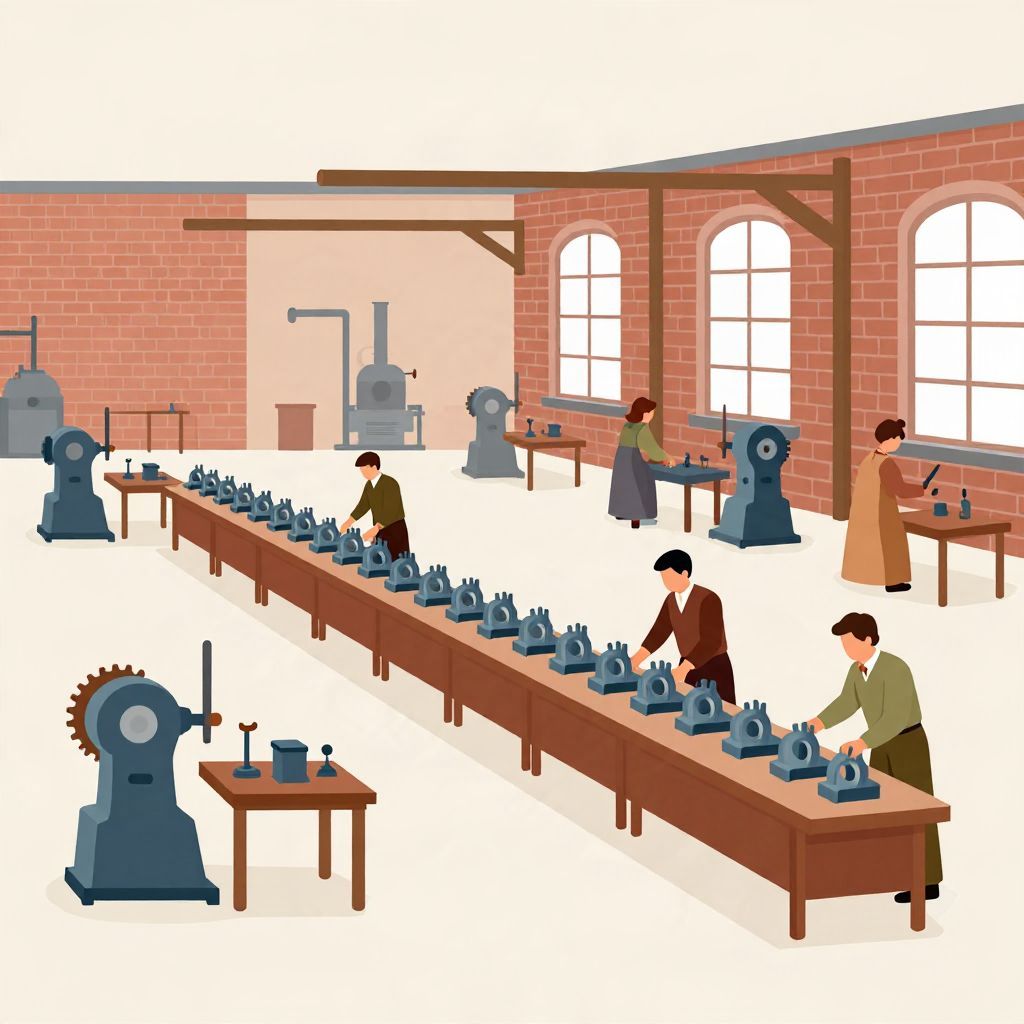
What method of manufacturing, introduced in the early 1800s, made mass production possible? The best answer is the interchangeable parts system, a manufacturing method in which standardized components could be made to the same measurements and fitted together with minimal hand adjustment. It helped transform production from skilled, custom craftsmanship into repeatable industrial output.
Developed most famously in the United States and refined over the early 19th century, interchangeable parts became one of the foundations of modern industry. It did not single-handedly create mass production, but it made larger-scale manufacturing practical, faster, and far less dependent on highly trained artisans.
What method of manufacturing, introduced in the early 1800s, made mass production possible?
The method was the interchangeable parts system. By producing identical components to standardized dimensions, manufacturers could assemble products quickly, repair them more easily, and expand output beyond what handcraft production allowed. This approach was a crucial step toward mass production and later factory assembly systems.
What were interchangeable parts?
Interchangeable parts are components made so precisely that one part can replace another of the same type without custom fitting. In older craft production, a gun, clock, or machine was often built by a skilled artisan who shaped each piece to match the others. With standardization, parts became uniform enough to be swapped in and out.
This was revolutionary because it changed the logic of manufacturing. Instead of relying on a master craftsperson to make each product as a unique object, factories could divide labor, produce components separately, and assemble them from a shared set of standardized pieces.
Why this mattered for mass production
- Speed: workers could assemble goods faster when parts already matched.
- Efficiency: less time was spent hand-fitting each item.
- Repairability: broken parts could be replaced rather than remade from scratch.
- Scalability: production could expand beyond the limits of one artisan’s skill.
- Labor division: tasks could be broken into smaller, repeatable steps.
How did the interchangeable parts system develop?
The idea did not appear overnight, and it was not invented by one person alone. Historians often associate its early development with military production in the late 18th and early 19th centuries, especially firearms manufacturing. Governments wanted weapons that could be produced in quantity and repaired in the field without requiring a master gunsmith for every fix.
In the United States, the system became especially associated with armories such as Springfield and Harpers Ferry, where officials and manufacturers worked toward standardized production methods. The process was gradual, involving experimentation, specialized tools, gauges, jigs, and machine methods that could reproduce the same dimensions again and again.
The “American System” of manufacturing
By the early to mid-1800s, this approach became known as the American System of Manufactures. It emphasized precision, standardization, and the use of specialized machinery to produce identical parts. While not unique to the United States, it became a defining feature of American industrial growth and influenced manufacturing in Europe as well.
What problems did it solve in the early industrial age?
Before interchangeable parts, many goods were made by hand in workshops or small shops. Even when powered machinery began to appear, manufacturing still depended heavily on skilled laborers who adjusted each item individually. That made output slower, more expensive, and harder to standardize.
Interchangeable parts solved several practical problems at once. They reduced dependence on rare artisanal skill, improved consistency, and made it possible to train workers for narrower tasks. This helped manufacturers meet growing demand in a commercial economy that was expanding rapidly in the early 1800s.
From craft production to factory production
- Craft stage: one worker or a small team makes an entire product by hand.
- Standardization stage: measurements and templates are introduced to make parts uniform.
- Factory stage: machines and specialized workers produce parts in larger quantities.
- Mass production stage: products are assembled quickly from interchangeable components.
Who was most closely associated with the idea?
Several figures are linked to the rise of interchangeable parts, but no single inventor created the whole system. In the United States, Eliphalet Remington, John H. Hall, and other firearms manufacturers and government armory officials were important in developing and demonstrating standardized production. Their work helped prove that precision manufacturing could be practical on a larger scale.
It is also important to note that the broader industrial transition involved many inventors and mechanics. Machine tools, gauges, and improved metalworking techniques all contributed. The system emerged through collaboration, experimentation, and the pressures of industrial demand rather than through one isolated breakthrough.
How did this lead to later mass production?
Interchangeable parts did not create the modern assembly line by itself, but it prepared the ground for it. Once parts were standardized, production could be divided into smaller steps, and workers or machines could specialize in one task. That logic eventually shaped the moving assembly lines of the late 19th and early 20th centuries.
In other words, interchangeable parts made it possible to think of manufacturing as a sequence of repeatable operations rather than a single craft process. This was a major conceptual shift. It allowed companies to produce more goods, more cheaply, and with greater consistency than before.
Connection to mechanization
Standardized parts worked best when paired with mechanization. Machines could cut, drill, stamp, and shape materials with greater consistency than hand tools alone. As factories adopted more powered equipment, interchangeable parts became even more useful, because machines could be designed to make the same component repeatedly.
Was the early 1800s really the beginning?
Yes, in broad terms. The early 1800s were a turning point, but the transition was gradual. Standardization had roots in the late 1700s, and its full industrial impact unfolded over decades. Historians usually treat the early 19th century as the period when interchangeable parts moved from promising idea to practical manufacturing system.
That said, the exact starting date is hard to pin down. Different industries adopted standardization at different speeds. Firearms, clocks, sewing machines, and agricultural tools each followed their own path. So while the early 1800s are the right era, the change was more of a process than a single invention date.
Why historians see it as historically significant
The interchangeable parts system mattered because it changed both production and society. Economically, it supported the growth of factories, larger firms, and wider markets. Socially, it helped shift work away from independent artisans and toward wage labor in industrial settings. Technologically, it encouraged precision engineering and the use of gauges, templates, and machine tools.
It also helped create the modern expectation that products should be uniform, repairable, and replaceable. That expectation is now so familiar that it can be easy to overlook how radical it once was. Standardization became one of the hidden foundations of industrial modernity.
Long-term consequences
- Expanded factory production in the United States and Europe
- Lowered costs for many manufactured goods
- Improved repair and maintenance of machines and weapons
- Encouraged specialization of labor
- Helped pave the way for assembly-line production
How does this fit into the broader Market Revolution?
The rise of interchangeable parts is closely connected to the Market Revolution, the early 19th-century transformation in which transportation, finance, communication, and manufacturing expanded commercial exchange. As markets grew, producers needed goods that could be made in larger quantities and sold across wider regions.
Standardized manufacturing fit that world perfectly. It made products more uniform and predictable, which suited a growing national market. Factories could produce for distant buyers rather than only for local customers, and that helped reshape the economy of the United States and other industrializing societies.
So what is the direct answer?
The manufacturing method introduced in the early 1800s that made mass production possible was the interchangeable parts system. By standardizing components so they could be assembled and replaced without custom fitting, it laid the groundwork for factory production, mechanization, and eventually the assembly line.
If you want to explore the wider transformation, you may also want to read about when the Market Revolution happened, since that broader economic shift helped create the conditions for industrial mass production.