
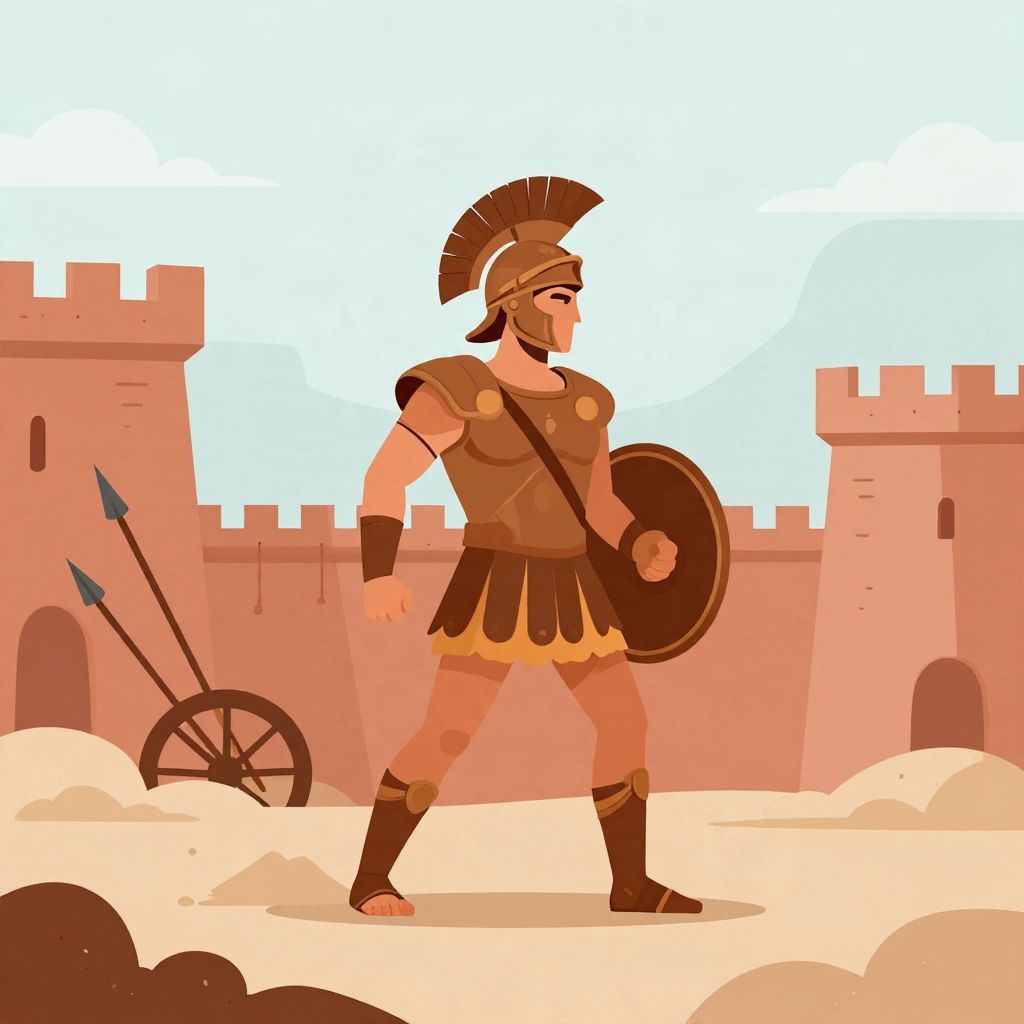
How does Achilles die? In the best-known version of the myth, Achilles is killed during the Trojan War by an arrow that strikes his heel, the one vulnerable part of his body. This story is famous, but it is not a straightforward historical fact: Achilles belongs to Greek heroic legend, preserved in epic poetry and later retellings rather than verified history.
To understand his death, it helps to separate the ancient myth from the broader cultural tradition around the Trojan War. Different Greek and Roman authors told the story in different ways, and the “Achilles’ heel” detail became the dominant version much later than the earliest epics.
How does Achilles die?
Achilles dies in myth when Paris shoots him with an arrow, often said to be guided by the god Apollo, and the arrow hits his heel or another vulnerable spot. The exact version varies by source, but the core idea is the same: Achilles is slain near the end of the Trojan War, before he can take Troy himself.
The myth of Achilles’ death
The most familiar version
In the popular tradition, Achilles is nearly invincible because his mother, Thetis, tried to protect him from death. Later storytellers explained that she dipped him in the River Styx, leaving only his heel unprotected. During the war, Paris fired the fatal arrow, and Apollo helped guide it to that weak point. This is the origin of the phrase “Achilles’ heel.”
What the earliest sources actually say
The earliest surviving Greek epic, Homer’s Iliad, does not describe Achilles’ death. The poem ends before Troy falls, with Achilles still alive. That means the famous heel story is not part of the oldest layer of the myth. It appears in later traditions, especially in post-Homeric poetry and Roman-era retellings, which filled in the rest of Achilles’ life.
Other versions of the story
Ancient authors did not always agree on the details. In some accounts, Achilles is killed by Paris alone; in others, Apollo is the real cause, with Paris acting as the archer. Some versions place the fatal wound in the ankle, leg, or chest rather than the heel. The common theme is not the precise anatomy, but Achilles’ sudden death by divine or semi-divine intervention.
Who was Achilles in Greek tradition?
Achilles was a legendary Greek hero of the Trojan War, celebrated for strength, speed, and combat skill. He was the son of the mortal king Peleus and the sea goddess Thetis, which made him a figure who stood between human and divine worlds. Ancient audiences admired him, but they also saw him as dangerous, proud, and emotionally intense.
Why Achilles mattered to the Greeks
Achilles was more than a warrior in a single story. He represented the heroic ideal and its limits. He could win glory, but he could not escape mortality. His death, therefore, was not just an ending; it was a reminder that even the greatest hero could be defeated. That tension made him one of the most important figures in Greek literature.
Timeline of Achilles’ death in the Trojan War tradition
Because Achilles is a mythic figure, the chronology comes from literary tradition rather than secure historical records. Still, the story unfolds in a recognizable sequence:
- Achilles fights in the Trojan War and becomes the Greeks’ greatest warrior.
- He withdraws from battle after a quarrel with Agamemnon, which causes major Greek losses.
- Patroclus dies wearing Achilles’ armor, pushing Achilles back into the war.
- Achilles kills Hector, Troy’s greatest defender, and dominates the battlefield.
- Later, Achilles is killed by Paris, with Apollo often credited as the hidden force behind the shot.
- His armor becomes a prize, leading to further conflict among the Greeks.
This sequence shows why Achilles’ death mattered so much in the larger epic cycle: it marked the end of the Greeks’ most powerful champion and moved the war toward its final phase.
Did Achilles really die from a heel wound?
Myth versus historical evidence
There is no historical evidence that Achilles was a real person in the modern sense, so his death cannot be confirmed as an event. The heel wound is a mythological explanation that became famous because it is vivid and symbolic. It may reflect a later attempt to make sense of a hero whose invulnerability had to be broken somehow.
Why the heel detail became so famous
The heel story endured because it is simple and memorable. It also fits a larger pattern in ancient mythology: heroes often have one fatal weakness that reveals the limits of human power. The “heel” detail may have grown in popularity because it turned a complex heroic death into a striking moral image about vulnerability and fate.
How ancient writers shaped the story
Homer and the lost epic tradition
Homer’s Iliad focuses on Achilles’ anger, grief, and return to battle, not his death. Later poets and mythographers supplied the missing ending. One of the most important sources was the broader Epic Cycle, now mostly lost, which included poems about the fall of Troy and Achilles’ fate. Later Greek and Roman writers inherited and reshaped these traditions.
Roman retellings
The Romans were especially interested in Achilles because he was part of the cultural world that led to the legendary founding of Rome through Troy’s survivors. Roman authors helped standardize the version in which Achilles is killed by Paris, with Apollo’s assistance and the heel as the weak point. By then, the story had become a familiar literary motif.
Historical significance of Achilles’ death
Even though Achilles is mythological, his death has real historical significance in the study of ancient culture. It shows how the Greeks imagined heroism, mortality, and divine power. It also demonstrates how oral tradition and literature preserved and altered stories over centuries, creating different versions for different audiences.
What the story reveals about ancient values
Achilles’ death emphasizes several ideas central to Greek thought: fame can outlast life, divine forces shape human events, and even the strongest warrior cannot escape death. The story also reflects the importance of honor and reputation in heroic society. Achilles seeks glory, but that glory comes at the cost of a short life.
The enduring legacy of “Achilles’ heel”
Today, “Achilles’ heel” is used to mean a hidden weakness in an otherwise strong person or system. That modern phrase comes from the myth, but it also shows how ancient stories continue to shape language and thought. The expression survives because the image is powerful: even the greatest champion can fall because of one vulnerable point.
Why the story still matters
Achilles’ death remains one of the most famous endings in world mythology because it combines heroism, fate, and fragility in a single image. Whether one reads it as literature, myth, or cultural memory, the story captures a timeless idea: greatness does not remove human vulnerability. In that sense, Achilles’ death is as important for what it symbolizes as for how it is told.
For readers interested in the wider mythic and historical background, it can also help to explore why the Trojan War started and how ancient traditions shaped the larger story world around Achilles.