
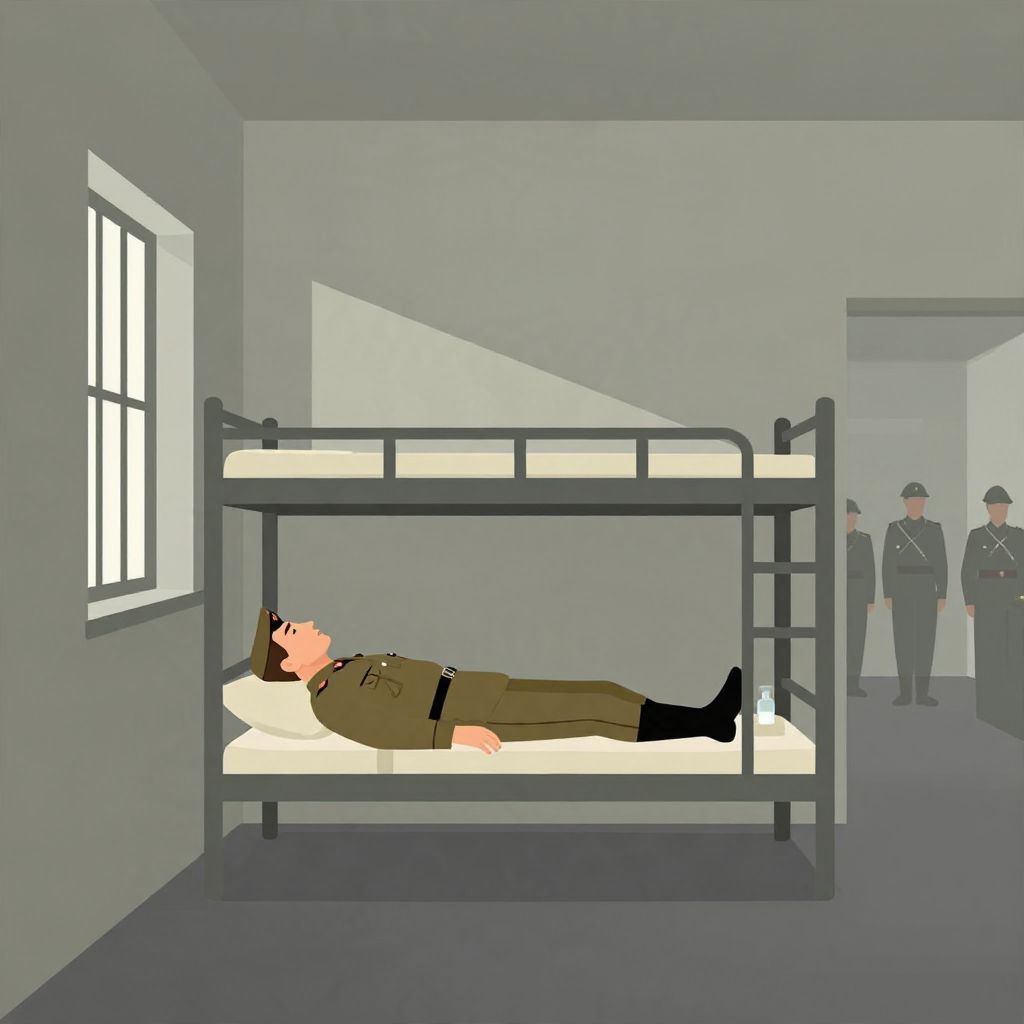
How did Goering die? Hermann Göring, one of Nazi Germany’s most powerful leaders, died by suicide on the night of 15 October 1946, only hours before he was due to be executed after the Nuremberg trials. He had swallowed cyanide in his cell at the Allied prison in Nuremberg.
His death became one of the most discussed episodes of the postwar trials because it raised immediate questions: how did he obtain the poison, and what did his final act mean in the context of Nazi defeat, Allied justice, and his own attempt to control his fate?
How did Goering die?
Hermann Göring died by taking cyanide in his prison cell at Nuremberg on 15 October 1946. He had been convicted at the International Military Tribunal and sentenced to death by hanging, but he avoided the gallows by killing himself shortly before the execution was to take place.
What happened in the hours before his death?
Göring spent his final day in Allied custody after the Nuremberg tribunal had announced its verdicts. He had been one of the most prominent defendants, and his sentence of death was meant to be carried out by hanging on 16 October. Instead, he died late on 15 October, inside his cell, after ingesting cyanide that he had somehow concealed from the prison authorities.
The prison setting at Nuremberg
The defendants were held under heavy guard, but the prison system was not airtight. Göring had managed to keep a cyanide capsule hidden from the moment of his arrest or to acquire one later under circumstances that remain debated. What is clear is that he had the means to escape execution on his own terms, and he used it just before the scheduled hangings.
The immediate discovery
When guards found him, he was already dead or dying. The exact minute of ingestion is not known with certainty, but the death was sudden and consistent with cyanide poisoning. The Allied authorities quickly recognized that he had cheated the executioners, and the incident became a major embarrassment for the prison system.
How did Göring get cyanide?
The precise answer is still not fully settled, but historians generally agree that Göring had a hidden cyanide capsule in his possession. The source of the poison has been the subject of investigation, speculation, and controversy since 1946. The most careful accounts conclude that he either retained the capsule from before his capture or obtained it through a chain of contacts and concealment that prison security failed to stop.
Why the source remains debated
Because Göring died before he could be fully questioned about the poison, and because wartime and postwar custody procedures were imperfect, no single explanation has ended the debate. What matters historically is not a dramatic mystery novel solution, but the broader fact that a high-ranking Nazi prisoner was able to outwit a system designed to prevent exactly this outcome.
The significance of the cyanide capsule
Cyanide capsules were associated with Nazi officials during the final months of the war, especially among those who feared capture. Göring’s possession of one fits the broader pattern of Nazi leaders preparing for defeat. His suicide was therefore not an isolated act, but part of a wider culture of self-destruction among members of the collapsing regime.
Why did Göring choose suicide?
Göring’s suicide was likely driven by a mixture of pride, political calculation, and fear. He had been publicly humiliated at Nuremberg, stripped of power, and condemned by the court. By ending his own life, he prevented the Allied powers from hanging him and denied them the symbolic victory of carrying out the sentence.
A final act of control
For a man who had been one of Hitler’s closest associates and one of the most visible figures of the Third Reich, suicide offered a way to retain a measure of control. It also allowed him to avoid the spectacle of execution, which he may have seen as degrading. In that sense, his death was as much political theater as personal escape.
Not remorse, but defiance
There is little evidence that Göring’s last act reflected repentance. His conduct at Nuremberg showed defiance, self-justification, and an effort to present himself as a statesman rather than a criminal. His suicide fits that pattern: it was a refusal to submit to the judgment of the tribunal in the final possible moment.
Who was Hermann Göring?
Hermann Göring was one of the most important Nazi leaders. He was a World War I fighter pilot, a senior member of the Nazi Party, head of the Luftwaffe, and a central figure in the Nazi state. He also played a major role in the regime’s repression, militarization, and plunder across occupied Europe.
Rise to power
Göring joined the Nazi movement early and became one of Adolf Hitler’s most trusted allies. He held numerous offices, including positions tied to the police, the economy, and the air force. At the height of Nazi power, he was among the most influential men in Germany, second only to Hitler in public prominence and often in practical authority.
Role in Nazi crimes
Göring was not merely a ceremonial figure. He was deeply involved in the machinery of dictatorship and war. He helped build the Nazi state, supported aggressive expansion, and was implicated in the exploitation of occupied territories and the persecution of Jews and other victims of Nazi rule. At Nuremberg, he was judged as one of the regime’s principal criminals.
What did the Nuremberg trial decide?
The International Military Tribunal at Nuremberg was created by the Allied powers to try major Nazi leaders after World War II. Göring was one of the most famous defendants. The court found him guilty on major counts and sentenced him to death. His case mattered because it symbolized the effort to hold top Nazi officials legally accountable rather than simply punish them through revenge.
Why his sentence mattered
Göring’s sentence carried enormous symbolic weight. As one of the regime’s leading architects, he represented the idea that high office did not protect a person from responsibility for war and mass atrocity. His planned execution would have been one of the most visible acts of postwar justice.
How his death changed the outcome
Because he died before hanging, the Allies lost the chance to carry out the sentence publicly. His suicide did not erase the verdict, but it did alter the final chapter of the trial. Instead of being executed by the state, he died alone in a cell, on his own terms, just before justice could be enacted in the prescribed way.
Why is Göring’s death historically important?
Göring’s death is important because it shows the collapse of Nazi power, the limits of prison security, and the tensions surrounding postwar justice. It also highlights how leading Nazis tried to shape their own endings, even after defeat. His suicide became part of the larger story of how Europe confronted the legacy of the Third Reich.
A lesson in postwar accountability
The Nuremberg trials were meant to demonstrate that even the most powerful leaders could be judged under law. Göring’s suicide did not defeat that principle, but it did reveal how fragile the process could be. Justice depended not only on legal verdicts, but also on custody, discipline, and the ability to carry sentences out.
The myth and the reality
Over time, Göring’s death has attracted sensational retellings, especially about the cyanide and the security failure that allowed him to keep it. The essential historical reality, however, is straightforward: he died by suicide using poison while awaiting execution. The surrounding uncertainty concerns the mechanics, not the fact of his death.
Key events leading to Goering’s death
- May 1945: Göring is captured by Allied forces after the defeat of Nazi Germany.
- 1945–1946: He is held in Allied custody and later brought before the Nuremberg tribunal.
- 1 October 1946: The tribunal announces its verdicts; Göring is sentenced to death.
- 15 October 1946: He dies by cyanide poisoning in his cell.
- 16 October 1946: He was scheduled to be executed by hanging, but his suicide makes that impossible.
How historians interpret his final act
Most historians treat Göring’s suicide as a deliberate final assertion of will. It was not an act of bravery in any moral sense, but a way to deny the Allies the satisfaction of executing him. It also reflected the mindset of a Nazi elite that often preferred death to humiliation, especially once the regime’s crimes were exposed and its defeat was complete.
Not a mystery, but a revealing episode
The death itself is not especially mysterious. What makes it historically revealing is what it says about the end of the Third Reich: the collapse of authority, the persistence of Nazi self-deception, and the difficulties of turning military victory into legal justice. Göring’s last act condensed all of those themes into a single night.
In short, Hermann Göring died by cyanide suicide in Nuremberg on 15 October 1946, shortly before his scheduled execution. His death remains a striking example of how top Nazi leaders tried to control their fate even in defeat. For related context, see how Goering got cyanide and compare it with other Nazi leaders such as how Himmler died.