
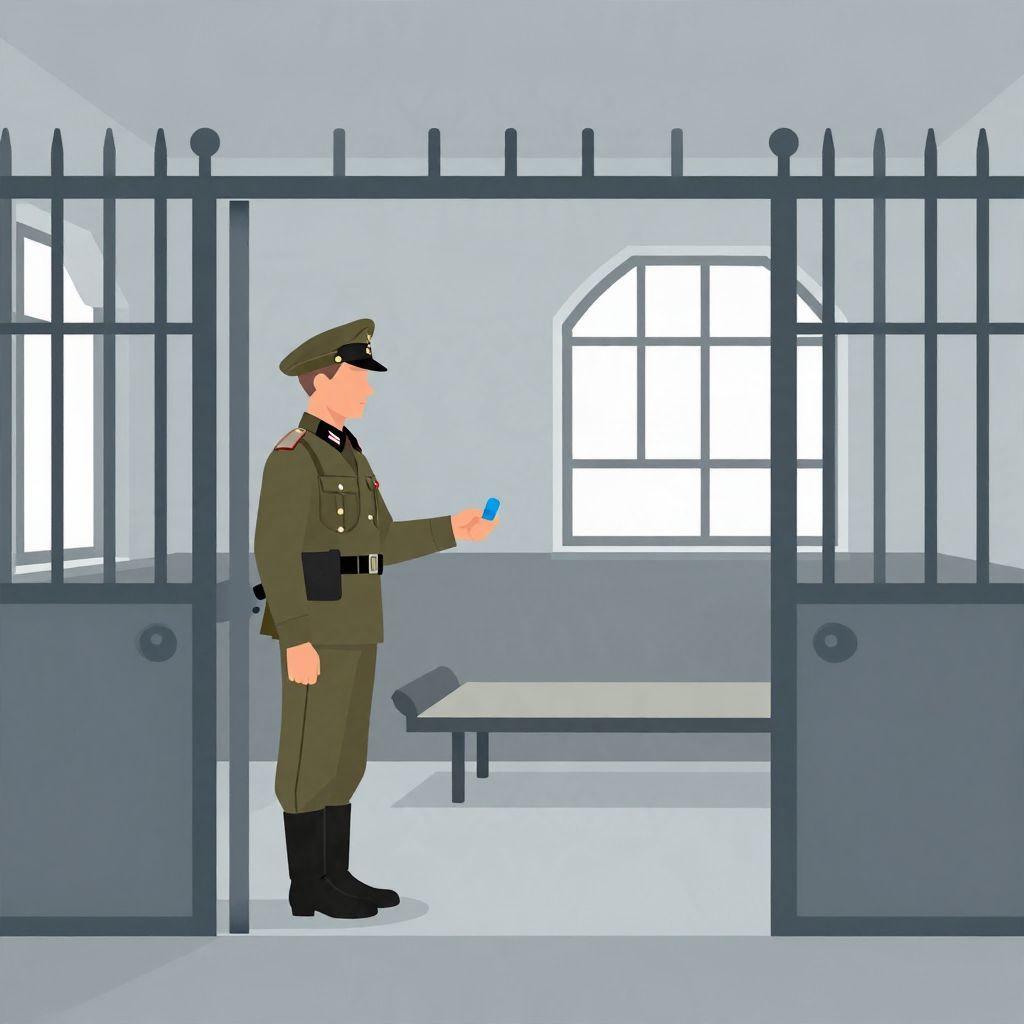
How did Hermann Göring get cyanide? The short answer is that he obtained a cyanide capsule while in American custody after the war, most likely through a concealed supply chain that Nazi prisoners used to hide poison from their captors. The exact route is still debated, but historians agree that he had access to it before his scheduled execution in October 1946.
His suicide became one of the most famous final acts of the Nazi era, both because of who Göring was and because it exposed serious security failures at Nuremberg.
How did Goering get cyanide?
Göring almost certainly got the cyanide through a hidden stash of poison that he had managed to keep after his capture, rather than from an official source. The most widely accepted explanation is that he concealed the capsule in his belongings or body and retained it while being transferred and imprisoned by the Allies. The exact handoff was never proven, which is why the episode remains partly mysterious.
The most likely explanation
By the time Göring was held at Nuremberg, many top Nazi prisoners had been thoroughly searched, but the Allied authorities did not always find every concealed item. Göring appears to have kept at least one cyanide capsule hidden from the start of his detention. He used that capsule to kill himself on the night of 15 October 1946, just hours before he was to be hanged.
Why historians are cautious
There is no single fully documented chain showing exactly who passed him the poison and when. Some accounts suggest he had hidden it before surrendering; others argue that a sympathetic guard or intermediary may have helped. Because the evidence is incomplete, responsible historians usually describe the source as probable rather than certain.
Who was Hermann Göring?
Hermann Göring was one of Nazi Germany’s most powerful leaders. A decorated First World War pilot, he later became a close ally of Adolf Hitler, head of the Luftwaffe, and one of the regime’s central figures in dictatorship, rearmament, persecution, and war. After Germany’s defeat in 1945, he was arrested, tried at Nuremberg, and sentenced to death for war crimes and crimes against humanity.
Why his case mattered
Göring was not just another defendant. He was the highest-ranking Nazi to stand trial at Nuremberg and, for much of the proceedings, the most prominent figure in the dock. His behavior, testimony, and eventual suicide made him a symbol of both Nazi arrogance and the Allies’ determination to impose legal accountability after the war.
The road to cyanide: capture, imprisonment, and trial
To understand how Göring got cyanide, it helps to follow the chronology of his final months. He surrendered to American forces in May 1945 and was later moved into Allied custody with other major Nazi leaders. The Allies searched prisoners, but the chaos of the immediate postwar period made total control difficult, especially for men who had spent years building secret networks and habits of concealment.
May 1945: surrender and arrest
Göring surrendered to U.S. troops in Austria in early May 1945. He was taken into custody as the Allies closed in on the collapsing Nazi state. Even at that stage, he was a valuable prisoner, and the Americans wanted to prevent both escape and suicide.
1945–46: detention at Nuremberg
At Nuremberg, Göring and the other major defendants were held under close guard while the International Military Tribunal prepared its case. The prison regime was strict, but not perfect. Prisoners were watched, yet they still had limited access to personal effects, correspondence, and occasional contact with staff. That environment created opportunities for contraband, especially for a man as determined and resourceful as Göring.
15 October 1946: the final night
On the night before his execution, Göring swallowed cyanide and died almost immediately. His suicide shocked the Allied authorities because it denied them the public hanging they had planned. It also raised urgent questions: how had he hidden poison for so long, and how had prison security failed at the decisive moment?
How could cyanide enter a prison like Nuremberg?
In the aftermath of the war, the Nuremberg prison was heavily guarded, but it was not airtight. Cyanide capsules could be tiny, easily hidden, and difficult to detect with the search methods available in 1945 and 1946. A prisoner who had prepared in advance had a real chance of keeping one concealed through multiple transfers and inspections.
Common theories about the source
- Hidden before surrender: Göring may have concealed the capsule on his person or among personal items before arrest.
- Smuggled during detention: A guard, intermediary, or other contact may have passed it to him later.
- Recovered from a hidden cache: He may have had more than one capsule and kept one secret while others were confiscated.
Of these, the first is generally considered the most plausible. Nazi leaders were accustomed to carrying poison for suicide, and many feared capture. Göring had both the motive and the means to prepare in advance.
Why did Göring want cyanide?
Göring had strong reasons to avoid execution by the Allies. He had been one of Hitler’s closest associates and a leading architect of the Nazi system. A public hanging would have marked him as a defeated criminal in front of the world. Suicide allowed him to control the end of his life and, in his own mind, preserve a final measure of dignity or defiance.
Nazi culture and suicide
Among senior Nazis, suicide was not unusual. The regime had long glorified loyalty unto death, and many leaders carried poison as a contingency. Hitler himself killed himself in April 1945. In that sense, Göring’s final act fit a broader pattern within the collapsing Nazi elite, where self-destruction was often treated as preferable to humiliation and capture.
Security failures and the Nuremberg controversy
Göring’s death embarrassed the Allied authorities because it suggested that one of the most closely watched prisoners in Europe had still managed to beat the system. The incident prompted scrutiny of prison procedures, searches, and guard discipline. It also fed speculation for decades about whether someone had helped him.
What the Allies learned
The main lesson was that even elite detention systems can fail when prisoners are determined, experienced in secrecy, and surrounded by confusion. The Nuremberg prison had to balance security, legal process, and humane treatment. That balance left room for mistakes, and Göring exploited them.
Did someone help him?
There has long been speculation that a guard or acquaintance smuggled the capsule to him. While such theories cannot be ruled out entirely, they remain unproven. No definitive evidence has established a named accomplice, and the historical record supports a cautious conclusion: assistance is possible, but not demonstrated.
What happened after Göring’s suicide?
Göring’s death changed the final stage of the Nuremberg trial but did not alter the broader outcome. The tribunal continued, and the other defendants faced judgment. His body was later cremated along with those of the executed Nazi leaders, and the ashes were scattered to prevent any place of martyrdom from forming around them.
Public reaction
For many observers, Göring’s suicide confirmed the moral collapse of the Nazi leadership. Rather than face judgment, he chose poison. For others, it highlighted the practical reality that the Allies were dealing with men who had spent years preparing for defeat, evasion, and self-destruction.
Why the question still matters
“How did Goering get cyanide?” is more than a curiosity about a prison break in miniature. It touches on the larger history of the Nuremberg trials, the difficulty of securing high-value prisoners, and the ways Nazi leaders tried to escape responsibility. The episode also shows how even a carefully organized war-crimes tribunal could be disrupted by a single hidden capsule.
In the end, the most careful answer is this: Göring almost certainly obtained cyanide through a concealed supply he had managed to keep after capture, though the exact route remains uncertain. His suicide on 15 October 1946 denied the Allies a public execution, but it did not spare him from historical judgment. For related context, see broader coverage of major historical figures and events and the closing phase of what happened in 1945.