
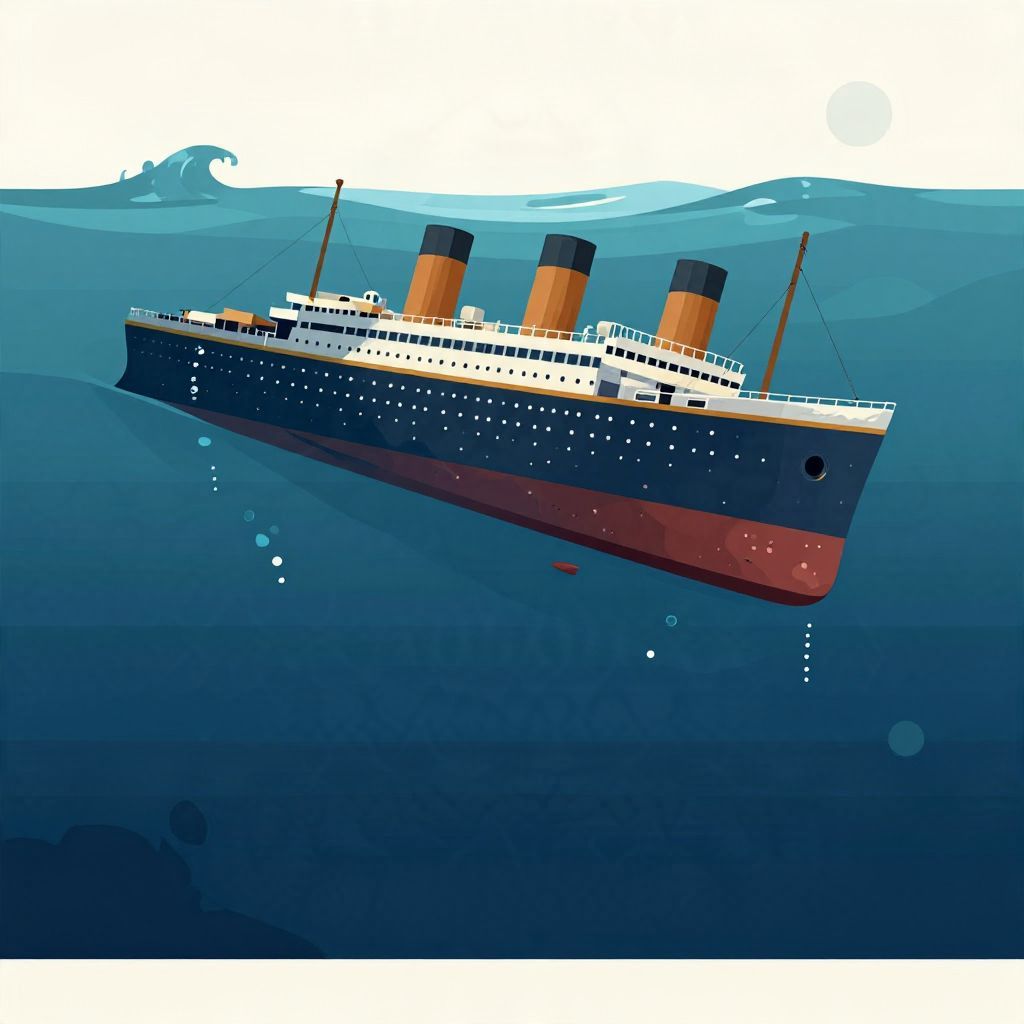
“How far down is the Titanic?” is a simple question with a surprisingly precise answer. The wreck lies on the North Atlantic seabed, about 12,500 feet, or roughly 3,800 meters, below the surface. That depth has helped preserve the ship in some ways while also making recovery, study, and protection extremely difficult.
The Titanic’s resting place is not just a matter of measurement. It is part of the story of the ship’s sinking in 1912, the long search for the wreck, and the continuing historical debate over how best to preserve one of the most famous maritime sites in the world.
How far down is the Titanic?
The Titanic lies about 12,500 feet down, or about 3,800 meters deep, in the North Atlantic Ocean. The wreck is on the ocean floor, not floating or buried in shallow water, which is why it was undiscovered for so long and why visiting it requires specialized submersibles.
The basic depth in context
That depth is far beyond the reach of ordinary diving equipment. Even advanced deep-sea exploration is technically demanding because of the crushing pressure, near-freezing temperatures, and total darkness. At roughly 3,800 meters, the pressure is about 380 times greater than at sea level, a major reason the Titanic has remained both difficult to study and vulnerable to deterioration.
Where exactly is the Titanic wreck located?
The Titanic rests in the North Atlantic, southeast of Newfoundland, Canada, near the site where it struck an iceberg and sank on 15 April 1912. The wreck is split into two main sections, the bow and stern, with a debris field spread across the seabed between them. The exact position is known today, but for decades after the disaster it remained lost.
Why the location mattered after the sinking
When the ship went down, the priority was rescue, not wreck recovery. The Titanic disappeared into deep water that was beyond the technology of the time. Survivors were brought to safety, but the ship itself was not found until 1985, when a joint expedition led by Robert Ballard located it using deep-sea search methods. That discovery transformed public understanding of the disaster.
Why was the Titanic so hard to find?
The Titanic was difficult to locate because the Atlantic is vast, the wreck lies at extreme depth, and the ship broke apart as it sank. Searchers in the early 20th century had no practical way to explore such deep water. Even after the wreck was found, mapping it required remotely operated vehicles, sonar, and submersibles designed for the deep ocean.
Technology and the limits of early search efforts
In 1912, oceanographic exploration was still in its early stages. There were no deep-diving robots, no modern sonar mapping, and no reliable way to descend thousands of meters and return safely. The Titanic’s loss therefore became one of history’s most famous “missing wreck” stories, not because the ship vanished mysteriously, but because the ocean floor was inaccessible.
What happened to the Titanic after it sank?
After the sinking, the Titanic settled into two major sections and a wide debris field. Over time, saltwater corrosion, deep-sea bacteria, and the pressure of the environment have steadily damaged the wreck. The ship is not preserved like a museum artifact; it is a deteriorating historical site that is slowly being consumed by the sea.
How the wreck changed over time
The bow section landed relatively intact compared with the stern, which suffered more damage during the breakup and descent. Over the decades, the wreck has become fragile. Metal structures have weakened, wooden interiors have disappeared, and artifacts have been recovered selectively. This gradual decay has made preservation a major concern for historians, archaeologists, and maritime authorities.
The Titanic’s sinking: a brief timeline
The depth question makes more sense when placed within the ship’s broader history. The Titanic was one of the most famous ocean liners of the early 20th century, launched as a symbol of modern engineering and luxury. Its sinking became a global tragedy because it combined technological confidence, human error, and inadequate safety measures.
- 31 May 1911 – The Titanic is launched at Harland and Wolff in Belfast.
- 2 April 1912 – Sea trials are completed.
- 10 April 1912 – The ship begins its maiden voyage from Southampton.
- 14 April 1912 – The Titanic receives iceberg warnings but continues at speed.
- 11:40 p.m., 14 April 1912 – The ship strikes an iceberg.
- 2:20 a.m., 15 April 1912 – The Titanic sinks.
- 1985 – The wreck is discovered on the seabed.
Why the depth became part of the story
The Titanic’s depth is not just a technical detail; it explains why the disaster became such a powerful historical symbol. Because the ship lies so far below the surface, it remained invisible for generations. That invisibility helped turn the wreck into a kind of underwater memorial, one that could be imagined but not easily seen.
How does the depth affect the wreck today?
The Titanic’s depth shapes everything about its preservation and study. The cold water slows some forms of decay, but the deep ocean also supports bacteria and chemical processes that break down iron and steel. The site is remote, expensive to reach, and environmentally fragile, which has created debate over whether the wreck should be visited, documented, or left alone.
Preservation versus recovery
Some historians and archaeologists argue that the wreck should be treated as a gravesite and protected from disturbance. Others emphasize the value of artifact recovery and scientific documentation. Because the Titanic is so deep, any expedition must balance historical research with ethical concerns and the practical limits of deep-sea operations.
Why the Titanic still matters historically
The Titanic remains important not only because of how far down it is, but because of what the wreck represents. The disaster exposed weaknesses in maritime safety, including insufficient lifeboats, poor emergency coordination, and overconfidence in the ship’s supposed unsinkability. Public reaction helped drive later reforms in ship safety and radio communication.
Historical significance beyond the wreck itself
The sinking became a defining event of the early 20th century. It revealed how modern industrial power could fail under pressure and how class, technology, and human decision-making shaped survival. The wreck’s great depth has reinforced its aura, but its historical importance comes from the lives lost and the changes that followed.
Common misconceptions about the Titanic’s depth
Because the Titanic is so famous, myths often surround it. One common misunderstanding is that the wreck is “buried” deep under mud; in fact, much of it rests exposed on the seabed. Another is that the ship is still mostly intact. In reality, the wreck is heavily damaged and continuing to deteriorate.
What is known and what is not
Researchers know the approximate depth and location of the wreck with confidence. What remains uncertain is how long major structural elements will survive and how best to manage the site. The deep ocean makes long-term monitoring difficult, so estimates about the wreck’s future are necessarily cautious rather than exact.
The Titanic lies about 12,500 feet below the surface, a depth that has made it both difficult to reach and impossible to forget. That remoteness helped preserve the wreck as a powerful historical site, but it also means the ship is slowly disappearing. For more context on the disaster itself, see how cold the water was when the Titanic sank and, more broadly, how historians interpret major loss of life in the destruction of Pompeii.