
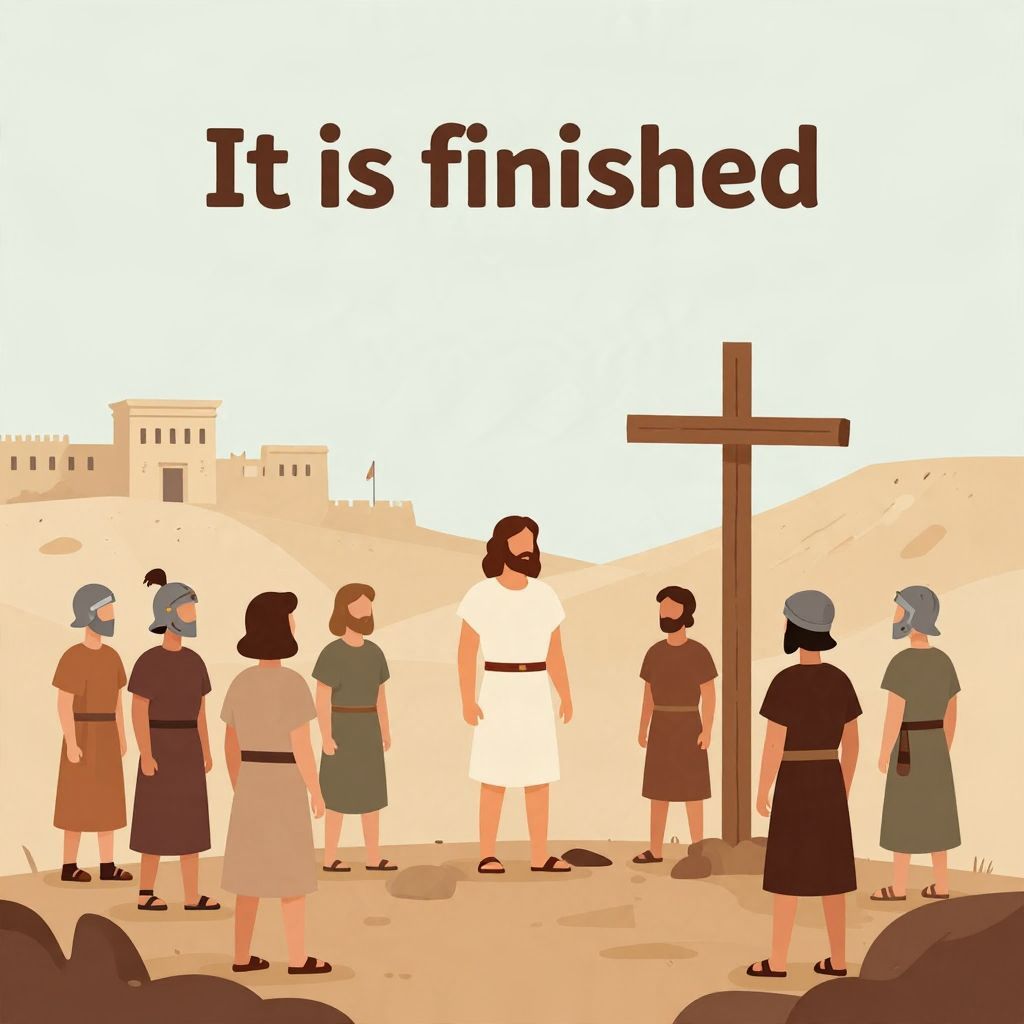
The phrase “It is finished” is best known from the New Testament, where it appears in the Gospel of John at the crucifixion of Jesus. In Hebrew, the idea is usually rendered as nishlam or hushlam for “it is completed,” though the exact wording depends on whether one is translating into modern Hebrew, biblical Hebrew style, or a liturgical setting.
Because the original Gospel was written in Greek, not Hebrew, the phrase is a translation question as much as a historical one. Its meaning has been shaped by ancient language, Jewish and Christian tradition, and centuries of interpretation.
What does “It is finished” mean in Hebrew?
The most common Hebrew sense of “It is finished” is נִשְׁלַם (nishlam) or הֻשְׁלַם (hushlam), both meaning “it was completed” or “it has been accomplished.” In biblical-style Hebrew, the root ש־ל־ם (sh-l-m) conveys completion, wholeness, or fulfillment, and is related to shalom, peace and fullness.
That said, there is no single ancient Hebrew phrase that can be proved as the exact original wording behind the famous line. The phrase comes to us through Greek text, and Hebrew translations reflect later interpretation rather than a surviving original Hebrew quotation.
Where does the phrase come from historically?
The phrase “It is finished” appears in John 19:30, one of the four canonical Gospels in the New Testament. In the Greek text, the word is tetelestai, a perfect tense form meaning “it has been completed,” “it has been brought to its goal,” or “it stands finished.” This is the earliest securely attested form of the saying.
Historically, that matters because the New Testament was composed in Greek in the first century CE, within the Roman world. Jesus of Nazareth likely spoke Aramaic in daily life, knew some Hebrew as a Jewish teacher, and lived in a multilingual environment. The Gospel writer, however, preserved the saying in Greek for a Greek-reading audience.
The language context of first-century Judea
In Judea and Galilee during the late Second Temple period, people commonly used Aramaic in everyday speech, while Hebrew remained important for scripture, prayer, and learned discussion. Greek was also widely used in administration, commerce, and broader communication across the eastern Roman Empire.
So when modern readers ask for “It is finished in Hebrew,” they are usually asking for a Hebrew equivalent of a phrase that entered history through Greek transmission. That makes the answer partly linguistic and partly historical.
What would the phrase have sounded like in ancient Jewish speech?
If the idea were expressed in Hebrew or Aramaic in the first century, it would likely have used a verb from the root meaning “complete” or “finish.” In Hebrew, forms like nishlam or hushlam fit the sense. In Aramaic, a close equivalent would also use a completion verb, though the exact form would vary by dialect.
Scholars are careful here: we do not possess a recording or an original Hebrew manuscript of the spoken crucifixion saying. Any Hebrew rendering is therefore a reconstruction, not a direct quotation from the event itself.
Why translations differ
Different Hebrew Bibles and Christian translations may choose slightly different wording because translation is not mechanical. One version may emphasize completion, another fulfillment, and another accomplishment. The choice depends on whether the translator wants to preserve the Greek nuance of finality, the theological sense of fulfillment, or the literary tone of the passage.
- נִשְׁלַם (nishlam) — “it is finished / completed”
- הֻשְׁלַם (hushlam) — “it has been completed”
- כָּלָה (kalah) forms — can mean “finished” in some contexts, though less common for this exact phrase
The biblical and theological background of the phrase
In John’s Gospel, “It is finished” is not merely a statement that an event has ended. It signals completion of a mission. The Gospel presents Jesus’s death as the fulfillment of a divine purpose, and the wording carries a strong sense of accomplishment rather than simple exhaustion or resignation.
This theological meaning developed within early Christian communities, but it also drew on Jewish scriptural language. In the Hebrew Bible, the idea of completing a task, fulfilling a command, or bringing something to its intended end appears frequently. That background helps explain why later Hebrew translations can sound natural even if they are not the original wording.
Completion, fulfillment, and wholeness
The Hebrew root sh-l-m is especially important because it connects completion with wholeness. This is one reason the phrase has resonated so deeply in both Jewish and Christian interpretive traditions. The idea is not only that something ended, but that it reached its intended state.
That nuance is historically significant. Ancient texts often carry layered meanings, and later readers may hear in the phrase a message about redemption, sacrifice, or fulfillment that goes beyond a simple “done.”
How has the phrase been translated over time?
As Christianity spread from the eastern Mediterranean into Latin, Syriac, Coptic, Armenian, and later European languages, translators had to decide how to handle John 19:30. Most chose equivalents that preserved the sense of completion. The Latin Vulgate, for example, rendered the Greek as a form meaning “it is consummated” or “completed,” influencing later Christian vocabulary.
In modern Hebrew, especially in religious or literary contexts, translators often prefer a form that sounds dignified and scriptural. This is why different Hebrew renderings may appear in Bible editions, church materials, or devotional works.
Translation history in brief
- 1st century CE: Gospel of John written in Greek.
- Late antiquity: Latin and Syriac translations help spread the phrase across Christian communities.
- Medieval and early modern periods: The saying becomes a major theological motif in preaching, art, and liturgy.
- Modern era: Hebrew translations vary by style, audience, and doctrinal emphasis.
Why the exact Hebrew wording is not settled
The uncertainty comes from history itself. The crucifixion narrative belongs to a multilingual world, and the surviving textual evidence begins with Greek manuscripts. Since no original Hebrew version of John’s Gospel survives, scholars cannot prove a single “official” Hebrew phrase for “It is finished.”
In addition, “Hebrew” can mean several things in practice: biblical Hebrew, modern Hebrew, or a Hebrew-style translation shaped by religious tradition. Each may produce a slightly different phrase while still conveying the same basic meaning.
Popular assumptions versus historical evidence
Popular devotion sometimes treats the phrase as if it were originally spoken in Hebrew and later translated into Greek. Historically, that is not supported by the surviving evidence. The best-attested original text is Greek. A Hebrew rendering is useful and meaningful, but it is a later translation of the Gospel text rather than a recovered original utterance.
Likewise, claims that one Hebrew version is the “real” phrase should be treated cautiously unless supported by textual evidence. In historical study, plausibility is not the same as proof.
What is the historical significance of the phrase?
“It is finished” became one of the most influential short statements in Christian tradition because it concentrates the meaning of the crucifixion into a single line. It has shaped theology, hymnody, art, and devotional language for nearly two millennia. In historical terms, it is important because it shows how a brief Gospel sentence can acquire enormous cultural power.
The phrase also illustrates the movement of ideas across languages. A Greek Gospel preserved a saying that later communities translated into Latin, Hebrew, and many other tongues. Each translation carried not only words, but interpretation, belief, and identity.
Lasting cultural impact
Across Christian history, the phrase has been used to express the completion of salvation, the end of suffering, and the fulfillment of prophecy. In art, it often appears in scenes of the crucifixion. In preaching, it has been used to emphasize finality and victory. In personal devotion, it can express trust that a task or life chapter has reached its intended end.
From a historian’s perspective, that lasting influence is a reminder that ancient phrases do not remain static. They are re-read by successive generations in changing languages and historical circumstances.
So what is “It is finished” in Hebrew?
If you want a natural Hebrew equivalent, the most common answer is נִשְׁלַם (nishlam) or הֻשְׁלַם (hushlam), both meaning “it is finished” or “it has been completed.” But historically, the phrase’s earliest surviving form is the Greek tetelestai in John 19:30, not a Hebrew original.
That distinction matters. The phrase is historically rooted in the Greek New Testament, linguistically connected to Hebrew ideas of completion and wholeness, and culturally significant because it became one of the most enduring lines in Christian memory. For readers interested in the broader language background, see also what language the Bible was originally written in and what language the New Testament was written in.