
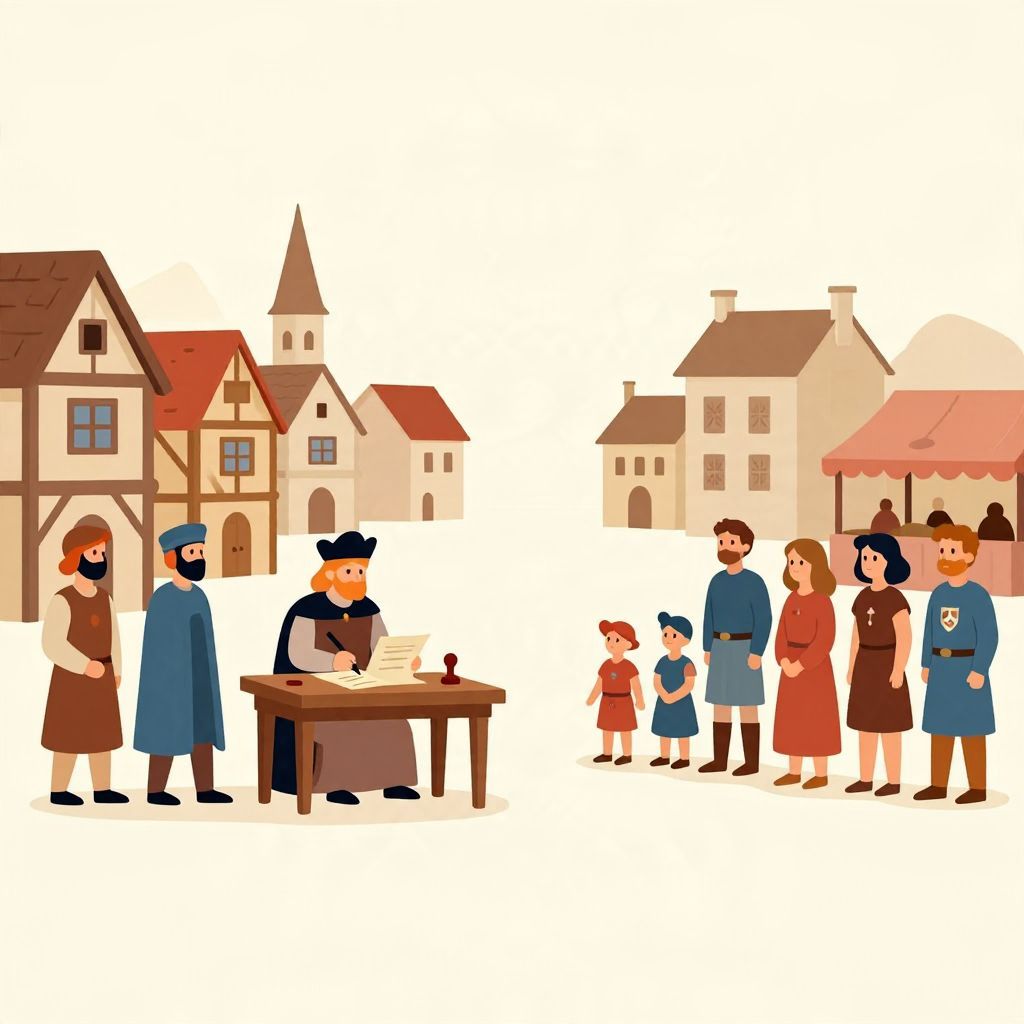
When did last names start? The short answer is that surnames began appearing in different places at different times, but they became common much later than first names. In some ancient societies, hereditary family names existed by around 1000 BCE, while in much of Europe they only became widespread between the 11th and 16th centuries.
The history of last names is not one single invention. Instead, they developed gradually as populations grew, governments expanded, and people needed better ways to identify individuals. What counts as a “last name” also varies: some names were inherited, while others began as descriptions, occupations, or references to a father’s name.
When did last names start?
Last names started in different eras depending on the region. The earliest hereditary family names are found in ancient China, where elite families used surnames more than 2,000 years ago. In the Middle East, South Asia, and Europe, fixed surnames appeared later and often spread slowly, becoming common only when states, churches, and local administrations needed more precise records.
Ancient origins of surnames
China: one of the earliest surname traditions
China has one of the oldest continuous surname systems in the world. Surnames were used by noble and aristocratic families in ancient times, and by the Han dynasty they were widespread among many people. Chinese surnames were often hereditary, making them closer to modern last names than many other early naming practices.
These names helped mark lineage, inheritance, and social status. Over time, the distinction between a family name and a personal name became an important part of Chinese identity, and that pattern endured for centuries.
Ancient Rome and the world of multiple names
Ancient Rome used a naming system that could include a personal name, a family name, and sometimes additional identifiers. Roman citizens often had a praenomen, nomen, and cognomen. This was not the same as the modern surname system, but it shows that societies long ago already needed more than one name to distinguish people.
Roman naming practices influenced later European traditions, though the modern hereditary surname did not emerge directly or immediately from Roman custom. After the Western Roman Empire fell, naming habits became more local and less standardized across Europe.
Other early naming traditions
In many ancient and medieval societies, people were identified by patronymics, clan names, tribal names, occupations, or places of origin. These could function like surnames in practice, but they were not always stable from one generation to the next. A person might be known as “son of,” “from,” or “the smith,” yet their children might not keep the same label.
How last names became hereditary
Last names became truly “modern” when they began passing from parent to child in a consistent way. That change usually happened when societies became more complex and record-keeping became more important. Taxation, inheritance, property ownership, legal disputes, and church registers all pushed names toward permanence.
In many places, a descriptive byname gradually hardened into a family surname. For example, a man called John the Baker might have descendants who eventually kept “Baker” as a fixed family name even if they no longer baked bread.
Common sources of surnames
- Occupations: Smith, Miller, Baker, Taylor
- Patronymics: Johnson, O’Brien, Ivanov, Fernández
- Places: Hill, Wood, York, Atwood
- Physical traits or nicknames: Short, Brown, Strong
- Clan or family identity: especially in societies with strong kinship systems
These categories appear across many cultures because they solve the same basic problem: how to tell one person from another when first names alone are not enough.
When did surnames become common in Europe?
In Europe, hereditary surnames spread unevenly. They appeared earlier in parts of Italy and southern France, often among the urban elite, and later in northern Europe. By the 11th and 12th centuries, surnames were becoming more common in some towns and noble families. In England, they spread steadily after the Norman Conquest of 1066 and were widely used by the late Middle Ages, though not everyone had a fixed surname right away.
England and the slow spread of last names
In England, many people in the 11th century still used only one name. Over the next several centuries, additional identifiers became more common, especially in legal and tax records. By the 14th and 15th centuries, many English families had hereditary surnames, though spelling often varied widely.
Standardized spelling came much later. A family name might appear in several forms in medieval documents because clerks wrote names phonetically and local accents differed. So even when surnames were hereditary, they were not always fixed in spelling.
France, Germany, and the Holy Roman Empire
In France and German-speaking lands, surnames also developed gradually from the High Middle Ages onward. Urban growth, feudal administration, and church record-keeping encouraged the use of stable family names. In many regions, surnames became common among townspeople before they were universal in rural areas.
German surnames often preserve old occupational, locational, or descriptive forms, while French names frequently reflect places, saints, or personal characteristics. The pattern is similar: local bynames became hereditary over time.
Scandinavia and patronymics
Scandinavia followed a different path. For centuries, many people used patronymics rather than fixed surnames. A man’s child might be called “Andersson” or “Johansdatter,” meaning son or daughter of Anders or Johan. These names changed each generation, so they were not originally hereditary surnames in the modern sense.
Fixed family surnames became more common in Scandinavia much later, especially in the 19th century, when governments encouraged or required stable names for censuses, military service, and civil administration.
When did last names start in other parts of the world?
The Islamic world
In many Islamic societies, naming traditions often included a given name plus patronymics, honorifics, tribal affiliations, or geographic identifiers. These were not always hereditary surnames, but they could be highly structured and informative. In some regions and periods, family names became more fixed over time, especially under modern state administration.
South Asia
South Asia has long had complex naming customs involving caste, clan, place, occupation, religion, and lineage. Some communities used hereditary family names early, while others relied on changing patronymics or titles. The modern use of surnames in South Asia was shaped not only by older traditions but also by colonial record systems and later state bureaucracy.
Japan
In Japan, surnames were once limited largely to aristocrats, samurai, and certain elite groups. After the Meiji Restoration, the government required all citizens to adopt surnames in the late 19th century. This is a good example of how a state can rapidly transform naming customs that had previously been unequal or restricted.
Russia and Eastern Europe
In Russia and parts of Eastern Europe, hereditary surnames emerged gradually among nobles and urban populations before spreading more broadly. Patronymics remained important, and in some cases they still are. The modern full name in Russian usage often includes a given name, patronymic, and surname, reflecting a layered naming history.
Why did last names develop?
Last names developed because societies needed clearer identification. As populations grew, it became harder to distinguish people with the same first name. Villages turned into towns, trade expanded, governments taxed more efficiently, and churches kept more detailed records of births, marriages, and deaths. A stable surname made all of that easier.
Inheritance was another major reason. If land, titles, debts, or obligations passed through families, then a fixed family name helped establish continuity. Surnames also reinforced social identity, linking a person to ancestry, occupation, locality, or kin group.
Key forces behind surname adoption
- Population growth made simple first names insufficient.
- Urbanization brought more strangers into contact.
- Taxation and law required reliable records.
- Church and civil registers encouraged consistency.
- Inheritance and property made family identity important.
A brief timeline of last names
- c. 1000 BCE and earlier: Some ancient societies, especially in China, used hereditary family names among elites.
- Classical antiquity: Romans and others used multi-part naming systems, though not always hereditary surnames in the modern sense.
- 11th–13th centuries: Surnames spread in parts of Europe, especially among nobles, merchants, and townspeople.
- 14th–16th centuries: Many European surnames became common and increasingly hereditary.
- 17th–19th centuries: Governments standardized surnames in many regions, including Scandinavia and Japan.
- Modern era: Surnames became nearly universal in state records, though naming customs still vary worldwide.
Did everyone have last names at the same time?
No. One of the biggest mistakes is assuming that surnames appeared everywhere at once. The history of last names is uneven. Some elite families had hereditary names centuries before ordinary people did. In some societies, surnames were common early; in others, they were imposed or standardized much later by governments.
Even today, not every culture uses surnames in the same way. Some people have fixed family names, some use patronymics, some use clan names, and some combine several naming traditions. That diversity is part of the history.
What this history means today
Last names are not ancient in the same way that personal names are ancient. They are historical solutions to practical problems: identification, inheritance, administration, and social organization. Their spread tells us a great deal about how societies became larger, more bureaucratic, and more connected.
So, when did last names start? The best answer is that they began in antiquity in some places, but they became widespread and hereditary much later, especially from the medieval period onward. If you want more historical context, you may also enjoy reading about the longest war in history and the history behind Holocaust-related books.