
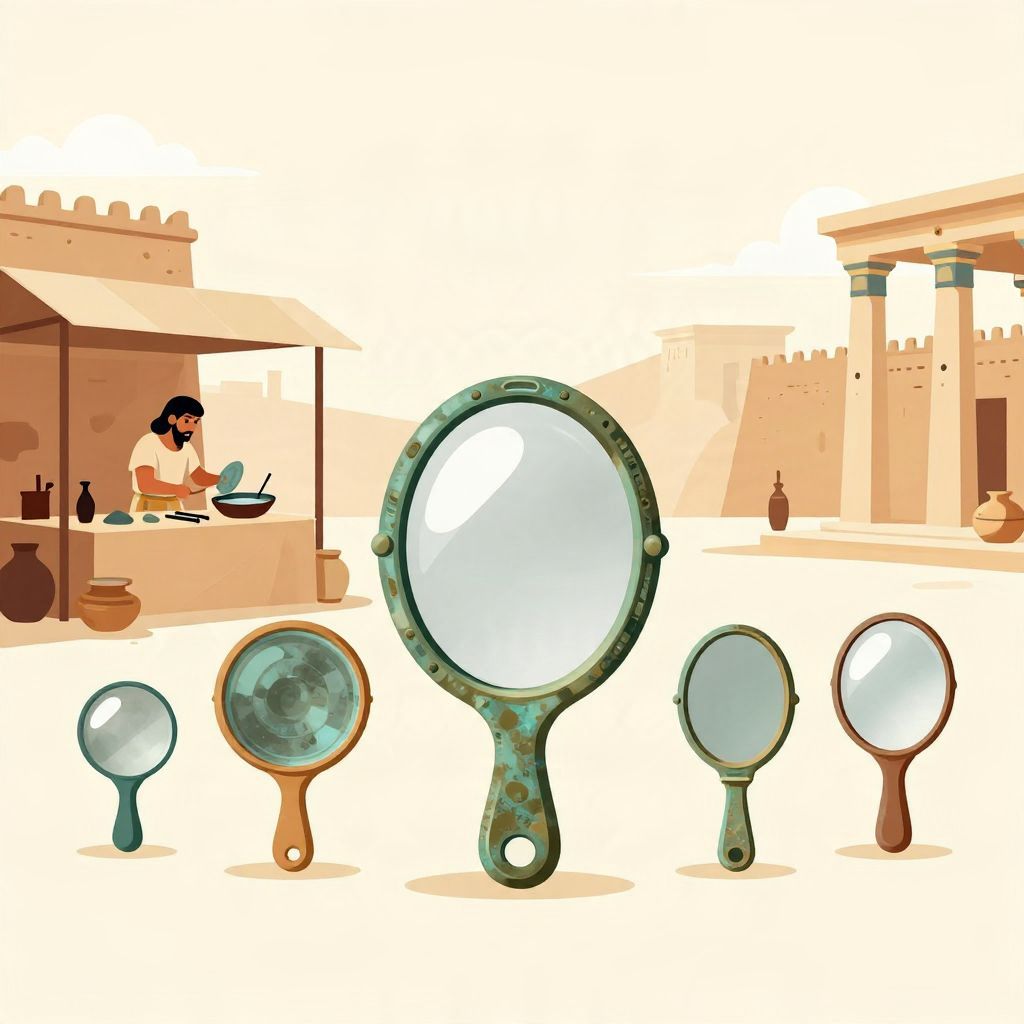
When was the mirror invented? The short answer is that mirrors were not invented all at once. The earliest mirrors were polished stones used in prehistoric times, while true reflective mirrors made from metal and glass developed much later in ancient civilizations.
Because mirrors evolved over thousands of years, the best historical answer is a timeline: from polished obsidian in the Neolithic era to silvered glass mirrors in early modern Europe. The story of the mirror is really a history of materials, craftsmanship, and changing ideas about self-image.
When Was the Mirror Invented?
Mirrors were first made in prehistoric times, with the earliest known examples dating to around 6000 BCE in Anatolia and nearby regions, where people polished volcanic glass such as obsidian. Glass mirrors appeared much later, in the 1st century CE, and the modern silver-backed mirror became common only in the 19th century.
The Earliest Mirrors: Polished Stone Before Glass
Obsidian mirrors in the Neolithic world
The oldest mirrors were not made of glass at all. Archaeologists have found polished obsidian mirrors from Neolithic sites in Anatolia, especially around Çatalhöyük, dating to roughly 6000 BCE. Obsidian, a naturally glossy volcanic glass, could be shaped and polished into a dark reflective surface.
These early mirrors were small, fragile, and expensive to make. They did not provide the bright, clear reflection modern people expect. Instead, they offered a dim image that was useful for grooming, ritual, and status display. In many early societies, mirrors were as much symbolic objects as practical tools.
Other ancient materials used as mirrors
Long before glass became common, people in different regions experimented with reflective surfaces made from polished copper, bronze, silver, and gold. These metal mirrors were especially important in the ancient Near East, Egypt, China, India, and later Greece and Rome.
Metal mirrors were more durable than stone, but they scratched easily and required regular polishing. They also reflected a warmer, darker image than modern mirrors. Even so, they represented a major technological step because they could be shaped more reliably and carried more easily than polished rock.
When Did Glass Mirrors Appear?
Roman-era experimentation
The first glass mirrors are generally dated to the 1st century CE, during the Roman Empire. Early glassmakers learned to create small mirrored surfaces by backing glass with metal, usually lead or other reflective metals. These objects were rare and costly, and they were not yet the large, clear mirrors associated with later centuries.
Roman glass mirrors were important because they marked the beginning of a new idea: instead of polishing the entire surface of a metal object, artisans could combine glass with a reflective backing. This principle eventually became the basis of modern mirror-making.
Why early glass mirrors were limited
Ancient glass was often uneven, cloudy, or full of bubbles. That made it difficult to produce a sharp reflection. For that reason, mirrors remained luxury items for elites long after glassmaking itself had spread widely. In the ancient and medieval worlds, most people still relied on polished metal mirrors or simply did without.
A Brief Timeline of Mirror History
The history of the mirror is best understood as a long sequence of improvements rather than a single invention.
- c. 6000 BCE — Polished obsidian mirrors appear in Neolithic Anatolia.
- Ancient Egypt and Mesopotamia — Polished metal mirrors become common among elites.
- 1st century CE — The earliest known glass mirrors appear in the Roman world.
- Medieval period — Mirror production continues, but mirrors remain expensive and relatively rare in Europe.
- 13th to 15th centuries — European glassmaking improves, especially in Venice, where skilled artisans refine mirror production.
- 16th century — Venetian mirrors become famous for their quality and prestige.
- 1835 — Justus von Liebig develops a chemical silvering process that helps create modern mirrors.
- 19th century — Mass-produced silver-backed glass mirrors become widely available.
Mirrors in the Ancient World
Egypt, Mesopotamia, and China
By the Bronze Age, mirrors were well established in several major civilizations. In ancient Egypt, polished metal mirrors often had decorative handles and were associated with beauty, femininity, and elite culture. In China, bronze mirrors became highly developed objects, sometimes decorated with intricate designs on the back.
These mirrors were not just everyday tools. They could carry religious, magical, or social meaning. In some cultures, mirrors were linked to the sun, purity, truth, or divine power. Their reflective quality made them seem mysterious, and that mystery added to their value.
Mirrors in Greece and Rome
Greek and Roman writers mention mirrors often, showing that they were familiar objects among the wealthy. Yet they were still not universal household items. A mirror could be a symbol of vanity, beauty, youth, or self-awareness, and it appears frequently in art and literature for that reason.
In practical terms, however, ancient mirrors were still limited by material quality. A polished bronze mirror might distort the face slightly, and a glass-backed mirror could be dim. The desire for a clearer reflection helped drive later innovations.
How Venice Changed Mirror Making
The rise of high-quality glass mirrors
During the late medieval and Renaissance periods, Venice became the leading center of European glassmaking. Venetian artisans on the island of Murano developed techniques for producing clearer glass and more refined mirrors. By the 16th century, Venetian mirrors were among the most prized luxury goods in Europe.
These mirrors were expensive because the process was difficult, labor-intensive, and closely guarded. Venetian glassmakers were so skilled that their products became famous across royal courts. A large mirror could cost a fortune and function as a symbol of wealth, taste, and power.
Why mirrors mattered in Renaissance Europe
As mirrors became clearer and more available, they changed how people saw themselves and their surroundings. They influenced portraiture, fashion, interior design, and scientific observation. In the Renaissance, mirrors were also used in art and optics, helping thinkers study reflection, perspective, and light.
This period did not invent the mirror, but it transformed the mirror into a more precise and culturally important object. The mirror became part of a broader shift toward observation, measurement, and self-representation.
The Modern Mirror: Silvered Glass
From luxury object to everyday household item
The modern mirror became possible in the 19th century, when chemists and manufacturers developed reliable methods for coating glass with a reflective metal layer. A major breakthrough came in 1835, when the German chemist Justus von Liebig developed a silvering process that made it easier to produce bright, accurate mirrors.
Once industrial production improved, mirrors became cheaper and more common. What had once been a rare luxury gradually entered ordinary homes, shops, and public buildings. This was the point at which mirrors became a familiar part of daily life for large numbers of people.
Why the 19th century is important
If someone asks when the mirror was invented, they may really mean when the mirror became like the one we use today. In that sense, the answer is the 19th century. Earlier mirrors existed, but modern silver-backed glass mirrors are the product of industrial chemistry and mass manufacturing, not ancient craftsmanship alone.
Did One Person Invent the Mirror?
No single person invented the mirror. That is one of the most important historical facts about the subject. Mirrors developed gradually across many places and time periods. Different cultures contributed different materials and techniques, from polished stone and bronze to glass and silvering.
Because of this long evolution, the mirror is better understood as a technology with many inventors rather than a single invention with one date. The question “when was the mirror invented?” depends on which kind of mirror you mean:
- Polished stone mirrors: prehistoric, around 6000 BCE or earlier
- Metal mirrors: widespread in ancient civilizations
- Glass mirrors: first known in the Roman period, around the 1st century CE
- Modern silver-backed mirrors: developed in the 19th century
Why the History of Mirrors Matters
Mirrors changed more than grooming habits. They affected art, science, religion, architecture, and ideas about identity. A mirror can reveal the face, but it also reshaped how people thought about truth, appearance, and the self. As mirrors became clearer and cheaper, they helped ordinary people see themselves in a new way.
The history of mirrors also shows a larger pattern in human history: everyday objects often have very long and complex origins. What seems simple today may have taken thousands of years of experimentation to create.
So, when was the mirror invented? The most accurate answer is that mirrors began in prehistoric times with polished stone, evolved into metal mirrors in ancient civilizations, appeared as glass mirrors in the Roman era, and became modern household mirrors in the 19th century. For more historical context on inventions and changing everyday life, you can also explore history and invention topics or related modern history coverage at HistoryOrg.