
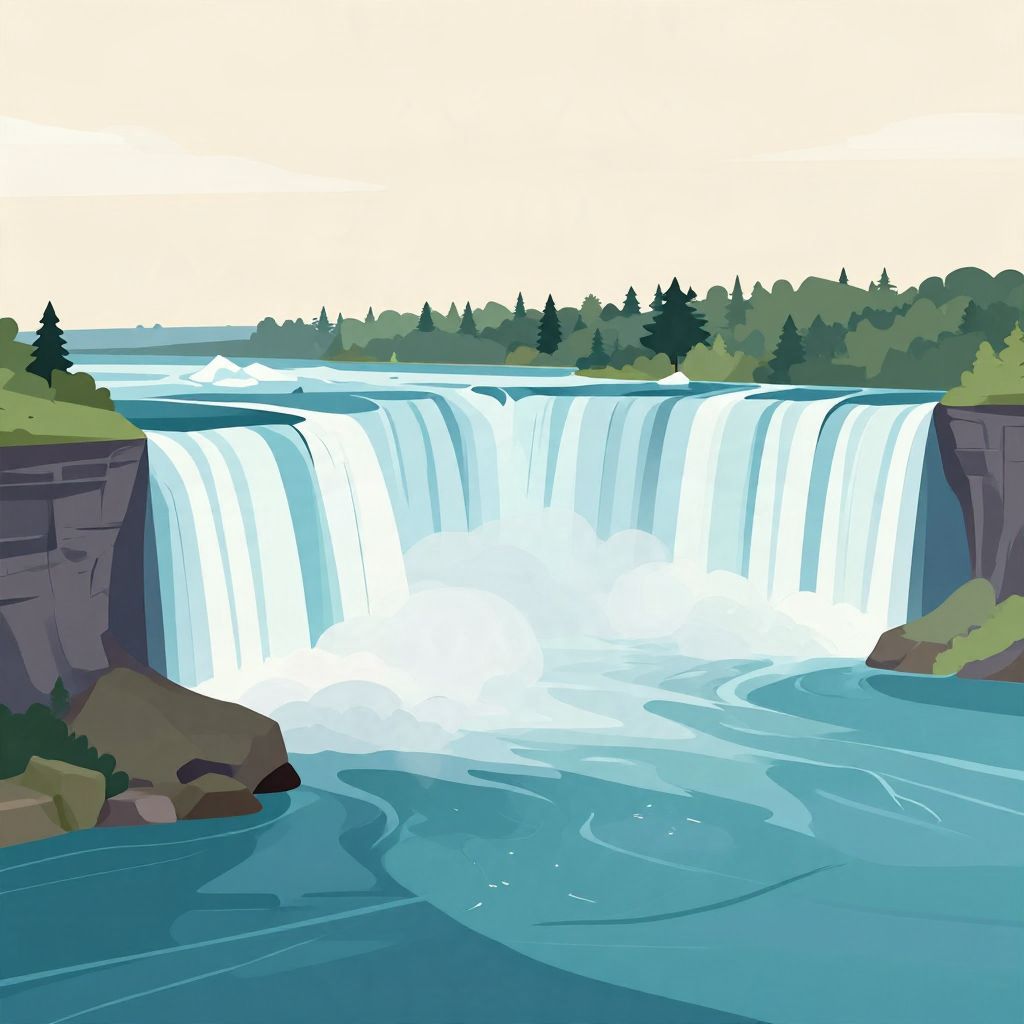
Niagara Falls is one of North America’s most famous natural landmarks, but it was not created in a single dramatic moment. It formed through the slow interaction of glaciers, rivers, and erosion after the last Ice Age. The falls are a geological feature shaped by deep time, yet their modern form is only a few thousand years old.
Understanding how Niagara Falls was formed means tracing both ancient geology and recent landscape change. The answer lies in the retreat of massive ice sheets, the carving of the Niagara River, and the gradual upstream migration of the waterfall over thousands of years.
How Was Niagara Falls Formed?
Niagara Falls formed after the last Ice Age, when retreating glaciers exposed a river route between Lake Erie and Lake Ontario. Water began flowing over layers of hard and soft rock, eroding the softer shale beneath the harder limestone cap. That erosion created a steep drop, and the falls have slowly moved upstream ever since.
The Geological Story Behind Niagara Falls
Glaciers shaped the landscape
The foundation of Niagara Falls goes back to the last glacial period, especially the retreat of the Laurentide Ice Sheet about 12,000 years ago. As the ice melted, it left behind a reshaped Great Lakes basin and redirected drainage across the region. The Niagara River emerged as meltwater found a path from Lake Erie toward Lake Ontario.
This was not a sudden event. The glaciers had scoured bedrock, deposited sediment, and altered elevation patterns across what is now southern Ontario and western New York. Once the ice withdrew, water took advantage of the new slope and began cutting through the land.
Rock layers made the waterfall possible
Niagara Falls exists because of a difference in rock strength. A layer of resistant dolostone and limestone sits above softer shale. Water erodes the weaker shale more quickly, undercutting the harder caprock above. Eventually, sections of the upper rock collapse, leaving the waterfall face exposed again.
This process is common in waterfall formation, but Niagara is especially striking because the rock layers are broad and the river carries a large volume of water. That combination created a massive, persistent waterfall system rather than a small cascade.
The falls are still moving
Niagara Falls is not fixed in place. Over thousands of years, erosion has caused the falls to retreat upstream from their original position near Queenston and Lewiston. Scientists estimate that the falls have moved several kilometers since they formed, though the exact rate has varied over time.
Today, engineering works such as water diversion and erosion control have slowed the natural retreat. Even so, the falls remain a dynamic geological feature rather than a static monument.
What Caused Niagara Falls to Form?
Three main forces created Niagara Falls: glacial retreat, river drainage, and differential erosion. The glaciers opened the route. The river supplied the water. The rock layers determined where the drop would occur and how the waterfall would evolve over time.
- Glacial retreat exposed the region after the Ice Age.
- Drainage from the Great Lakes fed the Niagara River.
- Soft shale beneath hard caprock allowed erosion to carve a cliff.
- Continued water flow kept the falls active and moving upstream.
In other words, Niagara Falls was not “built” by one event. It emerged from a chain of post-Ice Age environmental changes that worked together over millennia.
When Did Niagara Falls Form?
Most historians and geologists place the formation of Niagara Falls at roughly 12,000 years ago, after the last Ice Age. That date is approximate because the landscape changed gradually as ice melted and water systems adjusted. The modern falls began to take shape when the Niagara River established its course and started eroding the escarpment.
Some details remain debated, including the exact timing of the river’s earliest path and the rate of retreat in different periods. But the broad sequence is well established: glaciation first, then meltwater drainage, then waterfall formation through erosion.
How the Niagara Escarpment Helped Create the Falls
A natural cliff line
The Niagara Escarpment is a long geological ridge that runs across parts of the eastern United States and Canada. It is not a man-made structure, but a natural landform created by the uneven erosion of rock layers over immense spans of time. Where the Niagara River crosses the escarpment, the sudden drop produces the falls.
The escarpment matters because it provides the steep edge needed for a waterfall. Without that abrupt change in elevation, the river would simply flow downhill more gradually.
Why the Horseshoe Falls became dominant
Niagara Falls is actually a group of waterfalls, with the Horseshoe Falls on the Canadian side being the largest. Over time, the distribution of water and the shape of the river channel helped make this section especially powerful. The larger volume of water over the Canadian edge has made it the most visually dramatic part of the system.
American Falls and Bridal Veil Falls on the U.S. side are also part of the same river system, but their appearance differs because of local rockfalls, debris, and channel shape.
Key Events in the Formation and History of Niagara Falls
The physical formation of Niagara Falls unfolded over thousands of years, but several later events shaped how people understood and used it.
- About 12,000 years ago: Glaciers retreat and expose the Niagara region.
- Early post-Ice Age period: The Niagara River establishes a route between Lake Erie and Lake Ontario.
- Over millennia: Water erodes soft shale and causes the falls to retreat upstream.
- 19th and 20th centuries: Engineers begin diverting water for hydroelectric power, changing the natural flow.
- Modern era: Conservation efforts and erosion control help preserve the falls as a natural and tourist landmark.
These later developments do not explain the original formation of the falls, but they are important to its history. Niagara became not only a geological feature, but also a site of industry, tourism, and environmental management.
How Human Activity Changed Niagara Falls
Hydroelectric power and water diversion
By the late 19th and early 20th centuries, people began using the Niagara River to generate electricity. Large-scale water diversion reduced the amount of water flowing over the falls at certain times, especially for power generation. This did not create the falls, but it affected their appearance and erosion rate.
Engineers and governments later worked to balance power production with preservation. The result is a heavily managed natural landmark whose flow is partly controlled by human decisions.
Tourism and preservation
Niagara Falls became a major tourist destination in the 19th century and has remained one ever since. That popularity encouraged preservation efforts, scenic development, and cross-border cooperation. The falls are now understood as both a natural wonder and a carefully protected landscape.
This human history matters because it changed how the falls are experienced, even though the geological origin remains entirely natural.
Why Niagara Falls Matters in History
Niagara Falls is important because it shows how dramatic landscapes can emerge from ordinary geological processes acting over long periods. It is also a reminder that “natural history” and human history often overlap. The falls were formed by Ice Age forces, but their modern meaning was shaped by Indigenous presence, exploration, industry, and conservation.
For historians and geologists alike, Niagara is a case study in change: ice shaped the land, water carved the cliff, and people later transformed the site into a symbol of both power and beauty.
In short, Niagara Falls was formed when retreating glaciers after the last Ice Age created a river path over layered rock, and erosion then carved the waterfall into the Niagara Escarpment. Its story is still unfolding, which is part of what makes it so remarkable. For more on landscape formation and ancient environmental change, see how Mount Everest was formed and how humans survived the Ice Age.