
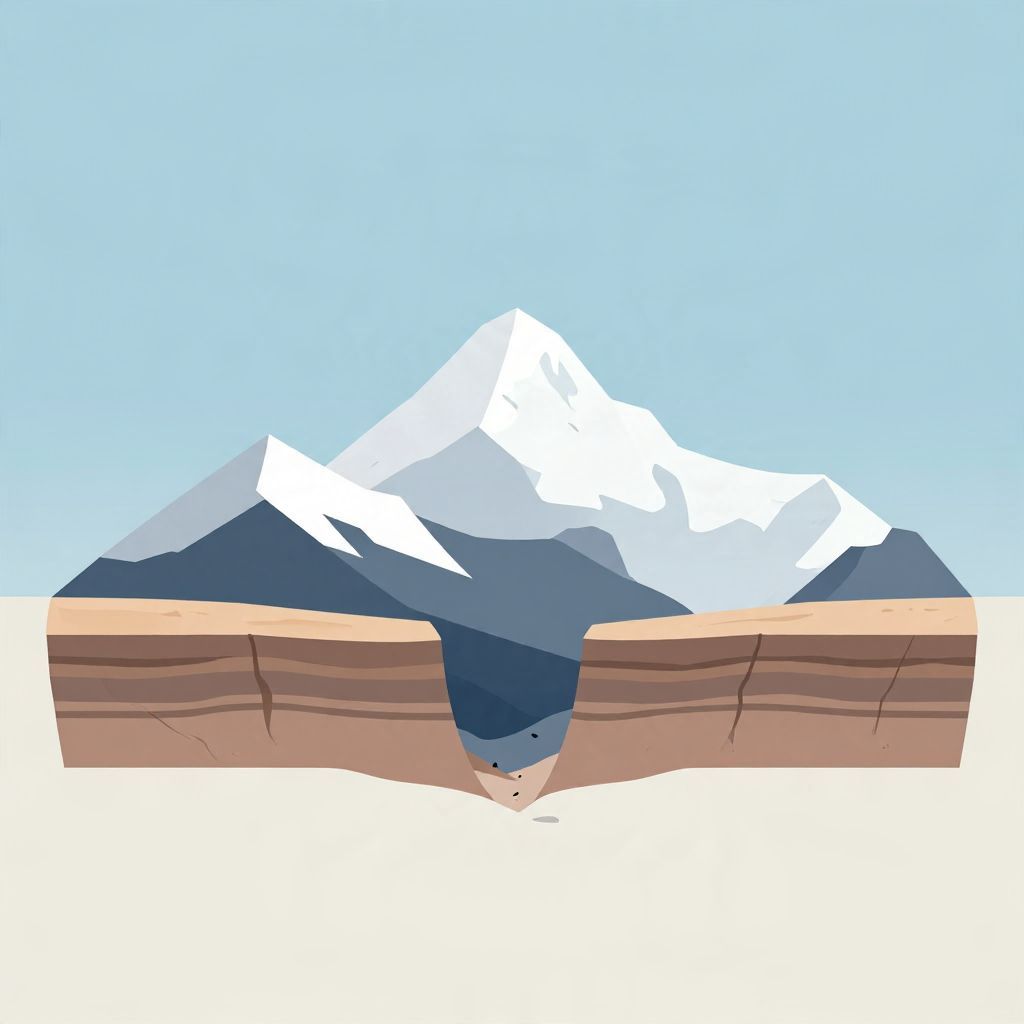
How was Mount Everest formed? The short answer is that Everest rose from a long collision between two of Earth’s tectonic plates: the Indian Plate and the Eurasian Plate. Over tens of millions of years, the Indian Plate pushed northward, crumpling, thickening, and lifting the crust into the Himalayas. Everest is the highest point in that vast mountain-building zone.
Its story is geological rather than human, but it has a clear history of causes and consequences. The mountain did not appear all at once; it emerged through deep-time processes that continue today, making Everest both a product of ancient plate tectonics and a living, changing peak.
How Was Mount Everest Formed?
Mount Everest formed when the Indian Plate collided with the Eurasian Plate, beginning about 50 million to 55 million years ago. The collision compressed former seafloor sediments and older rocks, forcing the crust upward into the Himalayas. Everest is still rising very slowly, even as erosion and earthquakes continually reshape it.
The Geological History Behind Everest
Before the Himalayas: a vanished ocean
Long before Everest existed, the region was part of the Tethys Ocean, a broad ancient sea between the drifting Indian landmass and Eurasia. Layers of marine limestone, shale, and sandstone accumulated on the ocean floor. Some of the rocks now near Everest’s summit were once deposited as sediment under that sea, which is why marine fossils have been found in Himalayan rocks.
The Indian Plate drifts north
After the breakup of the supercontinent Gondwana, the Indian Plate moved north at a geologically rapid pace. By the early Cenozoic Era, it was closing in on Eurasia. This movement set the stage for one of the most dramatic mountain-building events in Earth’s history: a continental collision that had no easy outlet, so the crust had to buckle upward.
Collision and uplift
When the Indian Plate met Eurasia, neither plate simply sank away. Because continental crust is relatively buoyant, the collision caused intense folding, thrust faulting, and crustal thickening. In simple terms, the rocks were squeezed, stacked, and lifted. The Himalayas began to rise, and Everest became part of the central uplift zone that would later include the world’s highest summit.
Why Everest Became So High
Crustal thickening and thrust faulting
Everest is not high because it is a single isolated block pushed straight up. It is high because enormous slabs of rock were shoved over one another along major faults. This process thickened the crust beneath the Himalayas, creating a broad elevated belt. The summit of Everest sits on rocks that were folded and thrust upward over millions of years.
Metamorphism and uplift of ancient rocks
As the crust was buried, heated, and compressed, some rocks changed form through metamorphism. Later, uplift brought them closer to the surface. The mountain’s famous summit area includes limestone and other sedimentary rocks from the ancient Tethys Ocean, while lower slopes expose different rock units transformed by pressure and heat. Everest is therefore a mountain made from both uplifted seabed and deformed continental crust.
Ongoing tectonic motion
The collision has not stopped. The Indian Plate still moves northward, so the Himalayas continue to rise in places by a few millimeters to roughly a centimeter per year, depending on location and measurement method. At the same time, erosion, landslides, and earthquakes wear the mountains down. Everest is the result of a dynamic balance between uplift and erosion.
Key Events in Everest’s Formation
A simple timeline
- More than 100 million years ago: The Indian landmass was part of Gondwana and later began drifting north.
- About 55 million to 50 million years ago: The Indian Plate collided with Eurasia, beginning major Himalayan uplift.
- Over the next tens of millions of years: Compression, folding, and thrust faulting thickened the crust and raised the highest parts of the range.
- In the recent geological past: Erosion, glaciation, and earthquakes carved the mountain into its present form.
- Today: Everest remains tectonically active and continues to change.
Glaciation shaped the modern mountain
Although tectonics created Everest, ice shaped its visible form. Repeated glacial cycles during the Quaternary Period carved valleys, sharpened ridges, and steepened faces. Glaciers also helped strip away loose material, exposing bedrock and making the summit region appear more rugged. The mountain’s dramatic profile is therefore the product of both plate collision and ice-age erosion.
What Kind of Mountain Is Everest?
A fold-and-thrust mountain, not a volcano
Everest is not volcanic. It is a tectonic mountain formed by compression. The Himalayas are often described as fold mountains because the crust was folded and faulted under pressure. This distinguishes Everest from volcanoes, which are built by erupted lava and ash. Its height comes from crustal shortening and uplift, not magma.
Why the summit includes marine limestone
One of the most striking facts about Everest is that the rocks near the summit include limestone deposited in a shallow sea. That does not mean the mountain was once underwater in the way a sunken island might be; rather, the rocks were laid down on an ancient seafloor and later lifted thousands of meters by tectonic forces. This is strong evidence for the mountain’s plate-tectonic origin.
How Scientists Know Everest Was Formed This Way
Evidence from rocks and fossils
Geologists study rock layers, mineral changes, and fossils to reconstruct Everest’s past. Marine fossils in Himalayan strata show that the rocks were originally deposited under the sea. Structural geology reveals folds and faults consistent with continental collision. Radiometric dating and regional comparisons help establish when the uplift began and how the crust has changed since then.
Plate tectonics explains the broader pattern
The modern theory of plate tectonics provides the framework for understanding Everest. It explains why mountain belts form at convergent boundaries, where plates move toward each other. The Himalayas are among the clearest examples on Earth of a continent-continent collision. Everest is the highest expression of that larger process.
Everest’s Formation in Historical Perspective
Ancient Earth, modern discovery
Everest’s formation belongs to deep geological time, but human understanding of it is relatively recent. For much of history, people living around the Himalayas knew the mountain as part of a sacred and formidable landscape, not as a tectonic structure. Scientific explanations came later, especially in the 19th and 20th centuries as geology developed and plate tectonics became accepted.
The mountain’s name and human history
The peak is known globally as Mount Everest, but local names long predate the English one. The mountain’s naming history is separate from its geological formation, yet it reminds us that landscapes have both natural and cultural histories. Human exploration, surveying, and climbing changed the mountain’s place in world history, even though they did not change the forces that created it.
Why Everest Is Still Changing
Earthquakes and erosion
The same tectonic forces that built Everest also make the region earthquake-prone. Sudden movement along faults can alter slopes and trigger landslides. Meanwhile, wind, ice, and gravity continue to erode the mountain. This means Everest is not a fixed monument; it is an active part of a living mountain system.
A mountain that is both rising and wearing down
Everest’s present shape is temporary in geological terms. Uplift keeps pushing it upward, while erosion cuts it back. Over millions of years, the balance between these forces determines how the mountain evolves. That is why the question “How was Mount Everest formed?” is also a question about how Earth constantly rebuilds and reshapes its surface.
Conclusion
Mount Everest was formed by the collision of the Indian and Eurasian plates, which compressed ancient seafloor sediments and continental rocks into the Himalayas over tens of millions of years. Its summit is a reminder that the highest mountain on Earth is the product of slow, powerful geological change. For related background, you may also enjoy reading about how Earth got its name and how humans survived the Ice Age.