
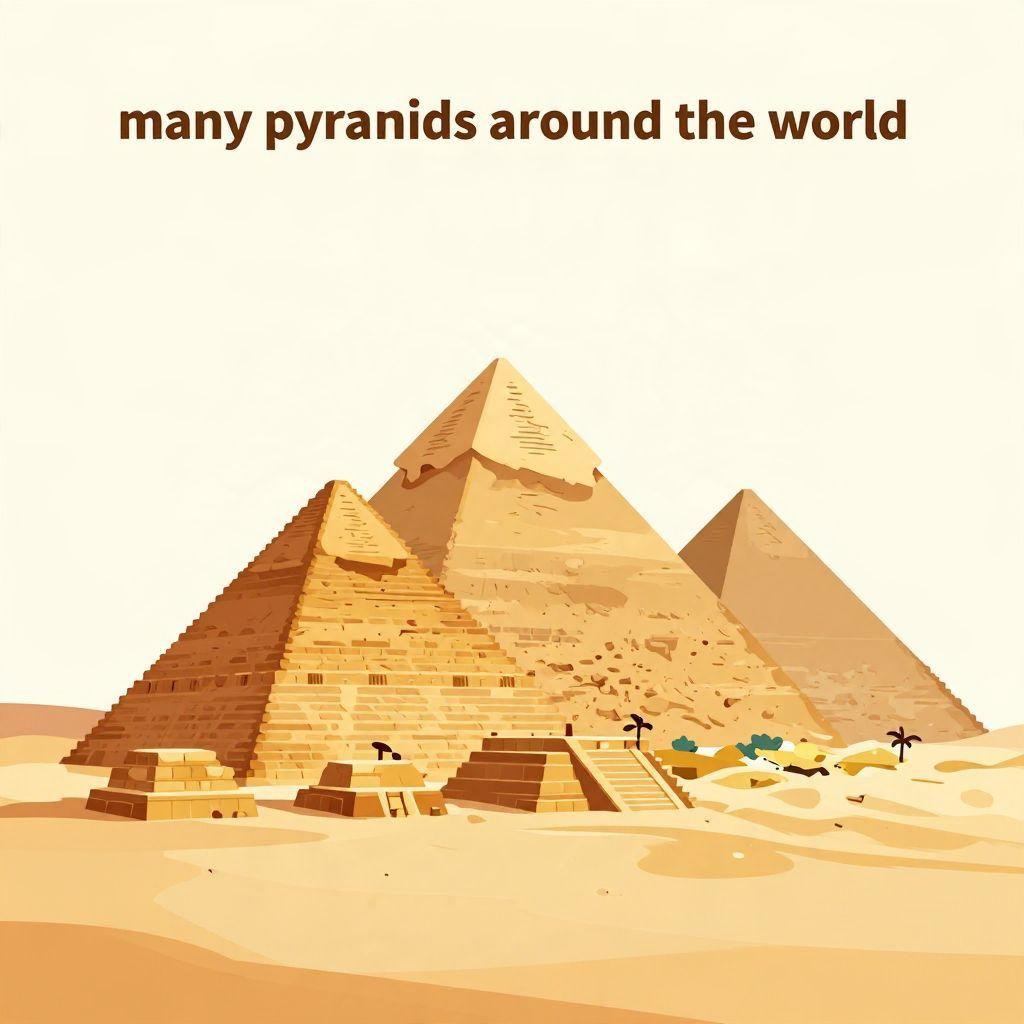
When people ask how many pyramids are in the world, they are usually thinking of Egypt’s famous monuments. But the true answer is broader: pyramids were built in several ancient civilizations, and many survive today in ruins or as archaeological remains.
The total is not fixed, because scholars count differently depending on whether they include damaged structures, buried foundations, or small local pyramids. Even so, the world almost certainly contains well over 200 pyramids, with the largest concentrations in Egypt and Sudan.
How Many Pyramids Are In The World?
There is no single official global count, but historians and archaeologists generally agree that more than 200 pyramids still exist worldwide. The exact number depends on what qualifies as a pyramid: fully standing monuments, ruined cores, unfinished structures, and regionally different pyramid forms all affect the total.
Why the Number Is Hard to Pin Down
Counting pyramids sounds simple, but archaeology rarely is. Some pyramids are complete and visible, while others survive only as low mounds, buried remains, or heavily eroded ruins. In addition, different cultures used the word “pyramid” for slightly different building traditions, so modern counts vary by definition.
What counts as a pyramid?
- Monumental Egyptian pyramids with square bases and sloping sides.
- Nubian pyramids in Sudan, usually smaller and steeper than Egyptian examples.
- Mesoamerican pyramids in Mexico and Central America, often stepped and used as temple platforms.
- Smaller or disputed structures that may be ceremonial mounds, tombs, or later reconstructions.
Because of these differences, a conservative count will be lower than a broad cultural count. A site may be called a pyramid in popular writing even if specialists classify it differently.
Where Are Most of the World’s Pyramids?
The greatest concentration of pyramids is in Egypt and Sudan. Egypt is the most famous pyramid landscape, but Sudan actually contains a very large number of royal and funerary pyramids from the ancient kingdoms of Nubia. Together, these two regions account for most surviving African pyramids.
Egypt
Egypt has dozens of pyramids, built mainly during the Old and Middle Kingdoms, roughly from the 27th century BCE to the 17th century BCE. The best known are the pyramids at Giza, but there are many others at Saqqara, Dahshur, Meidum, and elsewhere along the Nile.
Sudan
Sudan has more pyramids than Egypt by some counts, though they are less famous. Most were built by the Kingdom of Kush, especially at sites such as El-Kurru, Nuri, and Meroë. These pyramids date mainly from the 8th century BCE to the 4th century CE.
Beyond Egypt and Sudan
Pyramids also appear in other parts of the world, especially in Mesoamerica. The Maya, Aztec, and earlier cultures built stepped pyramids for ritual, political, and religious purposes. These are not tomb pyramids in the Egyptian sense, but they are still pyramidal monuments and are often included in broad global counts.
A Brief Global History of Pyramid Building
Pyramids were not invented in one place and copied everywhere. Different civilizations developed pyramid-like architecture independently, for different religious and political reasons. The form was attractive because it created a stable, monumental structure that could symbolize power, sacred space, and a connection between earth and the heavens.
Ancient Egypt
Egyptian pyramid building began in the Third Dynasty, around the 27th century BCE. The step pyramid of Djoser at Saqqara is often treated as the first major stone pyramid. Later pyramids became smoother-sided, culminating in the great royal pyramids of the Fourth Dynasty, including those at Giza.
Nubia and Kush
Centuries later, Kushite rulers in Nubia adopted the pyramid form for royal burials. Their pyramids were generally smaller, steeper, and more numerous than the Egyptian examples. This tradition lasted for many centuries and created one of the richest pyramid fields in the ancient world.
Mesoamerica
In the Americas, pyramid construction developed independently. The earliest Mesoamerican pyramids appeared in the first millennium BCE, and later civilizations expanded the tradition dramatically. These structures often supported temples on top and served as stages for ceremony, astronomy, and state power.
Famous Pyramid Regions and Their Approximate Counts
Because counts change with new discoveries and different definitions, it is safer to speak in approximate terms. The following outline reflects broad scholarly understanding rather than a fixed census.
- Egypt: several dozen known pyramids, including major royal and subsidiary pyramids.
- Sudan: well over 100 pyramids, especially from the Kushite period.
- Mexico and Central America: many dozens of major pyramid complexes, plus numerous smaller ceremonial platforms.
- Other regions: isolated pyramidal monuments and structures in places such as China, Italy, and parts of the Mediterranean world.
These figures are approximate because some sites are single monuments while others are entire complexes with multiple pyramidal buildings. Archaeologists may count a site differently from a tourist guide or a general history book.
Why Did Ancient People Build Pyramids?
Pyramids were more than architectural achievements. They were statements of belief and authority. In many ancient societies, the pyramid linked rulers to divine power, marked sacred landscapes, or served as a monumental tomb or temple base. Their shape also made them practical for building large, durable structures with ancient construction methods.
Religious meaning
In Egypt, pyramids were closely tied to royal burial and the afterlife. Their form may have symbolized the primordial mound or the rays of the sun. In Mesoamerica, pyramids often supported temples where rituals, offerings, and public ceremonies took place.
Political meaning
Building a pyramid required labor, organization, and resources. That made pyramids visible signs of state power. A ruler who could command such a project demonstrated control over workers, materials, and religious authority.
Practical meaning
The pyramid shape is structurally stable. Sloping sides distribute weight effectively, which helped ancient builders create massive monuments with stone, mud brick, or earth fill. This practical advantage partly explains why the form appeared in different places and times.
The Most Famous Pyramids in the World
Although many pyramids exist, a few have become iconic because of their size, age, or preservation. These monuments shape public memory of ancient history and often stand for the entire pyramid tradition.
The Great Pyramid of Giza
Built around 2600 BCE for Pharaoh Khufu, the Great Pyramid is the largest pyramid in Egypt and one of the most famous monuments in the world. It remains central to any discussion of pyramid history, though it is only one part of a much wider ancient tradition.
The Pyramid of Djoser
At Saqqara, the step pyramid of Djoser marks an important turning point in architectural history. Designed under the supervision of the official and architect Imhotep, it represents one of the earliest large-scale stone monuments in human history.
The pyramids of Meroë
In Sudan, the pyramids of Meroë are among the most distinctive in Africa. Their steep angles and dense clustering make them visually striking, and they testify to the long-lived political and cultural power of the Kushite kingdoms.
How the Pyramid Count Changes Over Time
The number of pyramids in the world is not static. Archaeologists continue to identify new remains, reinterpret old sites, and refine classifications. Some pyramids have been lost to erosion, quarrying, urban development, or looting, while others are restored or newly recognized through excavation and remote sensing.
Discovery and preservation
New technology, including satellite imagery and ground surveys, has helped researchers detect buried structures or map large ancient landscapes more accurately. At the same time, preservation challenges mean that some pyramids may disappear from the archaeological record if they are not protected.
Why estimates differ
- Some counts include only major standing monuments.
- Others include ruined, buried, or unfinished pyramids.
- Some include stepped temple pyramids; others do not.
- Local archaeological traditions may classify the same structure differently.
So, What Is the Best Answer?
If you want the shortest accurate answer, it is this: there are well over 200 pyramids in the world, and possibly more depending on how broadly they are defined. Egypt and Sudan contain the largest concentrations, while Mesoamerica preserves many of the most important non-Egyptian examples.
The exact total will probably remain flexible as archaeology advances, but the historical significance is clear. Pyramids were one of humanity’s most enduring monumental forms, created independently by different civilizations to express religion, power, and permanence. For related reading, see what country has the most pyramids and when the Pyramids of Giza were built.