
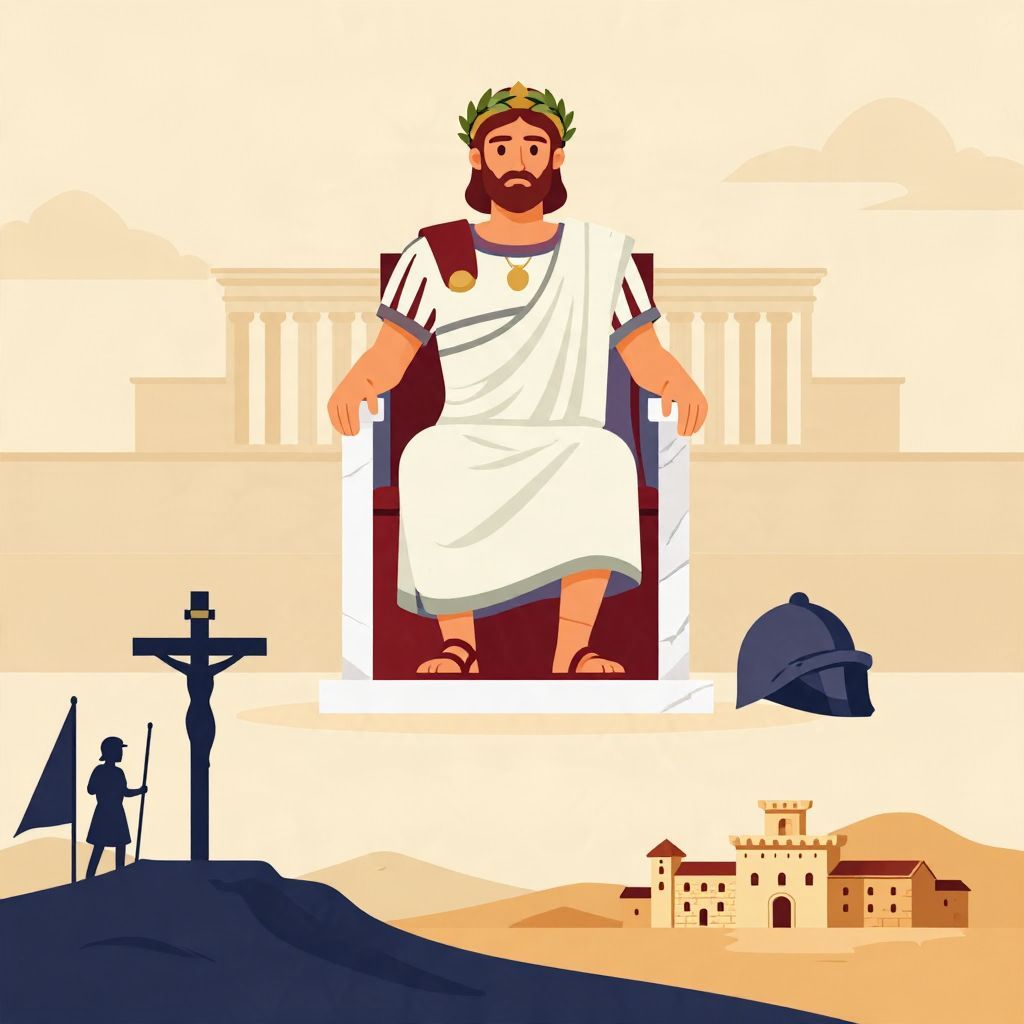
When Jesus died, the Roman emperor was Tiberius. Jesus’ crucifixion is usually dated to around AD 30 or AD 33, during Tiberius’ reign, when Judea was under Roman rule and governed locally by Pontius Pilate. That setting matters because the execution of Jesus was not just a religious event; it also reflected the political realities of Roman provincial power.
Understanding who ruled Rome at the time helps place the death of Jesus in its historical world: an empire expanding across the Mediterranean, a tense province in the eastern frontier, and a local administration balancing Roman authority with Jewish religious and political concerns.
Who Was the Roman Emperor When Jesus Died?
Tiberius was the Roman emperor at the time of Jesus’ death. He ruled from AD 14 to AD 37, and the crucifixion most likely took place in the early 30s AD, during his reign. The exact year is debated, but the emperor is not: the historical evidence points to Tiberius as the ruler of Rome when Jesus was executed in Judea.
Who Was Tiberius?
A reluctant emperor turned Roman ruler
Tiberius Claudius Nero, known simply as Tiberius, was born in 42 BC into the elite Roman Claudian family. He became emperor after the death of Augustus, Rome’s first emperor. Unlike Augustus, who had carefully built the imperial system, Tiberius inherited it. He was experienced in military and political affairs, but ancient writers often portray him as distrustful, reserved, and increasingly isolated later in life.
His place in Roman history
Tiberius was not a founder of the empire, but he was one of the rulers who stabilized it after Augustus. He maintained imperial administration, controlled the army, and preserved Rome’s dominance over its provinces. Judea, where Jesus lived and was crucified, was one of those provinces, though its status was complicated and often politically sensitive.
Why Tiberius Matters to the Story of Jesus
The death of Jesus took place in a Roman-ruled province, so the emperor in power shaped the broader political environment. Tiberius did not personally order the crucifixion, but his reign provided the imperial framework under which Roman governors like Pontius Pilate exercised authority. Jesus’ execution was therefore tied to Roman power, even if carried out locally.
Judea under Roman rule
By the early first century AD, Judea was under Roman control. It was not governed exactly like Italy or the older Roman heartland. Instead, Rome relied on client rulers, prefects, and governors to keep order. This arrangement allowed Rome to collect taxes, suppress unrest, and manage a region that was religiously and politically complex.
Pontius Pilate and local authority
Pontius Pilate served as Roman prefect of Judea roughly from AD 26 to AD 36. He was the official most directly connected to Jesus’ trial and crucifixion. In the Roman system, a provincial governor could authorize capital punishment when public order seemed threatened. The Gospel accounts place Pilate at the center of the legal process, which fits what is known about Roman provincial governance.
When Did Jesus Die?
The exact year of Jesus’ death is not known with absolute certainty, but most historians place it either in AD 30 or AD 33. Both dates fall within Tiberius’ reign. The uncertainty comes from the way ancient calendars, Passover timing, and Gospel chronology intersect. Scholars weigh these clues differently, which is why the date remains approximate rather than fixed.
Why historians debate the date
The main evidence comes from the New Testament, especially the Gospels, which connect Jesus’ death to Passover and to Pilate’s governorship. Historians also consider references to John the Baptist, the length of Jesus’ ministry, and astronomical calculations for the lunar calendar. These lines of evidence narrow the range, but they do not produce a single universally accepted year.
Tiberius’ Reign in Historical Context
From Augustus to Tiberius
Augustus had transformed the Roman Republic into an imperial system, though he avoided the title of king. Tiberius inherited this system after Augustus died in AD 14. By then, the empire was already a vast political and military structure stretching from Britain to Egypt and from Spain to Syria. Judea was a small but strategically important part of that world.
Rome’s eastern provinces
The eastern Mediterranean was one of the most heavily Romanized and politically sensitive regions of the empire. Cities, trade routes, local elites, and religious communities all interacted under Roman control. Judea was especially difficult to govern because of its strong monotheistic tradition, expectations of divine kingship, and periodic unrest. Rome usually preferred order over ideological understanding.
Tiberius and provincial administration
Tiberius was known for being cautious and for relying on governors and administrators to handle local matters. That style of rule meant that decisions in Judea were often made on the ground, not in Rome itself. Jesus’ execution therefore reflects how Roman authority operated: the emperor stood at the top of the system, but local officials carried out the day-to-day enforcement of imperial power.
What the Sources Actually Tell Us
Roman evidence
Roman historians such as Tacitus mention Jesus’ execution under Pontius Pilate during Tiberius’ reign. This is important because it places the event within Roman historical memory, not only Christian tradition. Roman sources do not give a detailed account of Jesus’ life, but they support the basic framework: Jesus was executed in Judea while Tiberius was emperor.
Christian sources
The Gospels are the main narrative sources for Jesus’ death. They are theological texts, but they also preserve historical information about Roman rule, Passover timing, and Pilate’s role. Because they were written for religious purposes, historians read them carefully, comparing them with Roman and Jewish history to separate probable historical fact from later interpretation.
What is certain and what is not
- Certain: Tiberius was emperor when Jesus died.
- Certain: Pontius Pilate governed Judea during the likely period of the crucifixion.
- Likely: Jesus died in AD 30 or AD 33.
- Uncertain: the exact day and year of the crucifixion.
Why the Roman Emperor Matters for Understanding the Crucifixion
Asking who the emperor was is not just a trivia question. It helps explain the political structure behind the event. Jesus was not executed in a vacuum. He lived under imperial rule, in a province where Roman officials feared disorder, especially during major religious festivals. The emperor’s reign shaped the system that made such an execution possible.
Roman power and local conflict
Rome generally allowed local religious practices to continue, but it did not tolerate challenges to public order or claims that could be interpreted as political threats. A figure like Jesus, who attracted followers and was associated by some with kingship or messianic expectation, could become suspicious in Roman eyes if authorities believed he might stir unrest.
The significance of crucifixion
Crucifixion was a Roman method of execution used especially for slaves, rebels, and those considered dangerous to state authority. Its use against Jesus underscores the political dimension of the event. Even when the dispute was rooted in local religious tensions, the final punishment was Roman and imperial in character.
Tiberius After Jesus’ Death
Tiberius continued to rule for several years after Jesus’ crucifixion, dying in AD 37. His later reign was marked by political suspicion and withdrawal from active public life, especially after he left Rome for Capri. Yet his reign remained crucial for the early history of Christianity because it was during his rule that Jesus was executed and the first Christian movement began to emerge.
Historical Takeaway
The Roman emperor when Jesus died was Tiberius, and that fact places the crucifixion firmly within the political world of the Roman Empire. Jesus’ death occurred under Roman provincial rule in Judea, most likely in AD 30 or AD 33, with Pontius Pilate acting as the local Roman authority. For readers interested in the wider imperial setting, see how many Roman emperors there were and the historical background to why the Romans killed Jesus.