
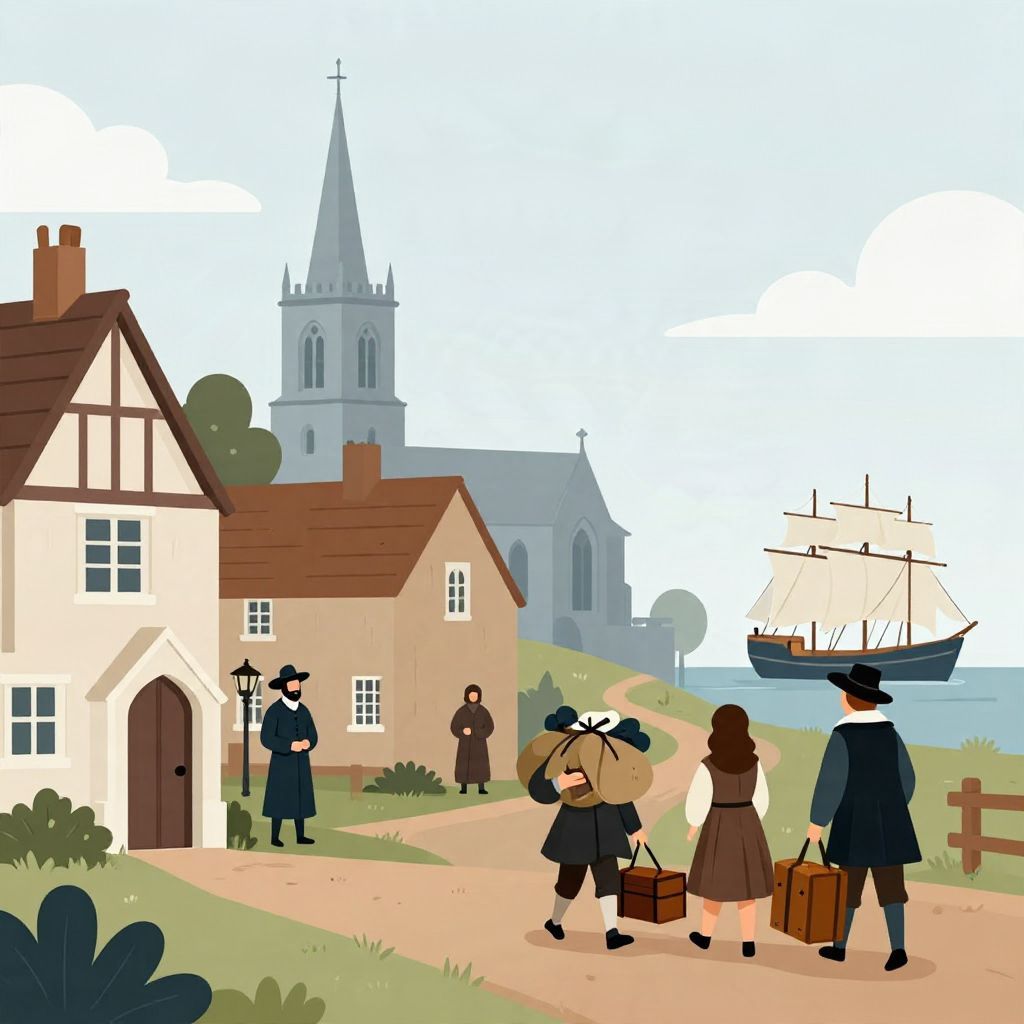
Why did the Puritans leave England? The short answer is that many Puritans did not leave at once, and not all of them left for the same reason. But those who did migrate in the early 17th century were driven by a mix of religious conflict, political pressure, and the hope of building a more godly society elsewhere.
Their departure was part of the larger story of the English Reformation, the reigns of James I and Charles I, and the growing tension between religious conformity and reform. Some Puritans stayed in England and tried to change the Church from within; others concluded that England would not allow the kind of church life they wanted.
Why did the Puritans leave England?
Many Puritans left England because they believed the Church of England still retained too many Catholic practices, while the government demanded religious conformity. Under pressure from bishops and the crown, some faced fines, censorship, and loss of office. A smaller group chose migration so they could worship and organize their communities more freely.
Religious conflict was the main cause
The Puritans were English Protestants who wanted to “purify” the Church of England after the break with Rome. They did not all reject the church itself, but they objected to practices they saw as too ceremonial, too hierarchical, or insufficiently biblical. Their goal was reform, not necessarily separation at first.
What Puritans wanted to change
- Simpler worship services and preaching centered on the Bible
- Less emphasis on bishops and church hierarchy
- Stricter moral discipline in both church and society
- Removal of rituals they associated with the old Catholic church
Because the Church of England was the official church, disagreement was not just theological. It was political. In early modern England, religious uniformity was tied to loyalty, public order, and obedience to the crown. That made Puritan criticism seem dangerous to authorities.
The crown and church authorities pushed conformity
Under Elizabeth I, the Church of England had already been established as a Protestant national church, but it still preserved many traditional structures. Puritans pressed for further reform and often found themselves in conflict with bishops and royal officials. By the early 1600s, the pressure to conform became more intense.
James I and Charles I increased the strain
When James I came to the throne in 1603, many Puritans hoped for reform. Instead, he defended episcopal authority and famously resisted radical change in the church. Under Charles I, especially in the 1630s, the situation worsened for many critics of religious policy. Archbishop William Laud promoted stricter ceremonial worship, which many Puritans saw as a step backward toward Catholicism.
Some Puritans were punished for nonconformity. They could be fined, suspended from ministry, or barred from advancement. For ministers and educated laypeople, this created a painful choice: conform outwardly, stay and suffer, or leave.
Migration offered a way to preserve their faith community
For a portion of Puritans, migration was not simply an escape from persecution. It was a deliberate attempt to create a community where they could practice religion as they believed it should be practiced. This is especially true of the New England migrants of the 1630s, who hoped to build a “godly commonwealth.”
Not all Puritans were separatists
It is important to distinguish Puritans from the Separatists, such as the group later associated with the Pilgrims. Separatists believed the Church of England was beyond reform and broke away entirely. Most Puritans, by contrast, wanted reform within the church. Still, some Puritans eventually concluded that England’s church and political system would not permit their vision.
The Massachusetts Bay migration, led by figures such as John Winthrop, was shaped by this hope. The colonists did not think of themselves as abandoning England in a simple sense; many saw their move as temporary exile or a providential mission. They remained culturally English, even while building a new society across the Atlantic.
Economic and social pressures also mattered
Religion was the central cause, but it was not the only one. Some Puritans were influenced by economic opportunity, family strategy, and the practical difficulties of life in a tense religious climate. The Atlantic world offered land, local autonomy, and the chance to establish communities without the same level of interference from bishops and royal courts.
Why the New World appealed
- More land was available than in crowded parts of England
- Colonial settlement allowed greater local control
- Migration could protect ministers and families from church discipline
- Some hoped to create a model Christian society
These motives should not be overstated, though. The Puritan migration was not mainly a search for wealth, and it was not a mass exodus of all English Puritans. It was a selective movement involving specific leaders, congregations, and families who believed their religious future was at risk in England.
How the Great Migration unfolded
The most important wave of Puritan migration came in the 1630s, especially to New England. This period is often called the Great Migration, though the term can be used in different ways. It did not mean all Puritans left England at once; rather, tens of thousands of English people, many of them Puritan or Puritan-adjacent, crossed the Atlantic over roughly a decade.
Key stages
- Late 1500s to early 1600s: Puritan reform movements grow within England.
- 1603–1620s: Increasing frustration under James I; some Puritans begin to emigrate.
- 1620: A Separatist group sails on the Mayflower, showing that religious migration is possible.
- 1630s: The largest Puritan migration to New England takes place under pressure from Laudian policy.
- 1640s: The English Civil War changes the political landscape, and migration slows.
The timing matters. Puritans were not leaving because England was uniformly hostile from the start. Many remained active in English politics and religion. In fact, the Civil War and the collapse of royal authority in the 1640s briefly gave Puritans greater influence in England itself.
Persecution, but not always in the modern sense
It is tempting to describe the Puritans as fleeing persecution in the same way later religious refugees did. That is partly true, but the historical reality is more complicated. Most Puritans were not hunted simply for being Protestant. They were part of the dominant Protestant culture. Their conflict was with the official form of Protestantism imposed by church and state.
That distinction helps explain why some stayed. Many Puritans believed they could reform England from within, and in some periods they had real influence. Others left when that hope seemed to fade. Their migration was therefore a response to a changing political and religious environment, not a single dramatic expulsion.
What happened after they left?
Puritan migration helped shape New England’s early colonies, especially Massachusetts Bay, Connecticut, and parts of New Hampshire. The migrants built towns, churches, schools, and civil institutions that reflected their religious priorities. Their communities were not fully tolerant by modern standards; they often enforced their own religious conformity and punished dissent.
Lasting significance
The Puritan departure from England had consequences on both sides of the Atlantic. In England, Puritan ideas influenced the politics of the Civil War era and later Protestant culture. In America, Puritan settlement helped establish patterns of education, local governance, and religious seriousness that left a long legacy in New England history.
So the best answer is this: the Puritans left England mainly because they believed the English church and state would not allow the religious reform they wanted. Some migrated to escape punishment, some to find freedom to build godly communities, and some because the political climate under the Stuart monarchy made their future in England uncertain. For related reading, see why the Pilgrims came to America and one reason colonists came to America.