
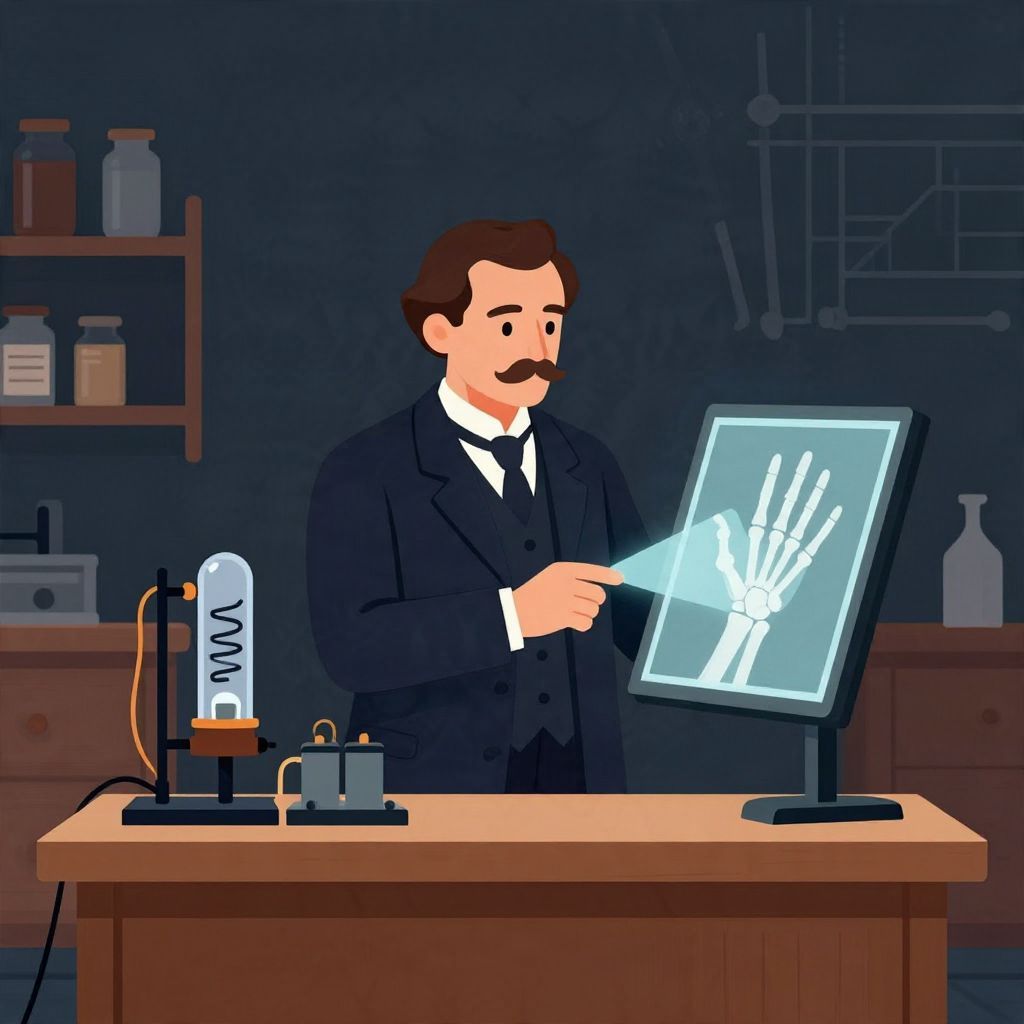
The X-ray was invented in 1895, when German physicist Wilhelm Conrad Röntgen discovered a new kind of invisible radiation while experimenting with cathode rays. He announced his findings in late 1895, and the discovery quickly transformed science and medicine.
Because X-rays were identified through experiment rather than designed as a finished device, historians usually date their invention to 8 November 1895, the day Röntgen recognized the new rays. Their medical use followed almost immediately in 1896.
When was the X-ray invented?
The X-ray was invented, or more precisely discovered, on 8 November 1895 by Wilhelm Conrad Röntgen in Würzburg, Germany. He noticed that a fluorescent screen glowed even when it was shielded from the cathode-ray tube, showing that an unknown form of radiation was passing through matter.
Who discovered X-rays, and how did it happen?
Röntgen was working with a Crookes tube, a glass vacuum tube used in experiments with electricity. He covered the tube and saw a nearby screen coated with barium platinocyanide light up. After testing further, he realized the rays could pass through paper, wood, and even flesh, but not dense materials like metal or bone.
He called them X-rays because the nature of the rays was unknown. In mathematics and science, “X” often stands for an unknown quantity. The name stuck, even after the rays were better understood as a form of electromagnetic radiation.
Key facts about the discovery
- Date: 8 November 1895
- Scientist: Wilhelm Conrad Röntgen
- Place: Würzburg, Germany
- First public report: late 1895
- First major medical use: 1896
Why 1895 matters in the history of science
Röntgen’s discovery came at a moment when physicists were exploring electricity, vacuum tubes, and radiation. X-rays did not emerge from medicine first; they emerged from laboratory physics. That is important because it shows how a basic scientific experiment can suddenly create a practical technology with enormous social impact.
The speed of the breakthrough was remarkable. Within weeks of Röntgen’s announcement, scientists and doctors across Europe and North America were reproducing the effect. By 1896, X-rays were already being used to locate broken bones, bullets, and other internal injuries.
A short timeline of the X-ray invention
- Late 1800s: Physicists study cathode rays and electrical discharge tubes.
- 8 November 1895: Röntgen notices a glowing screen and identifies a new kind of radiation.
- December 1895: He prepares his first report and famous test images, including an image of his wife’s hand.
- Late 1895 to early 1896: News of the discovery spreads rapidly through scientific circles.
- 1896: X-rays begin to be used widely in medicine, especially for diagnosis.
Was Röntgen the first person to produce X-rays?
Röntgen is credited with the discovery because he was the first to recognize and describe the phenomenon clearly. Some historians and scientists have suggested that other experimenters may have produced X-rays unintentionally before 1895, but they did not identify them as a distinct type of radiation or publish a convincing explanation.
That distinction matters. In history, “invented” can mean the first successful production, the first clear recognition, or the first practical application. For X-rays, the standard answer is that Röntgen discovered them in 1895, and that discovery launched their invention as a usable scientific and medical tool.
How X-rays changed medicine
Before X-rays, doctors had limited ways to see inside the body without surgery. X-rays made internal imaging possible for the first time. This transformed diagnosis, especially in cases involving fractures, swallowed objects, infections, and gunshot wounds.
The new technology also brought risks. Early users did not yet understand radiation exposure well, and some doctors and technicians suffered burns and long-term injuries. Over time, safety standards, shielding, and better equipment made X-ray use far safer.
Early consequences of the discovery
- Faster diagnosis of broken bones and internal injuries
- Growth of radiology as a medical specialty
- New research into atomic and electromagnetic physics
- Recognition of radiation hazards and the need for protection
Why the discovery spread so quickly
Röntgen’s work was widely respected because he published careful observations and showed compelling evidence. One of the most famous early images was the X-ray of a hand, often identified as his wife’s hand, which made the invisible visible in a dramatic way. That image helped the public grasp the importance of the discovery.
Newspapers and scientific journals helped spread the news rapidly. In an age before television or the internet, the combination of a striking visual result and a clear scientific explanation made X-rays one of the most famous discoveries of the 19th century.
What happened after 1895?
Röntgen’s discovery did not remain a laboratory curiosity. It became part of modern medicine, physics, and engineering. In the years that followed, X-ray tubes improved, exposure times shortened, and medical imaging became more practical. The discovery also helped open the way to later developments in radiation science.
Röntgen received the first Nobel Prize in Physics in 1901, a sign of how profoundly the discovery had changed science. His work marked a turning point: for the first time, doctors and scientists could look inside opaque objects without cutting them open.
So, when was the X-ray invented?
The clearest historical answer is 8 November 1895. That is when Wilhelm Conrad Röntgen discovered X-rays in Germany. If you are looking for the moment the invention became known to the world, the answer is late 1895, with medical use expanding rapidly in 1896.
X-rays are a strong example of how a scientific discovery can become a world-changing invention almost immediately. For more history from the same era, see what happened in 1917 and what happened in 1945.