
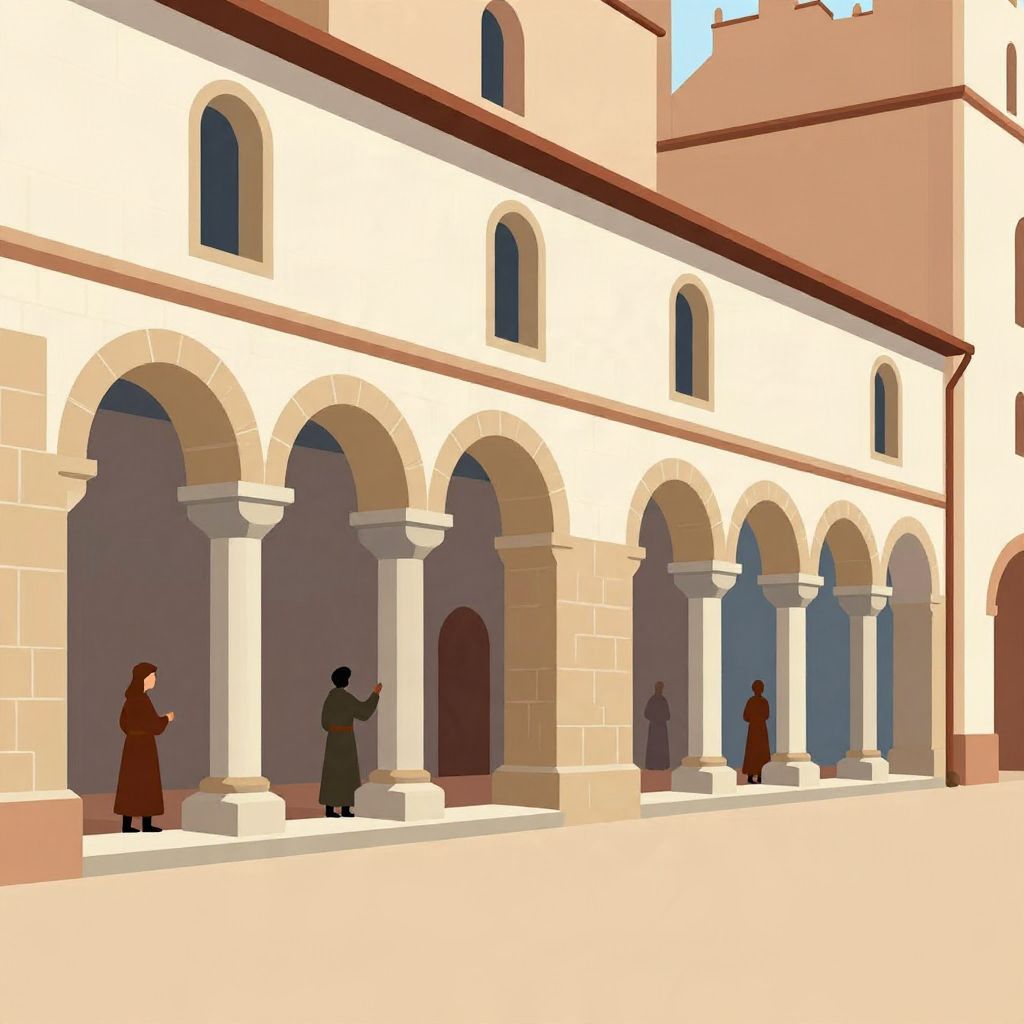
What is the arcade in Ottonian architecture? In simple terms, it is a row of arches carried on columns or piers, used to divide interior spaces or shape exterior walls in churches and imperial buildings of the 10th and early 11th centuries. In Ottonian art and architecture, the arcade was both structural and symbolic, helping create rhythm, order, and a sense of sacred hierarchy.
Understanding the arcade helps explain how Ottonian builders transformed Carolingian traditions into a monumental style that prepared the way for Romanesque architecture in central Europe.
What Is the Arcade in Ottonian Architecture?
An arcade in Ottonian architecture is a repeated series of arches supported by columns or piers, usually found in church interiors, apses, cloisters, and exterior walls. It organized space visually and structurally, creating a measured, ceremonial effect that suited Ottonian ideas of imperial and sacred order.
The Ottonian World and the Rise of the Arcade
Ottonian architecture developed in the German-speaking lands of the Holy Roman Empire during the 10th and early 11th centuries, under rulers such as Otto I, Otto II, and Otto III. The style drew on Carolingian precedents, late antique Roman forms, and local building traditions. The arcade became one of its most recognizable devices because it could unify a building while also breaking it into legible parts.
Ottonian patrons, especially bishops and imperial abbeys, wanted churches that expressed both Christian devotion and imperial authority. Arcades helped achieve that goal. They made walls appear ordered and dignified, while also guiding the eye through the building’s sacred spaces. In this sense, the arcade was not merely decorative. It was part of a larger architectural language of hierarchy and procession.
Why arches mattered
The arch had long been associated with Roman building, and Ottonian architects inherited that legacy through surviving ancient structures and earlier medieval models. By repeating arches in sequence, builders could create a sense of continuity and grandeur. The arcade also allowed for practical solutions: it could support upper walls, separate aisles from a nave, or frame openings in galleries and crypts.
How Arcades Worked in Ottonian Churches
In Ottonian churches, arcades most often appeared as interior arcades separating the central nave from side aisles. They might also run around a choir, appear in crypts, or decorate an exterior wall. The form varied from building to building, but the basic idea remained the same: a repeated arched rhythm that structured the architectural space.
Nave arcades
The nave arcade was one of the most important features. It divided the main central space from the side aisles and created a visual framework for worship. In large Ottonian churches, such as the great abbey churches associated with imperial patronage, the arcade helped emphasize the length and solemnity of the building. It also supported clerestory walls above, allowing more light into the central vessel of the church.
Alternating supports
Some Ottonian churches used alternating supports in their arcades, such as a pattern of columns and piers. This created a stronger visual rhythm and became especially influential in later Romanesque architecture. The alternation was not only aesthetic. It also reflected practical differences in load-bearing and spatial emphasis, giving the interior a measured pulse that matched liturgical movement.
Arcades in crypts and galleries
Arcades were not limited to the main body of a church. In crypts, they could frame small chapels or support vaulting above. In galleries, they formed layered spaces for clergy, rulers, or pilgrims. These smaller arcades often intensified the sense of sacred enclosure, making the architecture feel ordered and hierarchical even in compact spaces.
The Meaning of the Arcade in Ottonian Culture
The arcade in Ottonian architecture had meaning beyond construction. It expressed the Ottonian ideal of a divinely ordered Christian empire. Repeated arches suggested stability, balance, and continuity—qualities that resonated with imperial ideology. The building itself became a visual metaphor for an ordered Christian world.
Ottonian patrons often linked church building to political legitimacy. A grand arcade could make a church feel like an imperial monument, not just a local parish structure. This mattered in a period when rulers and bishops worked closely together. Architecture served as a public statement of authority, faith, and continuity with Rome and the Christian past.
Symbolic order and sacred space
Medieval churches were not neutral containers. Their forms shaped how people experienced worship. The arcade marked transitions: from aisle to nave, from earthly space to sacred focus, from the ordinary to the ceremonial. In that sense, it helped define the church as a structured spiritual environment.
Origins: Roman, Carolingian, and Local Influences
Ottonian arcades did not appear out of nowhere. They grew from several traditions. Roman architecture supplied the model of the arch and the monumental colonnade. Carolingian architecture, especially under Charlemagne and his successors, revived classical forms and established important church plans. Local builders then adapted these ideas to the materials and needs of central Europe.
From Rome to the Middle Ages
The Roman world had used arcades in aqueducts, basilicas, amphitheaters, and baths. Medieval builders knew these forms through surviving ruins, reused materials, and inherited design habits. In Ottonian buildings, the arcade often looks less like a direct copy of a Roman monument and more like a Christian reworking of Roman vocabulary.
Carolingian inheritance
Carolingian architecture had already emphasized monumental church interiors and westworks, and it preserved the idea that architecture could express imperial power. Ottonian builders inherited this ambition. The arcade became one of the means by which they turned inherited forms into a more unified and disciplined style.
Examples of Arcades in Ottonian Architecture
Several important Ottonian monuments show how arcades functioned in practice. Not every building survives intact, and some have been altered over time, but the surviving evidence makes the importance of the arcade clear.
- St. Michael’s, Hildesheim (begun c. 1010–1020): famous for its clear articulation of space, with arcades that help organize the nave and aisles into a balanced composition.
- St. Cyriakus, Gernrode (10th century): an important early Ottonian church where arcaded forms contribute to the building’s orderly interior rhythm.
- St. Pantaleon, Cologne (late 10th century): associated with imperial and ecclesiastical patronage, showing how arcades could support a monumental and prestigious church design.
These buildings differ in plan and decoration, but each uses repeated arches to create visual coherence. The arcade was especially valuable in large churches because it made the interior intelligible at a glance while also encouraging a sense of movement through the sacred space.
Arcade, Gallery, and Blind Arcade: What’s the Difference?
Historians and architectural scholars distinguish between several related forms. A true arcade is an open sequence of arches supported by columns or piers. A blind arcade is a decorative series of arches applied to a wall without openings. A gallery arcade usually refers to arches opening onto an upper level or passage.
Blind arcades in Ottonian design
Blind arcades were especially useful for exterior walls and apses, where they added depth and rhythm without weakening the structure. They also created shadow and texture, enlivening otherwise plain masonry. In Ottonian architecture, blind arcades often reinforced the impression of disciplined order and classical memory.
Why the distinction matters
Not every arched motif in an Ottonian church served the same purpose. Some were structural, some decorative, and some both. Recognizing the difference helps avoid oversimplifying the style. The arcade was a flexible architectural tool, adapted to different settings and meanings.
How the Arcade Shaped Later Romanesque Architecture
The Ottonian arcade was an important step toward Romanesque architecture in the 11th and 12th centuries. Later Romanesque churches expanded the use of arcades, thickened walls, and developed more elaborate systems of bays, galleries, and vaults. The Ottonian preference for clear spatial rhythm and monumental repetition helped lay the groundwork for that development.
In this sense, the arcade was part of a longer architectural evolution rather than a closed style. It helped medieval builders think in terms of modular space: repeated units, balanced proportions, and legible structure. Those ideas became central to Romanesque church design across much of western Europe.
Why the Arcade Still Matters to Art History
For historians, the arcade is one of the best clues to how Ottonian architecture worked. It reveals how builders balanced practicality with symbolism, and how a church could serve as both a functional space and a political statement. The arcade also shows the Ottonian ability to adapt older forms into a new medieval vocabulary.
When we see an Ottonian arcade, we are not just looking at a row of arches. We are seeing an architectural expression of empire, liturgy, memory, and order. That is why the arcade remains central to understanding Ottonian churches and their place in medieval art history.
In short, the arcade in Ottonian architecture is a repeated series of arches that organizes space, supports structure, and conveys sacred and imperial order. It is one of the defining features of the style and a bridge between Carolingian precedent and later Romanesque design. For readers interested in related medieval topics, it also helps to compare Ottonian church planning with broader Romanesque architecture and the political culture of the Holy Roman Empire.