
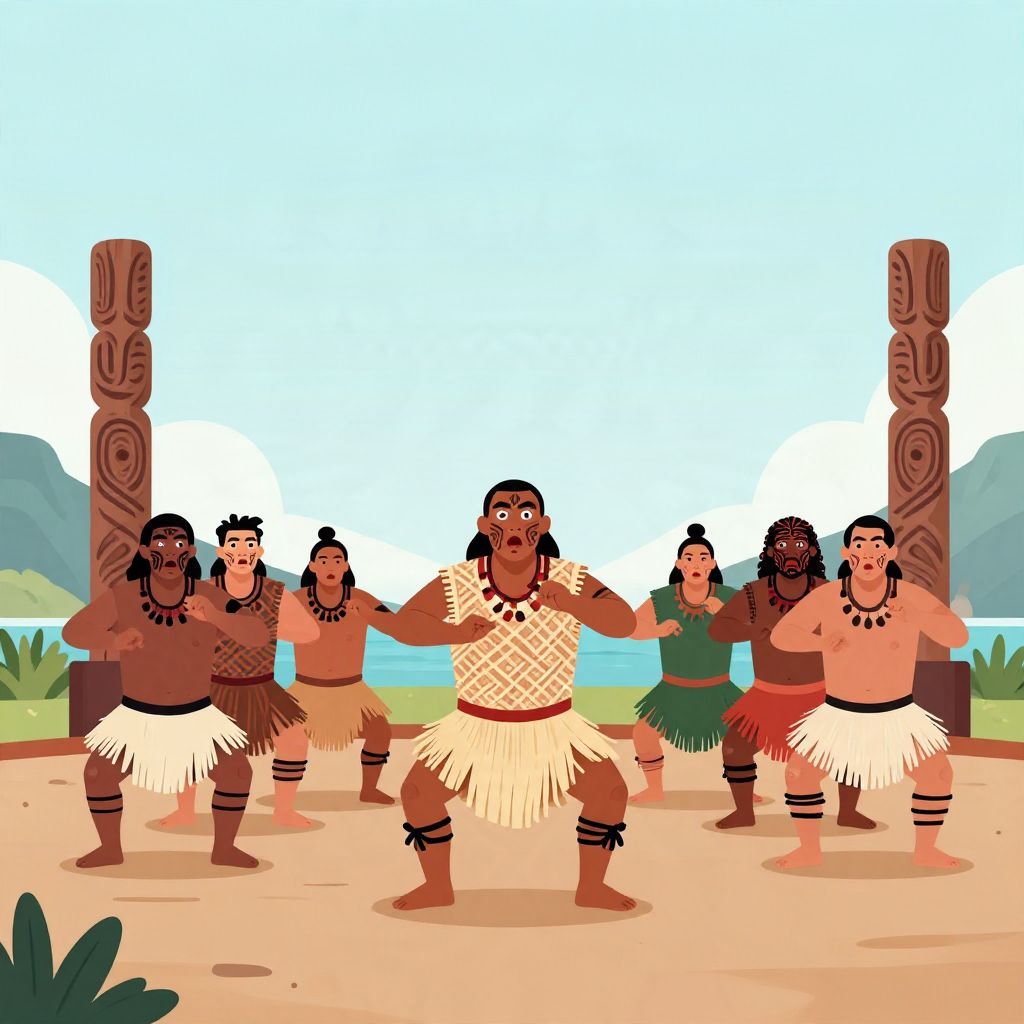
What is haka? It is a powerful Māori performance tradition from Aotearoa New Zealand, combining chanting, rhythmic movement, facial expression, and sometimes weapon work to express identity, challenge, welcome, or commemorate. Today it is widely recognized around the world, but its roots are deeply historical and tied to Māori language, ceremony, and social life.
Haka is not a single dance with one fixed meaning. It is a family of performances that developed within Māori culture over many generations, shaped by warfare, ritual, celebration, mourning, and public display. Its history shows how performance can carry memory, authority, and community identity across time.
What is haka?
Haka is a Māori form of performance that uses chant, movement, stamping, posture, and expression to communicate emotion and intent. It can be performed by men, women, or mixed groups, and it has been used for many purposes, including welcoming guests, honoring the dead, motivating fighters, and marking important occasions.
Origins and historical meaning of haka
The origins of haka lie in the long history of the Māori people, the Indigenous Polynesian population of Aotearoa New Zealand. Māori ancestors arrived in the islands from eastern Polynesia in the centuries before European contact, bringing traditions of oral history, genealogy, ritual speech, and performance. Haka grew within that world as a form of embodied communication.
More than a war dance
Haka is often described in popular culture as a “war dance,” but that label is too narrow. Some haka were indeed linked to warfare, especially as a way to prepare warriors, intimidate opponents, or express collective strength. Yet many other forms had peaceful or ceremonial purposes. Over time, the term came to cover a broad range of performances, each with its own context and style.
Performance, language, and identity
In Māori society, spoken words carried authority, and public performance could reinforce social bonds and rank. Haka often included kupu—carefully chosen words—alongside movement. The performance could honor ancestors, celebrate a chief, or respond to an event. Because Māori culture placed great value on genealogy and collective identity, haka became a way of making history visible in the present.
How haka developed in Māori history
Haka developed before written records in a society where knowledge was transmitted orally. That makes precise dating difficult, but scholars agree that haka is ancient in the sense that it predates European colonization and belongs to long-standing Māori cultural practice. Its forms evolved regionally and socially, rather than appearing all at once in a single moment.
Pre-contact Māori society
Before Europeans arrived in the late 18th century, Māori communities used performance in many settings. Haka could accompany preparations for conflict, formal welcomes, seasonal gatherings, and rites connected to death or remembrance. The physical force of the performance—stamping feet, thrusting the body, widening the eyes, and projecting the voice—made it a compelling public act of unity and resolve.
Contact with Europeans and changing meanings
After British and other European contact from the late 1700s onward, haka took on new historical roles. Māori communities used it to assert identity in the face of colonization, land loss, and political pressure. At the same time, Europeans observed haka and often misunderstood it, reducing it to spectacle or exotic performance. This misunderstanding helped spread a simplified image of haka outside Māori contexts.
What does haka look and sound like?
Haka is characterized by synchronized movement, strong vocal delivery, and intense facial expression. Performers may slap their bodies, stamp the ground, gesture with arms, and maintain a powerful stance. The eyes, tongue, and facial muscles can be used dramatically to project emotion and challenge. The result is not random energy but disciplined collective performance.
Common elements
- Chanting or recitation that carries the words and rhythm of the performance
- Stomping and posture that create a grounded, forceful presence
- Facial expression that communicates intensity, pride, or challenge
- Group synchronization that emphasizes unity and shared purpose
- Sometimes weapon work in forms connected to martial training or display
Different kinds of haka
There is no single universal haka. Different forms include haka used for welcome, celebration, mourning, or challenge. Some are performed by women, some by men, and some by mixed groups. The meaning depends on the words, the setting, and the community performing it. In other words, the same broad tradition can serve very different social functions.
Haka in war, ceremony, and social life
Historically, haka could serve both practical and symbolic purposes. In war-related settings, it helped prepare fighters psychologically and project strength toward an enemy. In ceremonial settings, it could honor visitors, mark important meetings, or express grief. In social life, it reinforced belonging and connected people to ancestors and community obligations.
Challenge and welcome
One of the most important features of haka is its flexibility. A haka can be a challenge, but it can also be a welcome. In Māori protocol, a visiting group may be greeted with a performance that establishes the status of the hosts and the seriousness of the occasion. This duality—challenge and hospitality—reflects the complexity of Māori social relations.
Mourning and remembrance
Haka has also been used in contexts of loss. In mourning, performance can help express collective grief and honor the dead. This aspect is often overlooked when haka is reduced to a pre-game spectacle. Historically, haka was part of a wider ceremonial world in which emotion, memory, and public ritual were closely connected.
Haka and colonial history
The colonial era changed the public life of haka but did not erase it. During the 19th century, Māori communities faced warfare, land confiscation, missionary influence, and government pressure. In that environment, haka remained a visible marker of Māori identity. It could be used in political gatherings, community events, and moments of resistance.
Misunderstanding and adaptation
European observers often treated haka as a curiosity or as proof of Māori “otherness.” Such interpretations ignored the sophistication of the tradition. At the same time, Māori performers adapted to new circumstances, sometimes presenting haka in arenas shaped by colonial institutions, tourism, or national display. This adaptation was not simple loss; it was also cultural survival and strategic change.
From local practice to national symbol
By the late 19th and early 20th centuries, certain haka had become strongly associated with New Zealand identity in the eyes of both Māori and non-Māori audiences. This process was uneven and often politically complicated. A Māori cultural form was increasingly used to represent the nation, even though Māori themselves continued to define its meaning in more specific and community-based ways.
The haka and rugby: how a cultural tradition became global
Today many people encounter haka through rugby, especially the New Zealand national team’s pre-match performances. This association has made haka internationally famous, but it is only one chapter in a much older history. Sport gave haka a global stage, yet the tradition itself long predates modern athletics and should not be reduced to it.
Why rugby made haka famous
Rugby offered a public setting where coordinated performance could be seen by large audiences. The visual power of haka fit the spectacle of international sport, and media coverage spread it worldwide. Over time, many viewers came to associate haka with New Zealand as a whole, even though it remains specifically Māori in origin and cultural meaning.
Questions of respect and appropriation
The global popularity of haka has also raised questions. When performed without context, it can be misunderstood, commercialized, or copied in ways that strip it of meaning. Māori voices have often emphasized that haka is not just a dramatic routine; it is a living cultural practice tied to language, ancestry, and protocol. Respectful use depends on understanding that history.
Why haka matters historically
Haka matters because it shows how performance can preserve identity across centuries of change. It is a historical source in motion: a living practice that carries memory, social order, and political meaning. Through haka, Māori communities have expressed strength, grief, welcome, defiance, and pride in ways that written records alone cannot capture.
Continuity and change
The history of haka is a history of continuity and adaptation. Its roots are ancient, but its forms have changed as Māori society has encountered war, colonization, urbanization, and globalization. That flexibility is one reason haka has endured. It remains meaningful because it can speak to the present while drawing authority from the past.
Conclusion
So, what is haka? Historically, it is a Māori performance tradition that combines chant, movement, and expression to communicate identity, emotion, and purpose. Its history is broader than the popular image of a war dance: haka has served ceremonial, social, political, and commemorative roles for generations. To understand haka is to understand an important part of Māori history and Aotearoa New Zealand’s cultural heritage.