
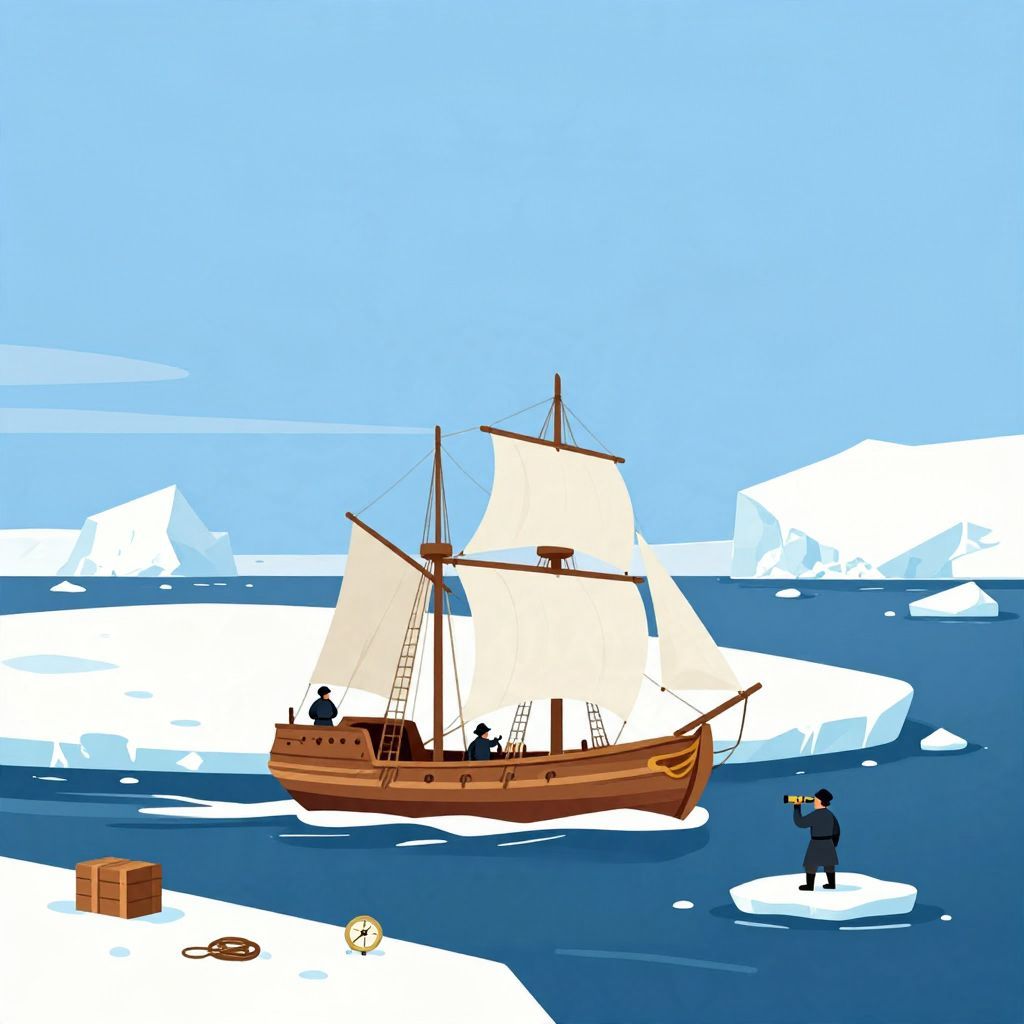
When was Antarctica discovered? The short answer is that Antarctica was not “discovered” in a single moment. Europeans first sighted the Antarctic region in the early 19th century, but the continent itself was only gradually confirmed through exploration, mapping, and later scientific expeditions.
Because Antarctica had no permanent human population and was known only indirectly through speculation and scattered sightings, its “discovery” depends on what definition you use. Most historians point to 1820 as the key year, when multiple expeditions likely saw the continent or its ice edge for the first time.
When Was Antarctica Discovered?
Antarctica is usually said to have been discovered in 1820, when explorers from several nations likely sighted the Antarctic mainland or its fringes. There is no single universally accepted “first discoverer,” because different expeditions saw different parts of the region around the same time, and early reports were sometimes unclear.
The Short Answer: 1820 Is the Key Date
For most historical purposes, 1820 is the date associated with Antarctica’s discovery. In that year, Russian, British, and American-linked voyages all made important Antarctic sightings. These were not yet detailed surveys of a known continent, but they marked the moment when the southern polar region moved from theory into documented exploration.
Why 1820 matters
Before 1820, Europeans had long imagined a southern landmass, often called Terra Australis, to balance the continents of the Northern Hemisphere. The idea was based more on geographic theory than on direct evidence. The sightings of 1820 gave explorers something real to describe, even if they still could not fully map or land on the continent.
What Happened Before Antarctica Was “Discovered”?
Long before anyone saw Antarctica directly, cartographers and scholars speculated that a large southern continent must exist. Ancient and early modern thinkers believed the Earth needed a southern land to maintain balance. This was a theory, not proof, but it influenced centuries of mapmaking and exploration.
Terra Australis and early speculation
By the 16th and 17th centuries, European maps often showed a vast southern continent. These maps mixed guesswork with fragments of reports from voyages into the far southern oceans. The imagined land was not Antarctica as we know it today, but the idea helped drive later exploration.
James Cook and the limits of early exploration
Captain James Cook crossed the Antarctic Circle in 1773 and circumnavigated the Southern Ocean at high latitudes. He did not see the Antarctic mainland, but he proved that any southern continent would be cold, isolated, and difficult to reach. Cook’s voyages narrowed the search and made later Antarctic discovery more plausible.
The Main Antarctic Sightings of 1820
The year 1820 is central because several expeditions reached Antarctic waters almost simultaneously. Their reports, taken together, form the strongest historical basis for saying Antarctica was discovered then. However, the exact “first sighting” remains debated because weather, ice, and poor visibility made identification difficult.
Fabian von Bellingshausen
The Russian expedition led by Fabian Gottlieb von Bellingshausen is often credited with one of the earliest sightings of the Antarctic continent. On 27 January 1820, his expedition likely saw the Antarctic mainland or an ice shelf near it. Because the evidence comes from ship logs and later interpretation, historians still discuss exactly what was visible that day.
Edward Bransfield
Just days later, on 30 January 1820, British naval officer Edward Bransfield sighted land in the Antarctic Peninsula region. His observations are among the clearest early European records of Antarctic land. Bransfield’s voyage is especially important because it produced one of the first relatively direct and credible claims of Antarctic sighting.
Nathaniel Palmer
In November 1820, American sealer Nathaniel Palmer reportedly saw parts of the Antarctic Peninsula region as well. Palmer’s voyage came later in the same year, but it helped confirm that the region was being explored by multiple national and commercial expeditions.
Was Antarctica “Discovered” by One Person?
No single person can fairly be called the sole discoverer of Antarctica. The continent was identified through a series of sightings by different explorers, each working in difficult conditions and often with incomplete information. The idea of one discoverer oversimplifies a complicated history of exploration.
Why the question is debated
There are several reasons historians avoid naming one definitive discoverer:
- Antarctica was not inhabited by a known human population, so there was no local “discovery” in the same sense as in other regions.
- Early explorers often saw ice shelves, pack ice, or nearby islands rather than the mainland itself.
- Records were inconsistent, and some sightings were not immediately recognized as part of a continent.
- Different countries later emphasized different explorers for national prestige.
From Sightings to Exploration: The 19th-Century Timeline
Antarctica’s history after 1820 is a story of gradual confirmation. Explorers, sealers, and scientists slowly mapped coastlines, crossed dangerous seas, and proved that Antarctica was a continent rather than a myth or a single island.
- 1773 – James Cook crosses the Antarctic Circle and demonstrates the harshness of southern polar waters.
- 1820 – Bellingshausen, Bransfield, and Palmer make major Antarctic sightings.
- 1821 – More sealing voyages enter Antarctic waters, increasing contact with the region.
- 1831–1833 – Further expeditions improve geographic knowledge of the Antarctic Peninsula and surrounding islands.
- 1840 – Major scientific expeditions, including those led by James Clark Ross, map parts of the Antarctic coast and strengthen the case for a continent.
- Late 19th century – The “Heroic Age” of Antarctic exploration begins, with expeditions focused on scientific discovery and attempts to reach the South Pole.
When Was Antarctica First Explored Scientifically?
Although 1820 marks the first major sightings, Antarctica was not scientifically explored in a serious and sustained way until later in the 19th century. Early sightings established that land existed; later expeditions measured coastlines, studied ice, and collected natural history data.
James Clark Ross and the scientific era
Between 1839 and 1843, British explorer James Clark Ross led a major expedition that greatly expanded knowledge of Antarctic geography. His work helped identify the Ross Sea, Ross Ice Shelf, and volcanic mountains such as Mount Erebus. This was a crucial step in turning Antarctica from a rumor into a mapped continent.
Why scientific exploration mattered
Antarctica’s discovery was not just about being first to see it. The real historical breakthrough came when explorers could describe its scale, climate, geology, and ice systems. That scientific phase laid the foundation for modern Antarctic research and international cooperation.
Did Anyone Reach Antarctica Before 1820?
There is no solid historical evidence that any known civilization reached the Antarctic mainland before the 19th century. Some theories and claims appear in popular writing, but they are not supported by strong documentation. Legends about ancient or medieval Antarctic visits should be treated cautiously.
Myths and unsupported claims
Occasionally, writers suggest that ancient sailors, Polynesian navigators, or lost civilizations reached Antarctica long before Europeans. These ideas are intriguing, but they remain speculative. Without reliable archaeological or documentary evidence, they cannot be accepted as established history.
Why Antarctica Was Discovered So Late
Antarctica was discovered later than other continents because it is one of the most inaccessible places on Earth. Its location, weather, sea ice, and lack of obvious commercial value made it extremely difficult to reach and even harder to identify accurately.
Geography and climate
The Southern Ocean is rough and dangerous, and sea ice can block ships for long periods. Even when explorers approached the region, fog, storms, and icebergs often prevented clear sightings. In many cases, crews could not tell whether they were seeing land, ice shelves, or floating ice masses.
Limited incentives
Unlike the Americas, Africa, or Asia, Antarctica offered no known trade routes, cities, or agricultural wealth. For centuries, it remained outside the main goals of empire and commerce. Only when improved ships, navigation, and scientific curiosity developed did sustained exploration become possible.
What Antarctica’s “Discovery” Means Today
Historically, Antarctica’s discovery is best understood as a process rather than a single event. The year 1820 marks the beginning of documented European awareness of the continent, but the full story includes speculation, repeated sightings, mapping, and later scientific exploration.
Lasting significance
Antarctica’s discovery changed geography and global science. It completed the picture of the Earth’s continents, opened a new frontier for polar research, and eventually led to international agreements about peaceful scientific use. Today, Antarctica is known less as a place to conquer than as a continent to study and protect.
So, when was Antarctica discovered? The best historical answer is 1820, though the discovery was gradual and shared among several explorers. If you are interested in related exploration history, you may also want to read about James Cook’s voyages and the broader age of European exploration.