
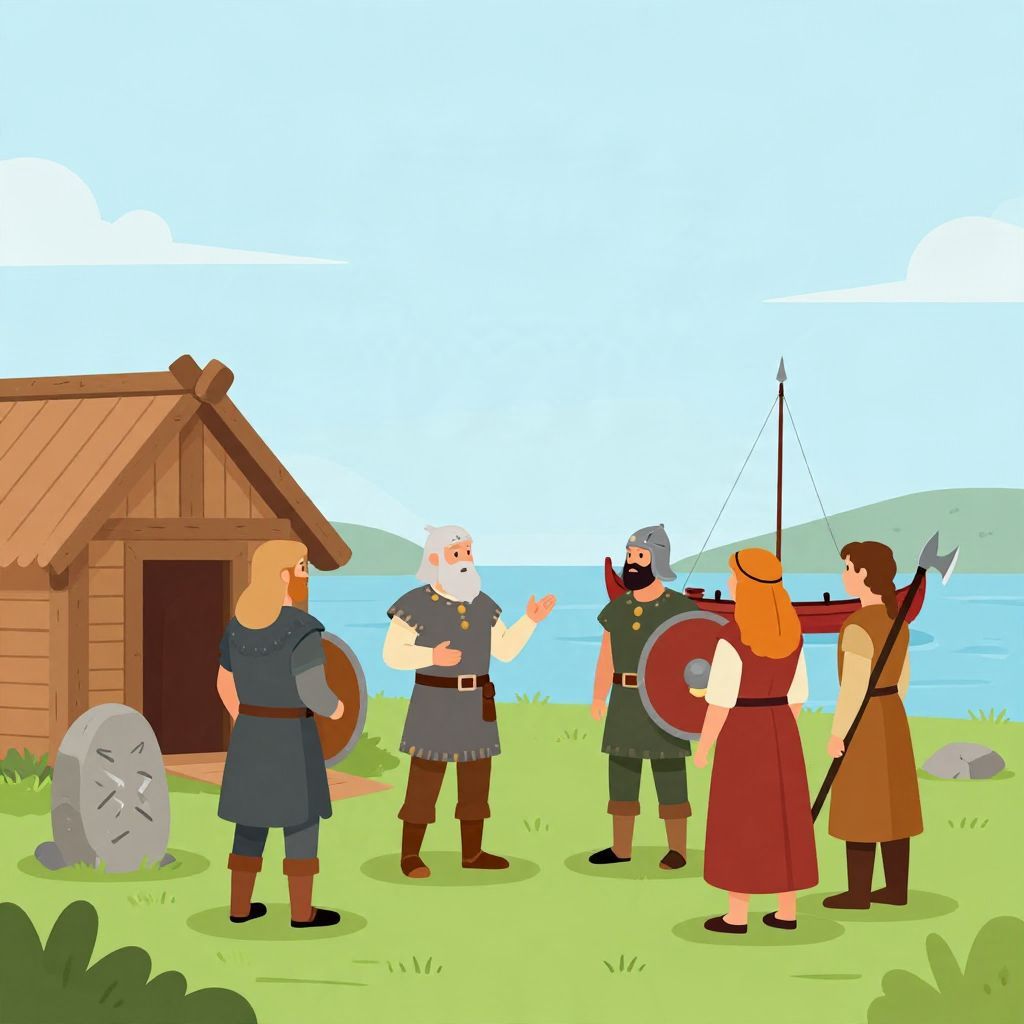
What language did Vikings speak? The short answer is Old Norse, a North Germanic language spoken across Scandinavia during the Viking Age, roughly from the late 8th to the mid-11th century. It was not one single modern “Viking language,” but a family of closely related dialects that changed over time and varied by region.
Because the Vikings traveled widely, Old Norse also spread through trade, settlement, and conquest, leaving traces in place names, inscriptions, and English vocabulary. Understanding their language helps explain how Viking society worked and how their world connected Scandinavia with the British Isles, Iceland, Greenland, and beyond.
What language did Vikings speak?
Vikings primarily spoke Old Norse, the common ancestral language of modern Icelandic, Faroese, Norwegian, Danish, and Swedish. In the Viking Age, it was spoken in different regional forms across Scandinavia, and it is best understood as a shared language continuum rather than a single standardized tongue.
Old Norse was the language of the Viking world
Old Norse developed from earlier Proto-Norse and became the language of everyday life, law, poetry, trade, and religion in Scandinavia. It was used by farmers, traders, shipbuilders, warriors, and rulers alike. When people today say “the Vikings spoke Viking,” they usually mean Old Norse, though that phrase is modern shorthand rather than a historical term.
It was not exactly one uniform language
Communication across Scandinavia was generally possible, but speech differed by region. Scholars usually divide Old Norse into West Norse and East Norse. West Norse was spoken mainly in Norway, Iceland, the Faroe Islands, and Norse settlements in the North Atlantic. East Norse was spoken in Denmark and Sweden. These varieties were close enough to be mutually intelligible in many contexts, especially early on.
Where and when was Old Norse spoken?
Old Norse was spoken across Scandinavia during the Viking Age, roughly from c. 793 to c. 1066, though the language existed before and continued to evolve long after the Viking Age ended. Its roots lie in earlier Germanic speech, and its descendants survive today in the modern Scandinavian languages, especially Icelandic, which preserves many older features.
The language’s earlier origins
Before Old Norse, the peoples of Scandinavia spoke Proto-Norse, attested in early runic inscriptions from the first centuries CE. Over time, sound changes and social development produced Old Norse by about the 8th century. This was not a sudden break but a gradual linguistic transition, the kind historians and linguists often reconstruct from inscriptions, later manuscripts, and comparative language study.
The Viking Age and beyond
The Viking Age is usually associated with the raid on Lindisfarne in 793 and ends around 1066, when major political changes in Scandinavia and the Christianization of the region transformed Norse society. But the language itself did not disappear at that point. Old Norse continued to develop into medieval Scandinavian languages, while Icelandic preserved many older grammatical forms because of its relative isolation.
How do we know what Vikings spoke?
Historians and linguists know about Viking speech from runic inscriptions, later medieval manuscripts, loanwords in other languages, place names, and comparative study of Germanic languages. We do not have recordings, of course, so reconstructions are based on written evidence and linguistic analysis rather than direct audio proof.
Runestones and inscriptions
Runes were the main writing system used in the Viking world. Many surviving inscriptions are short memorial texts, ownership marks, or messages carved on stone, wood, bone, or metal. They show vocabulary, grammar, and spelling conventions from different regions and periods. Some of the clearest evidence for Old Norse comes from Scandinavian runestones dating from the 10th and 11th centuries.
Medieval manuscripts
The richest written Old Norse texts were copied down after the Viking Age, especially in Iceland during the 12th and 13th centuries. These manuscripts preserve sagas, law codes, poems, and historical narratives. Although they were written later than the classic Viking Age, they are crucial for understanding the language and its literary culture.
Loanwords and place names
Old Norse left a strong imprint on English, especially in areas of settlement and interaction in northern and eastern England. Common English words such as sky, window, knife, egg, husband, and law come from Old Norse or were strongly influenced by it. Place names ending in -by, -thorpe, and -thwaite also reflect Norse settlement and speech.
Did all Vikings speak the same language?
No. “Viking” describes a way of life and activity, not a single ethnic or linguistic group. Most Vikings were Scandinavian and spoke varieties of Old Norse, but the Viking world included people from different regions, social classes, and mixed communities. Language use could vary by homeland, travel route, and settlement area.
Regional differences within Scandinavia
People from Norway, Denmark, and Sweden spoke related but distinct forms of Old Norse. Differences in pronunciation and vocabulary became more noticeable over time. In the Viking Age, however, these varieties were still close enough to function within a shared cultural sphere, especially in trade networks and elite communication.
Language in Viking settlements abroad
When Norse settlers moved to places such as Iceland, the Faroe Islands, Greenland, and parts of the British Isles, they carried their language with them. In some places, Old Norse coexisted with local languages such as Old English, Gaelic, or Latin. Over generations, this contact produced borrowing, bilingualism, and in some areas a gradual language shift.
What did Old Norse sound like?
Old Norse would not have sounded like modern English or any one modern Scandinavian language. It had a rich system of endings that marked case, number, and gender, and its pronunciation included sounds that later disappeared or changed. Modern Icelandic is often the closest living language to Old Norse in grammar and vocabulary, though it is still not identical.
Grammar was more complex than modern English
Old Norse nouns, adjectives, and pronouns changed form depending on their role in a sentence. This meant word order could be more flexible than in modern English. Verbs also carried important grammatical information. For modern readers, this makes Old Norse feel more like Latin or Old English than contemporary English.
Poetry preserved older features
Skaldic poetry, composed by court poets and elite performers, preserved archaic language and highly structured meter. Poets often used kennings, compact metaphorical phrases that depended on shared cultural knowledge. This poetry is one reason scholars can study the language in great detail, even though its style is more formal than everyday speech.
What languages did Vikings encounter?
Vikings met many languages during travel, trade, raiding, and settlement. Their journeys brought them into contact with Old English, Gaelic, Latin, Slavic languages, Arabic, and others. These encounters shaped Norse vocabulary and, in some cases, the speech of the communities they joined or dominated.
In the British Isles
In England, Norse settlers and local English speakers lived side by side in some regions, especially in the Danelaw. Over time, contact between Old Norse and Old English influenced both languages. The similarity between the two Germanic tongues made borrowing easier, and many everyday words entered English from Norse speech.
In the wider trading world
Norse traders traveled along river routes into Eastern Europe and the Byzantine world, where they encountered Slavic, Greek, and other languages. Some Norsemen served as mercenaries or merchants far from Scandinavia. The famous Varangians, for example, were Norse-linked warriors who entered Byzantine service, showing how mobile Viking-age language communities could be.
Why does Viking language matter historically?
Old Norse is important because it reveals how Viking society communicated, remembered its past, and interacted with the wider medieval world. Language evidence helps historians trace migration, settlement, trade, and cultural exchange. It also shows that the Vikings were not isolated raiders but participants in a broad and connected Eurasian world.
It helps identify settlement and influence
Place names and loanwords can show where Norse speakers settled or had strong influence. This is especially useful in Britain and Ireland, where written records alone do not capture the full scale of interaction. Language evidence often confirms or complicates what archaeology and chronicles suggest.
It connects the Viking Age to modern Scandinavia
Modern Danish, Norwegian, Swedish, Icelandic, and Faroese all descend from the language spoken by the Vikings, though they evolved differently after the Middle Ages. Studying Old Norse helps explain why these languages are related and why Icelandic, in particular, still preserves many older grammatical features.
Common misconceptions about Viking language
One common mistake is assuming there was a single “Viking language” separate from Scandinavian languages. Another is imagining that all Vikings spoke the same way everywhere they went. In reality, language varied by region, time, and social setting, just as it does in any living society.
Not all Norse speakers were Vikings
Many people who spoke Old Norse were not Vikings at all. Most were farmers, household members, craftsmen, or merchants who never went raiding. “Viking” refers to a specific activity or role, not the entire population of Scandinavia. So the language belongs to a broader society than the popular image of helmeted raiders alone.
Runes were not the only writing system forever
Runes were important in the Viking Age, but they were not the only way Norse people communicated over time. With Christianization, the Latin alphabet gradually became more important in Scandinavia. That shift changed how language was recorded, preserved, and standardized in the centuries after the Viking Age.
The historical legacy of Old Norse
Old Norse shaped the medieval North Atlantic and left lasting marks on European languages and literature. Its influence survives in English vocabulary, Scandinavian identity, Icelandic culture, and the study of medieval history. The language of the Vikings was not just a means of speech; it was a vehicle for law, memory, poetry, and power.
So, what language did Vikings speak? They spoke Old Norse, especially in regional forms that developed across Scandinavia and the Norse world. If you want to explore more about Viking society, you might also enjoy what Vikings looked like and the broader linguistic world of antiquity in what language the Romans spoke.