
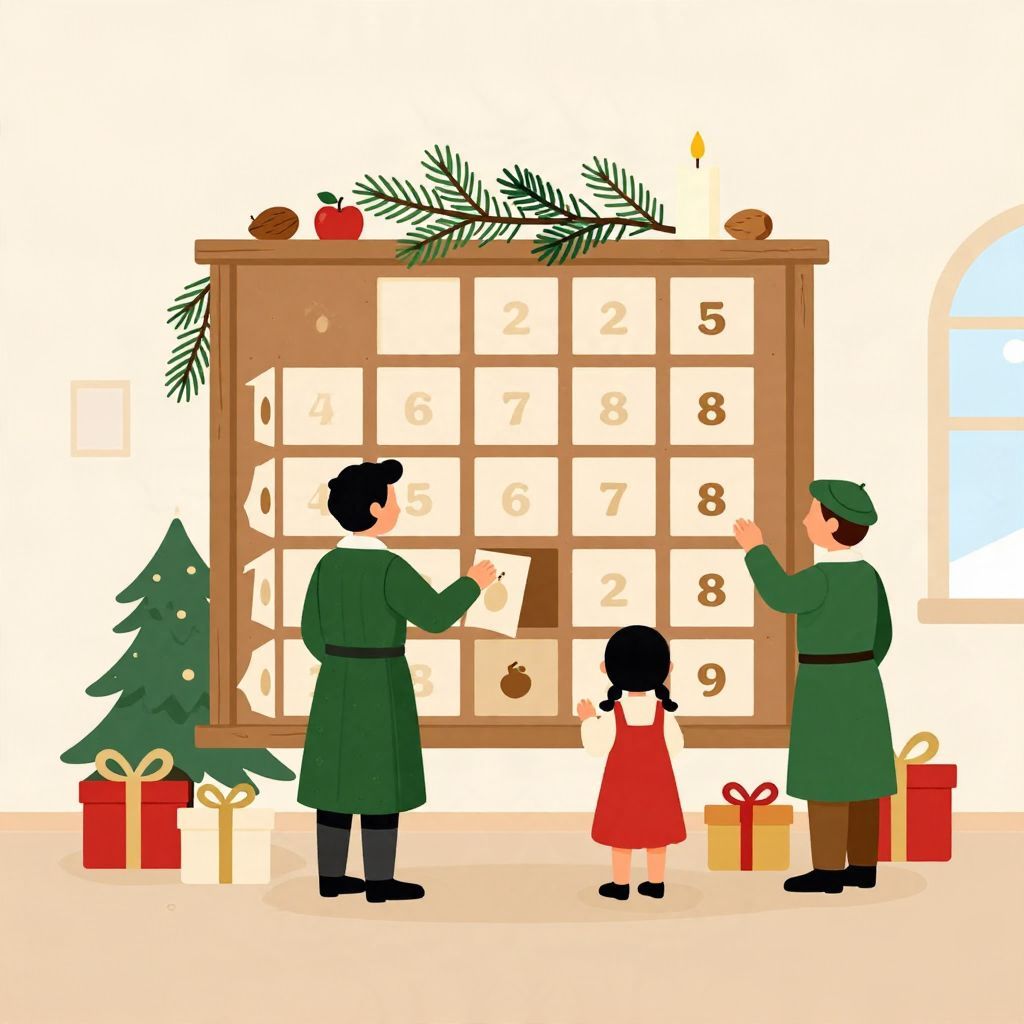
What is an Advent calendar? At its simplest, it is a calendar used to count down the days of Advent, the Christian season leading to Christmas. Today it is often associated with small doors, pictures, chocolates, or gifts, but its roots lie in devotional practices meant to mark time, encourage anticipation, and prepare for the celebration of Christ’s birth.
The Advent calendar is both a religious object and a cultural tradition. Its history stretches from 19th-century German-speaking Protestant households to a global seasonal custom shaped by printing, consumer culture, and modern holiday marketing.
What Is an Advent Calendar?
An Advent calendar is a calendar that counts the days from the start of Advent until Christmas Eve or Christmas Day, depending on the tradition. It usually contains numbered doors, windows, or compartments opened one by one. Historically, it began as a devotional aid; in modern form, it is also a popular festive product.
The Christian Meaning of Advent
Advent is the liturgical season that prepares Christians for Christmas and, in many traditions, also reflects on the expected return of Christ. The word comes from the Latin adventus, meaning “coming” or “arrival.” In Western Christianity, Advent generally begins on the fourth Sunday before Christmas, though exact observance varies by denomination and calendar tradition.
Long before commercial calendars appeared, Christians used Advent as a period of reflection, prayer, fasting in some traditions, and anticipation. The calendar form developed later as a practical way to make that waiting visible, especially for children.
Where Did the Advent Calendar Come From?
The modern Advent calendar emerged in German-speaking Protestant communities in the 19th century. There is no single inventor universally accepted by historians, but the tradition grew out of earlier ways of marking the days before Christmas, such as chalk markings on doors, lighting candles, hanging devotional images, or giving children a daily religious picture or verse.
By the mid-1800s, some families in Germany were already creating informal countdowns to Christmas. These home-based customs helped shape the Advent calendar as a structured, numbered object. The practice spread gradually, first through religious households and then through print culture.
Early forms before the printed calendar
- Children might receive one devotional image each day in December.
- Families sometimes drew lines, lit candles, or marked days on walls or doors.
- Some households used nativity scenes with one added figure per day.
These customs were not yet the familiar cardboard calendar, but they reveal the same basic idea: making the wait for Christmas tangible and daily.
When Did the Modern Advent Calendar Appear?
The first printed Advent calendars appeared in the early 20th century, especially in Germany. One of the best-known early commercial forms is associated with Gerhard Lang, a German publisher who helped popularize printed calendars before and after World War I. Exact claims about “the first” Advent calendar can be difficult to prove, because several similar products appeared around the same time.
What is clear is that by the 1920s and 1930s, printed Advent calendars had become established in German markets. Early versions often featured religious images, Bible verses, or small illustrations behind each numbered door. The format was designed to be both devotional and entertaining.
From home craft to printed product
The transition from handmade countdowns to printed calendars was part of a wider change in modern life. Mass printing made seasonal goods cheaper and easier to distribute. Publishers could now sell a reusable idea to a broad audience, turning a private family practice into a shared commercial tradition.
How Did Advent Calendars Change Over Time?
Advent calendars changed significantly in the 20th century. Early calendars often emphasized Christian imagery and scripture. Over time, especially after World War II, many calendars became more secular and festive, featuring winter scenes, toys, sweets, or popular characters instead of explicitly religious themes.
This shift reflected broader social changes: the growing commercialization of Christmas, the expansion of consumer goods, and the increasing appeal of holiday traditions to nonreligious households. In many countries, the Advent calendar became less a strictly devotional object and more a seasonal family ritual.
Key stages in the evolution of Advent calendars
- 19th century: informal household countdowns in German-speaking regions.
- Early 20th century: printed calendars appear and spread.
- Mid-20th century: calendars become widely commercialized and exported.
- Late 20th century to present: chocolate, toy, beauty, and luxury versions multiply.
Why Did Advent Calendars Become So Popular?
Advent calendars became popular because they combine anticipation, ritual, and reward. For children, the daily opening of a door creates excitement and structure during the long wait for Christmas. For adults, the calendar can evoke nostalgia, family tradition, or religious reflection. The format is simple, memorable, and easy to adapt.
Marketing also played a major role. Companies recognized that the calendar could sell not just a product, but an experience. By placing a small treat or image behind each window, manufacturers turned the calendar into a daily habit, which made it especially effective as a seasonal item.
Why the format works
- It creates a daily ritual leading up to Christmas.
- It offers suspense and a small reward.
- It can be adapted for religion, family fun, or consumer products.
- It is easy to personalize with images, verses, or gifts.
Religious and Secular Uses Today
Today, Advent calendars exist in many forms. Some are still explicitly Christian, containing Bible passages, prayers, or nativity images. Others are fully secular, focusing on chocolate, toys, tea, cosmetics, or collectibles. In some households, the calendar remains part of Advent devotion; in others, it is simply a holiday countdown.
This diversity shows how traditions change over time without disappearing. The Advent calendar has retained its basic structure while adapting to different audiences and markets. That flexibility explains its long survival.
Advent Calendars in Different Countries
Although the tradition began in German-speaking Europe, Advent calendars spread widely across Europe and then to North America and beyond. In some countries they are closely tied to Christian practice; in others they are mainly a Christmas custom. Local styles vary, but the underlying idea remains the same: counting down the days of December with a daily reveal.
In many places, the calendar is now a familiar part of holiday culture even among people who do not observe Advent religiously. That broad appeal has helped it become one of the most recognizable Christmas traditions in the modern world.
What Makes the Advent Calendar Historically Important?
The Advent calendar is historically important because it shows how religious practice, family life, and consumer culture can overlap. It began as a devotional aid rooted in Christian timekeeping, then became a mass-produced seasonal object. Its history reflects larger changes in printing, childhood culture, and the commercialization of Christmas.
It also illustrates how traditions are not fixed. The Advent calendar has been reshaped repeatedly, yet its core function remains recognizable: to mark the passage of time with expectation. That simple idea has allowed it to endure for more than a century.
Conclusion
An Advent calendar is a countdown to Christmas that began as a Christian devotional practice and evolved into a widely loved holiday tradition. Its origins lie in 19th-century German-speaking households, its printed form emerged in the early 20th century, and its modern popularity reflects both religious meaning and commercial creativity. For readers interested in holiday customs and their historical development, related topics include the history of Christmas traditions and the origins of the nativity scene.