
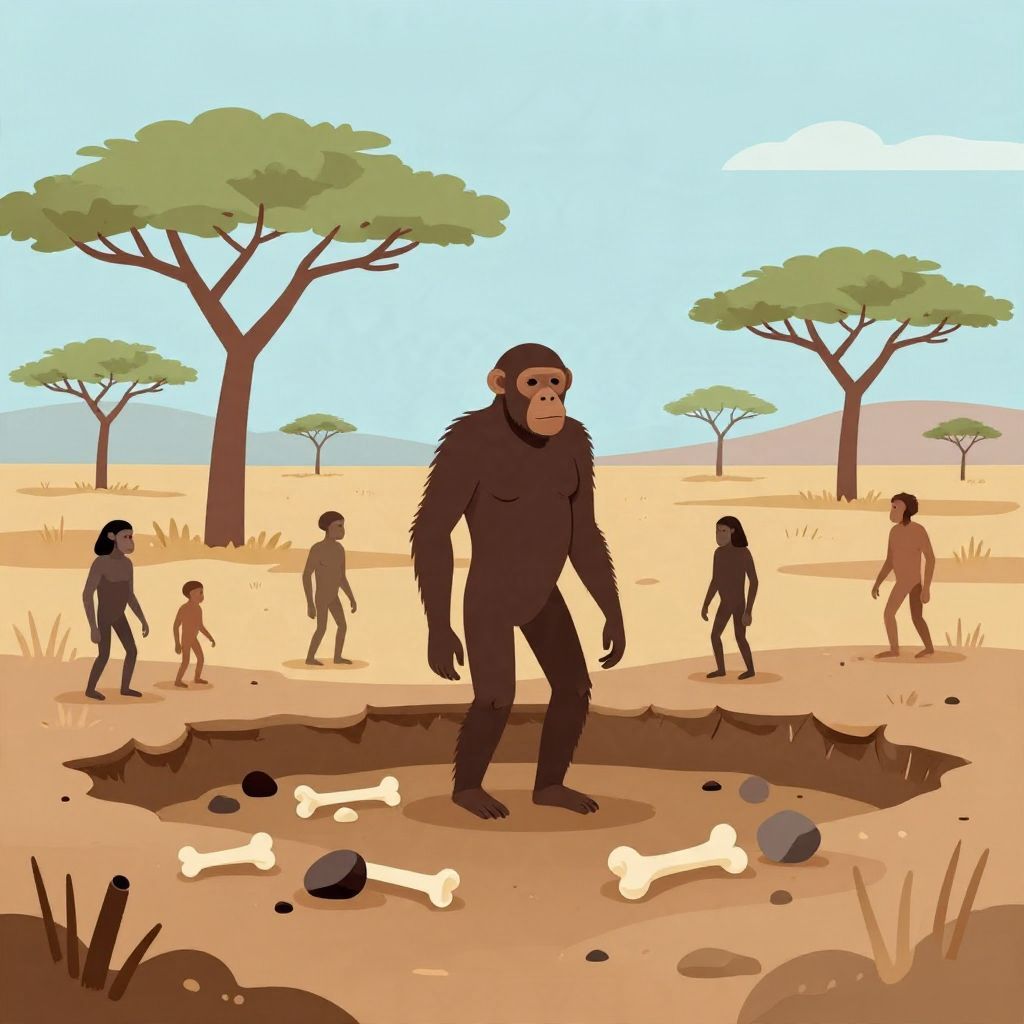
When people ask “How did Lucy die?” they are usually referring to the famous fossil hominin nicknamed Lucy, one of the most important discoveries in human evolution. The short answer is that Lucy almost certainly died after a serious fall or other traumatic event about 3.18 million years ago, though the exact cause cannot be proven with absolute certainty.
Her skeleton, discovered in Ethiopia in 1974, preserves enough evidence to show that her death was sudden and violent rather than the result of old age or disease. Scientists have debated the details, but Lucy’s remains continue to shape how we understand early human ancestors and the risks they faced in their environment.
How did Lucy die?
Lucy likely died from traumatic injuries, probably caused by a fall from a height such as a tree, though this remains an interpretation rather than a proven fact. Her bones show damage consistent with a fatal accident. Because the skeleton is incomplete and fossil evidence is limited, researchers cannot say with total certainty exactly what happened.
Who was Lucy, and why is her death important?
Lucy is the nickname given to a fossil skeleton of Australopithecus afarensis, an early human ancestor that lived in East Africa around 3.18 million years ago. She was not a “human” in the modern sense, but she belonged to a species closely related to later members of the human family tree.
Her death matters because it offers a rare glimpse into the lives and hazards of early hominins. Unlike many fossils that are found as isolated bones, Lucy’s skeleton was unusually complete. That completeness allowed scientists to study her anatomy, movement, and final injuries in remarkable detail.
What evidence suggests Lucy died from a fall?
The main reason scientists suspect a fall is the pattern of damage on Lucy’s bones. Several of her limb bones, especially in the upper body, show fractures that appear to have occurred around the time of death. The injuries are consistent with a person or animal hitting the ground after falling from a significant height.
Key clues in the fossil record
- Fractures in bones that appear to be fresh when they broke
- Injury patterns that fit a sudden impact rather than slow decay
- Damage concentrated in ways that could result from landing awkwardly
One widely discussed interpretation is that Lucy may have slept or rested in a tree and then fallen. This idea fits with the possibility that A. afarensis still spent at least some time climbing, even though it also walked upright on the ground. However, this scenario is not the only possibility, and it should not be treated as settled fact.
Could Lucy have died in another way?
Yes. While a fall is the most common explanation, other causes cannot be ruled out. She could have been injured in a conflict, attacked by a predator, or suffered some other traumatic accident. The fossil evidence does not preserve enough detail to identify a single definite cause of death.
What makes the fall hypothesis persuasive is that the injuries seem to match a sudden, high-energy event. Still, fossils rarely tell a complete story. Scientists must work from partial remains, geological context, and comparison with modern and ancient bone injuries. That means the conclusion is best stated as a strong probability, not a certainty.
What happened after Lucy died?
After Lucy died, her body was likely exposed for a time before being buried by sediment. Over millions of years, mineral-rich water gradually replaced the organic material in her bones, turning them into fossils. This slow process preserved enough of her skeleton for later discovery, but not enough to reveal every detail of her final moments.
The environment of ancient Ethiopia also mattered. Rivers, floodplains, and shifting sediments could quickly cover remains, protecting them from scavengers and decay. That burial helped create the fossil record that modern scientists study today.
How was Lucy discovered?
Lucy was discovered in 1974 at Hadar in Ethiopia by a team led by paleoanthropologist Donald Johanson. Her skeleton was found in fragments, but it was still exceptionally valuable because it included many bones from the same individual. The discovery became a landmark in paleoanthropology.
The nickname “Lucy” came from the Beatles song “Lucy in the Sky with Diamonds,” which the team played after the discovery. The name stuck, even though the fossil itself belongs to a much older and scientifically significant past.
Why Lucy’s death still matters to historians and scientists
Lucy’s death is important not because it is a dramatic historical event in the usual sense, but because it helps reconstruct the everyday realities of early human ancestors. Her injuries suggest that life in the distant past was physically dangerous, and that upright walking did not mean a completely ground-based existence.
Her fossil also helped challenge older ideas about human evolution. Before discoveries like Lucy, some scholars imagined a simple, linear path from ape to human. Lucy showed that early hominins had a mix of traits: they walked upright, but they also retained features useful for climbing.
What Lucy taught researchers
- Early hominins were more diverse than once believed
- Bipedal walking evolved before modern human brains and bodies
- Tree climbing may have remained important in some early species
- Fossil injuries can reveal behavior as well as anatomy
How certain are scientists about Lucy’s cause of death?
Scientists are fairly confident that Lucy died from trauma, but less certain about the exact mechanism. In historical and scientific research, there is a difference between evidence that strongly supports a conclusion and evidence that proves it beyond doubt. Lucy falls into the first category.
That caution is important. Fossil interpretation depends on incomplete remains, and different experts can weigh the same evidence differently. The fall theory remains popular because it fits the injuries well, but responsible scholarship leaves room for alternative explanations.
Lucy’s legacy in the study of human origins
Lucy’s death is only one part of her significance. Her discovery transformed public understanding of human evolution and made Australopithecus afarensis one of the best-known early hominin species. She became a symbol of the deep past and of the scientific process itself: patient, careful, and always open to revision.
In that sense, Lucy did not simply “die” millions of years ago and disappear. Her remains continue to inform debates about locomotion, adaptation, and the environment in which early human ancestors lived. Her fossil is a reminder that even a single individual can reshape history when the evidence survives.
So, how did Lucy die? The best historical and scientific answer is that she probably suffered fatal traumatic injuries, most likely from a fall, but the exact cause cannot be known with complete certainty. If you want to explore similar questions about the end of a life and the evidence behind it, you may also be interested in how Marcus Aurelius died and how John Wayne Gacy died.