
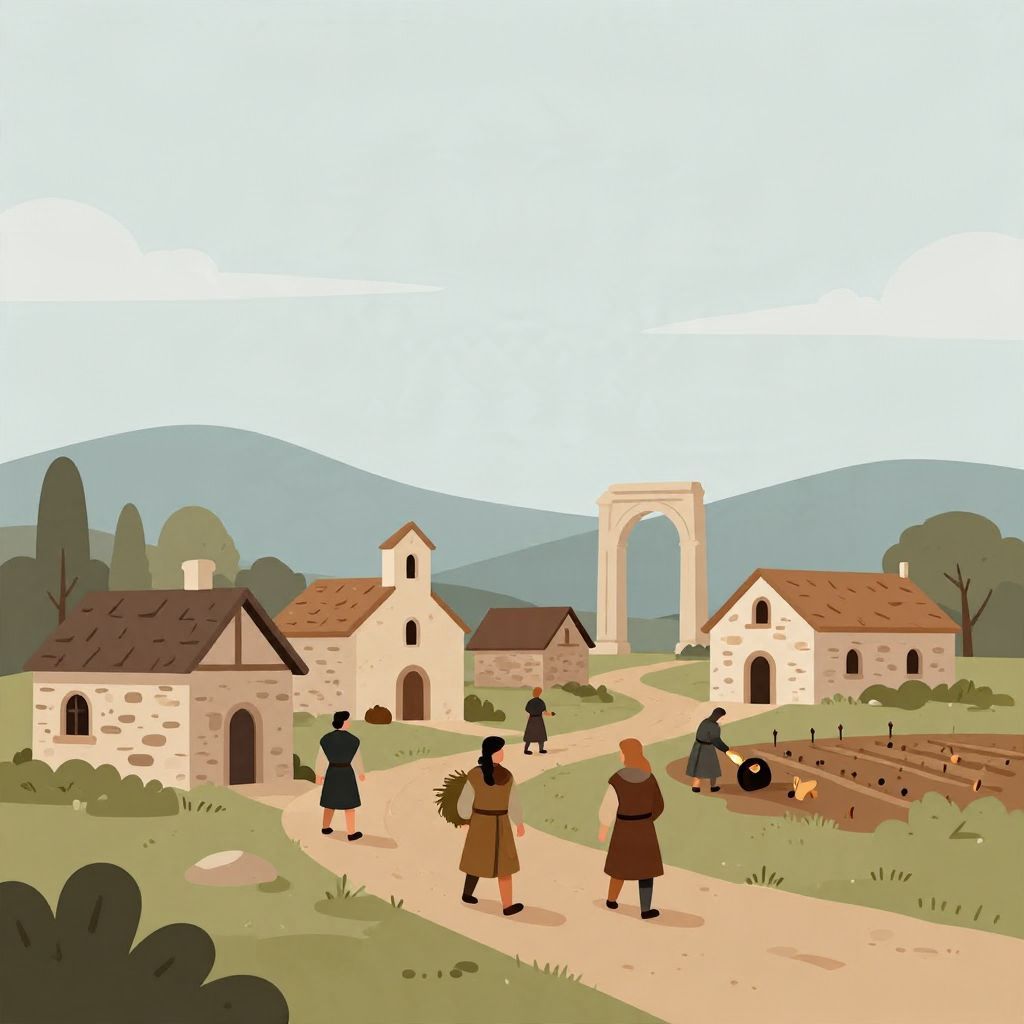
The phrase “the Dark Ages” usually refers to the early Middle Ages in Europe, especially the period after the fall of the Western Roman Empire in 476 CE. In broad terms, it is often placed between the 5th and 10th centuries, though historians now use the term cautiously because it can oversimplify a complex era.
So, when was the Dark Ages? The short answer is that it was not a single, universally agreed-upon date range. It is a later label for parts of early medieval Europe, and many historians prefer more precise terms such as the Early Middle Ages or specific regional periods rather than “Dark Ages.”
When Was the Dark Ages?
The “Dark Ages” is most commonly associated with Europe from about 500 to 1000 CE, especially the centuries after the collapse of Roman authority in the West. Some people extend it from 476 CE to around 1000 CE, while others use it more narrowly for the earlier post-Roman centuries. The exact dates depend on region, because Europe did not change all at once.
Why historians avoid a single fixed date
There was no moment when Europe suddenly entered darkness. Roman institutions declined unevenly, local kingdoms rose at different times, and literacy, trade, and political stability varied widely from place to place. In Italy, Gaul, Britain, Spain, and the Germanic kingdoms, the pace of change was different. That is why “Dark Ages” is more a traditional label than a precise historical period.
What the term “Dark Ages” means
The phrase originally came from later writers who saw the centuries after Rome as a time of cultural decline compared with the classical world. “Dark” did not mean literally unrecorded; it meant, in their view, less literate, less urban, and less politically stable than Roman antiquity. Modern historians usually reject that value judgment because the period also saw adaptation, innovation, and the formation of new societies.
Why the term is controversial
Today, historians often avoid “Dark Ages” because it can suggest that nothing important happened. In reality, the era saw the spread of Christianity, the emergence of new kingdoms, the preservation and transformation of learning, and major developments in agriculture, law, and art. The term can still appear in popular writing, but it is less common in academic history.
Timeline of the Dark Ages in Europe
If the term is used in its broadest sense, the timeline usually begins with the end of Roman imperial rule in the West and ends around the start of the High Middle Ages. A simplified chronology helps show how the period developed.
- 476 CE – The last Western Roman emperor, Romulus Augustulus, is deposed.
- 5th to 6th centuries – Germanic kingdoms form across former Roman lands; Roman institutions weaken in the West.
- 6th to 7th centuries – The Byzantine Empire remains strong in the East; Christianity expands and reshapes European culture.
- 8th to 9th centuries – The Carolingian Empire rises under Charlemagne; learning and administration revive in some areas.
- 9th to 10th centuries – Viking, Magyar, and Muslim raids affect parts of Europe; local powers strengthen.
- c. 1000 CE – Many historians mark the transition into the High Middle Ages, with population growth, stronger states, and expanding trade.
What happened after Rome fell?
The fall of the Western Roman Empire did not erase Roman culture overnight. Instead, Roman roads, laws, churches, and administrative habits continued in altered form. New rulers often borrowed Roman titles and customs while building their own power. The result was not a total collapse but a long transformation from Roman imperial rule to medieval kingdoms.
Political change
As central Roman authority faded, local rulers gained power. The Franks, Visigoths, Lombards, Anglo-Saxons, and others established kingdoms in former Roman territories. These states were often less bureaucratic than Rome, but they were not chaotic in every respect. Many developed legal codes, royal courts, and church alliances that helped stabilize rule.
Economic and social change
Trade became more regional in many places, and some cities shrank compared with their Roman peak. Rural life became more important, especially where security and long-distance commerce weakened. At the same time, monasteries, estates, and local markets played a growing role in everyday life. This was a reorganization of society, not simply a disappearance of civilization.
Was the Dark Ages really “dark”?
In many ways, no. The label exaggerates decline and ignores continuity. Some areas did experience reduced urban life, fewer surviving written records, and political fragmentation. But other developments were significant and creative: Christian scholarship, manuscript copying, new artistic styles, and the blending of Roman, Germanic, and local traditions into medieval European culture.
Examples of progress during the period
Monasteries preserved and copied texts, helping transmit classical learning. Carolingian reforms encouraged education and standardized writing practices. Agricultural improvements gradually increased food production in some regions. Architecture, metalwork, and illuminated manuscripts also flourished in distinctive ways, showing that the era was not intellectually barren.
Regional differences: Europe was not the same everywhere
The “Dark Ages” label fits some regions better than others, and even there only imperfectly. The Eastern Roman, or Byzantine, Empire remained a major center of state power and learning. In the Islamic world, meanwhile, scholarship, science, medicine, and philosophy advanced rapidly. Europe was part of a wider Afro-Eurasian world that was changing in many directions at once.
Britain and western Europe
In Britain, Roman administration ended in the early 5th century, and political fragmentation followed. In Gaul and Italy, Roman traditions survived longer through church structures and local elites. The experience of “darkness,” if one uses the term at all, was therefore uneven and should never be treated as a single European condition.
The Byzantine and Islamic worlds
It is important to remember that the so-called Dark Ages were not dark everywhere. Constantinople remained a major imperial capital, and cities in the Islamic caliphates became centers of learning, trade, and scientific exchange. This broader context reminds us that Europe’s early medieval changes were part of a larger interconnected world.
Key historical facts about the Dark Ages
Several facts help clarify the period and correct common myths. The era was long, uneven, and full of change. It was not a total collapse of culture, and it did not begin or end on one exact date across all of Europe.
- 476 CE is the traditional date for the fall of the Western Roman Empire, but Roman influence continued afterward.
- The term “Dark Ages” is older than modern historical scholarship and is now considered misleading by many historians.
- Most historians prefer “Early Middle Ages” for roughly the 5th to 10th centuries in western Europe.
- The period saw both decline in some urban and administrative systems and growth in new political and religious institutions.
- Different regions of Europe experienced the transition in different ways and at different times.
Why the Dark Ages still matter
Understanding when the Dark Ages was helps explain how medieval Europe formed. The era produced the foundations of later kingdoms, churches, legal traditions, and cultural identities. It also shows how history can be distorted by labels: what later generations called “dark” was actually a time of adaptation, survival, and new beginnings.
In the end, the Dark Ages is best understood as a traditional name for parts of the early Middle Ages, roughly from the 5th to the 10th centuries in western Europe, beginning after 476 CE and ending gradually around 1000 CE. For a broader view of Europe’s medieval transformation, you may also find what Prussia was and Ottonian architecture useful next steps.