
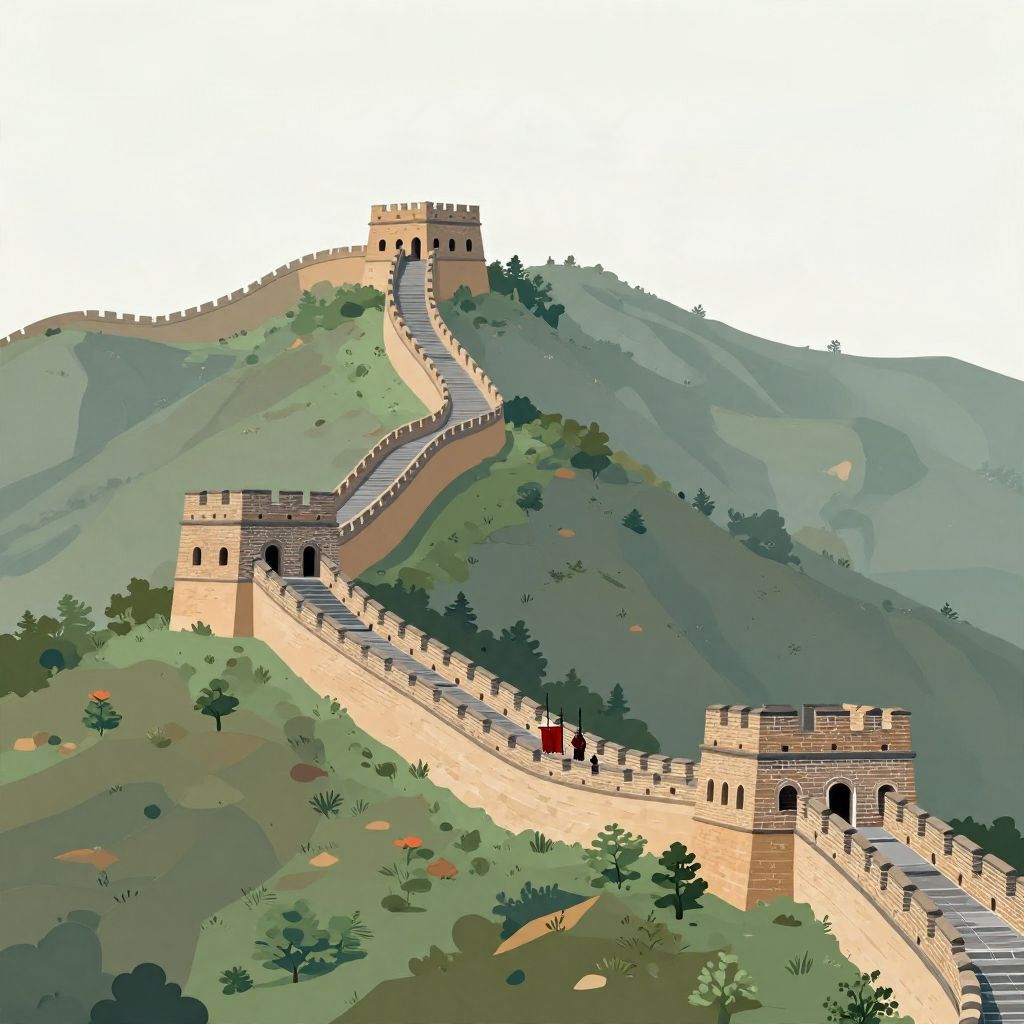
How tall is the Great Wall of China? There is no single answer, because the Wall is not one continuous structure built at one time. Its height varies by section, but many surviving parts are roughly 6 to 8 meters tall, or about 20 to 26 feet, with some towers and fortifications rising higher.
That simple answer hides a much longer history. The Great Wall was built, rebuilt, and extended over many centuries by different Chinese states and dynasties, especially the Qin, Han, and Ming. Its height depended on local terrain, materials, military needs, and the era in which a section was constructed.
How tall is the Great Wall of China?
The Great Wall of China is generally about 6 to 8 meters tall in many preserved Ming-era sections, though some parts are lower, damaged, or buried, and watchtowers can be much taller. Because the Wall stretches across varied landscapes and was built in different periods, its height is not uniform.
Why there is no single height
People often imagine the Great Wall as one continuous monument with the same dimensions throughout, but historically it was a chain of walls, trenches, beacon towers, passes, and fortifications. Some stretches were built from rammed earth, others from brick or stone. Erosion, collapse, and restoration also changed the Wall’s present-day appearance.
In practical terms, the Wall’s defensive value came not just from height, but from its placement on ridges, its length, its towers, and the ability of garrisons to signal and move troops quickly. A wall that was moderately high in a mountain pass could be more effective than a taller wall on flat ground.
Origins of the Great Wall: when and why it began
The Great Wall did not begin as a single imperial project. Its earliest roots go back to the Warring States period (roughly the 5th to 3rd centuries BCE), when rival Chinese states built frontier walls against one another. These early defenses were later linked and expanded under imperial rule.
Pre-imperial frontier walls
Before China was unified, states such as Qin, Zhao, and Yan built defensive walls to protect farmland and settlements from raids and rival armies. These walls were regional military works, not yet the famous “Great Wall” in the later sense. Their exact lengths and heights varied widely, and many have not survived intact.
The Qin dynasty and early unification
After Qin Shi Huang unified China in 221 BCE, he ordered connections and extensions of existing walls in the north. Later tradition often credits him with “building the Great Wall,” but historians usually treat this as a simplification. He helped create an imperial frontier defense system, not the single wall seen today.
How the wall changed across dynasties
The Great Wall’s appearance evolved dramatically over time. Different dynasties strengthened northern defenses in response to changing threats, especially steppe powers to the north. The best-known surviving sections are mostly from the Ming dynasty, which rebuilt the wall on a grand scale.
Han dynasty expansion
During the Han dynasty (206 BCE–220 CE), the wall system was extended far into the northwest to protect trade routes and military outposts. Han frontier defenses helped secure the Silk Road corridor, showing that the Wall was not only a barrier, but also part of a wider imperial strategy of control and communication.
Ming dynasty rebuilding
The most visible Great Wall today is largely a product of the Ming dynasty (1368–1644). After setbacks against northern forces, the Ming invested heavily in brick and stone fortifications, especially in the 15th and 16th centuries. These sections were often taller, stronger, and more standardized than earlier earthworks.
Ming engineers built walls with parapets, crenellations, guard paths, and watchtowers. In many places, the wall was designed to support soldiers, weapons, and signaling systems rather than simply to stand as a barrier. This is why surviving Ming sections often look more imposing than earlier remains.
What determined the Great Wall’s height?
The height of the Great Wall depended on military strategy, available materials, and geography. Builders adjusted the wall to suit mountains, valleys, deserts, and plains. In some places, the natural landscape did much of the defensive work; in others, the wall had to be taller and more substantial.
Terrain and local conditions
On steep ridges, a lower wall could still be formidable because attackers had to climb difficult slopes. In flatter areas, builders sometimes made the wall higher and thicker. Sections near important passes or vulnerable routes were often reinforced more heavily than remote stretches.
Materials and construction techniques
Early walls were often made of rammed earth, brushwood, and local soil. These materials could create substantial but weather-sensitive defenses. Later Ming walls used brick facing and stone foundations in many places, which made them more durable and often visually taller. The choice of material strongly affected how much of the wall survived.
Military purpose
The Wall was meant to delay invaders, channel movement toward guarded passes, and give defenders time to respond. Height mattered, but so did thickness, patrol routes, and watchtower spacing. A wall that was too high without a practical defensive system would have been less useful than a carefully integrated frontier network.
How the Great Wall looked in history
Historically, the Great Wall was not the smooth, continuous tourist image many people know today. It was a working military frontier with gaps, towers, gates, and outposts. Some sections were formidable; others were modest earthworks or even little more than embankments.
Watchtowers and passes
Watchtowers were essential to the Wall’s operation. They served as observation points, storage spaces, and signaling stations. Smoke by day and fire by night could relay warnings across long distances. Major passes, such as those near strategic mountain corridors, were fortified more heavily than ordinary stretches of wall.
Restoration and modern appearance
Much of what visitors see today has been repaired, reconstructed, or stabilized in modern times. That means the present height of some sections reflects conservation choices as well as ancient engineering. In places where the wall has eroded or collapsed, its original height can only be estimated from archaeological evidence.
Historical significance of the Great Wall
The Great Wall matters not only as an architectural feat, but as a symbol of how Chinese states managed frontiers, security, and imperial power. It represents centuries of labor, military planning, and adaptation to changing political realities. Its significance is both practical and symbolic.
A frontier system, not just a barrier
Modern readers sometimes think of the Wall as a simple line separating “China” from “outside.” Historically, it was more complicated. The Wall helped regulate movement, defend agricultural zones, support garrisons, and project state authority across borderlands. It was part of a frontier system rather than a sealed boundary.
Symbol of state power and continuity
Because different dynasties rebuilt and reimagined it, the Wall came to symbolize continuity across changing regimes. It also reflected the enormous administrative capacity needed to mobilize labor, transport materials, and maintain remote defenses. In that sense, the Wall is as much a story about government as about warfare.
Human cost
Traditional accounts often emphasize the labor and hardship involved in building the Wall, especially under Qin. While the scale of suffering is difficult to measure precisely, it is clear that frontier construction demanded heavy taxation, labor service, and military organization. The Wall’s grandeur was inseparable from the burden it placed on workers and local communities.
Common myths and historical corrections
Several popular claims about the Great Wall are exaggerated or inaccurate. Separating legend from evidence helps explain what the Wall really was and why it endured in historical memory.
- Myth: The Great Wall is one single wall built all at once.
Reality: It is a network of walls and defenses built over many centuries. - Myth: The wall is uniformly the same height everywhere.
Reality: Its height varies greatly by period, region, and state of preservation. - Myth: Qin Shi Huang personally built the entire wall.
Reality: He expanded and linked earlier defenses, but later dynasties, especially the Ming, rebuilt major portions. - Myth: The wall was an impenetrable barrier.
Reality: It was a defensive system that could be bypassed, breached, negotiated, or outmaneuvered.
The Great Wall today
Today, the Great Wall is one of the most famous historical landmarks in the world and a UNESCO World Heritage Site. Its surviving sections preserve evidence of military engineering, imperial ambition, and regional adaptation. For historians, its changing height is a reminder that monuments are often layered across time rather than fixed in one original form.
So, how tall is the Great Wall of China? In the sections most people see today, it is often around 6 to 8 meters high, though the true answer depends on which dynasty, which location, and which surviving section you mean. To understand the Wall fully, it helps to see it not as one wall, but as a long historical process. For related reading, you may also enjoy history articles on broader world history and a look at the Dust Bowl.