
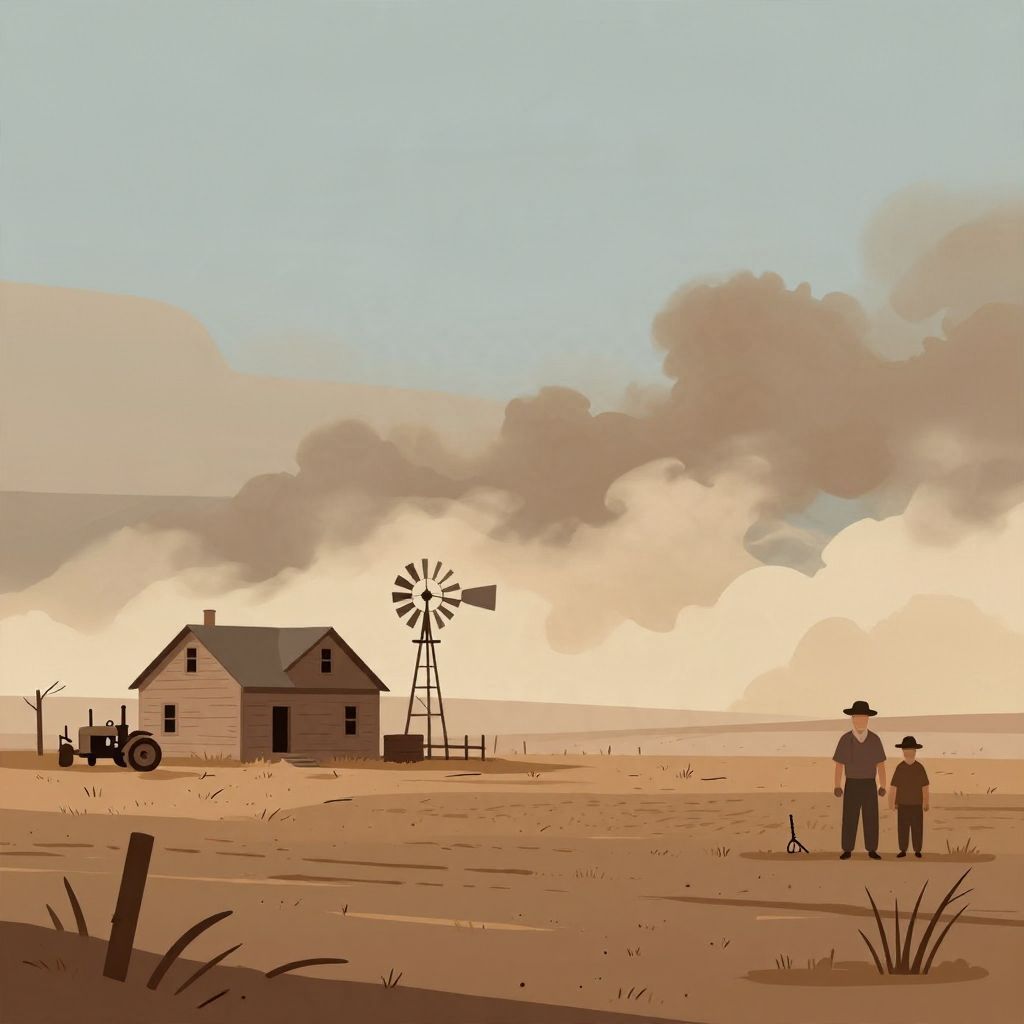
The Dust Bowl was one of the worst environmental disasters in United States history. In the 1930s, severe drought, extreme heat, and destructive farming practices turned much of the Great Plains into a region of blowing dust, crop failure, and mass hardship.
It was not a single storm or one isolated event, but a prolonged crisis that reshaped agriculture, migration, and government policy. The Dust Bowl became a symbol of how environmental change and human choices can combine to produce disaster.
What Is the Dust Bowl?
The Dust Bowl was a period of intense drought and wind erosion in the Great Plains during the 1930s, especially from about 1930 to 1936. It affected parts of Texas, Oklahoma, Kansas, Colorado, and New Mexico, where dry conditions and plowed-up grasslands allowed topsoil to blow away in huge dust storms.
Where and when did the Dust Bowl happen?
The Dust Bowl unfolded mainly on the southern and central Great Plains of the United States. Its worst years were the early to mid-1930s, though some areas suffered before and after that peak. The disaster overlapped with the Great Depression, which made recovery even harder for farming families already facing poverty and debt.
The hardest-hit region
The most famous area was the “Dust Bowl” itself, centered on the Texas Panhandle, western Oklahoma, southeastern Colorado, southwestern Kansas, and northeastern New Mexico. Not every part of the Great Plains was affected equally, but these areas experienced the most dramatic dust storms and the most severe loss of farmland.
Why the timing mattered
The crisis struck during an economic collapse. Falling crop prices, bank failures, and widespread unemployment meant that many farmers had little financial cushion. When drought arrived, they could not easily wait it out or absorb repeated harvest failures.
What caused the Dust Bowl?
The Dust Bowl was caused by a combination of natural drought and human land-use practices. The Great Plains are naturally vulnerable to dry spells and strong winds, but decades of deep plowing removed native grasses that had held the soil in place. When drought hit, exposed topsoil dried out and was carried away by the wind.
Natural drought and climate conditions
The 1930s brought prolonged dry weather to large parts of the Plains. Rainfall dropped sharply in many places, temperatures rose, and the land lost moisture. Without enough water, crops failed and fields became loose dust that could be lifted into the air.
Farming practices that worsened erosion
Before the disaster, farmers had expanded cultivation across grassland areas that had been covered for centuries by hardy prairie grasses. These grasses had deep roots and helped anchor the soil. Once they were removed for wheat and other crops, the land became far more vulnerable to erosion during dry years.
Some of the most damaging practices included:
- plowing large areas of native grassland
- growing a single crop repeatedly without restoring soil nutrients
- leaving fields bare after harvest
- farming marginal land that was poorly suited to intensive cultivation
Economic pressure encouraged risky farming
Farmers had strong reasons to maximize production. During and after World War I, wheat prices had risen, encouraging expansion. Many farmers borrowed money to buy land and equipment, then kept planting even when conditions became less favorable. When the market weakened and drought came, those debts became crushing.
What happened during the Dust Bowl?
As drought deepened, the Plains were hit by massive dust storms that darkened the sky and buried homes, barns, roads, and machinery. Some storms were local, while others carried dust hundreds of miles. Families had to seal windows, wear cloth over their faces, and constantly clean dust from food, furniture, and lungs.
“Black blizzards”
Contemporary observers often called the worst storms “black blizzards.” These were not snowstorms, but walls of dust driven by powerful winds. They could arrive suddenly, reduce visibility to near zero, and make travel dangerous or impossible.
Daily life under dust
Dust entered houses through cracks in walls and windows. It ruined food, irritated eyes and throats, and made breathing difficult. Livestock suffered too, as pastures dried up and feed became scarce. Many farms became impossible to sustain, and some families abandoned them entirely.
Health and hardship
The Dust Bowl created serious physical and emotional strain. Dust pneumonia and other respiratory problems became common concerns, especially for children and older adults. Beyond illness, the constant failure of crops and the loss of income caused stress, shame, and family breakdown in some households.
How did the Dust Bowl affect migration?
One of the Dust Bowl’s most important consequences was migration. Tens of thousands of people left the hardest-hit areas, especially from Oklahoma, Texas, and nearby states, seeking work in California and other places. Not all migrants were from the Dust Bowl region, but the term became closely associated with these displaced farm families.
Who were the “Okies”?
The label “Okies” was commonly used, often insultingly, for migrants from Oklahoma and nearby states. In practice, the migrants came from several states and had different backgrounds. Some were tenant farmers, some were small landowners, and some had already lost their land to debt or foreclosure before leaving.
Life on the road and in new places
The journey west was often difficult. Families traveled in overloaded cars or trucks, carrying what they could. Once in California, many found low-paying seasonal work in agriculture and faced discrimination, overcrowded camps, and unstable living conditions. Migration did not solve poverty for everyone, but it did become a central part of Dust Bowl history.
How did the government respond?
The Dust Bowl helped push the federal government toward new forms of environmental and agricultural intervention. Under President Franklin D. Roosevelt’s New Deal, the government created programs to reduce erosion, support farmers, and improve land management. These efforts did not end the drought, but they did help change farming practices.
Soil conservation
One major response was the creation of the Soil Conservation Service in 1935. Its work encouraged contour plowing, crop rotation, terracing, shelterbelts, and other methods designed to keep soil in place and retain moisture.
Shelterbelts and land reform
The government also promoted shelterbelts—rows of trees planted to reduce wind erosion. In some areas, land was taken out of cultivation or managed more carefully. These measures reflected a new understanding that soil was not an unlimited resource and that farming had to be adapted to local ecology.
Why is the Dust Bowl historically important?
The Dust Bowl mattered far beyond the Great Plains. It changed how Americans thought about the relationship between people and the land. It also influenced federal policy, migration patterns, literature, photography, and public memory. The disaster became a lasting warning about the consequences of environmental misuse under economic pressure.
A lesson in environmental history
Historians often see the Dust Bowl as a classic example of environmental history: natural forces and human decisions interacting to produce a crisis. Drought alone did not create the disaster, and farming practices alone did not cause the drought. The catastrophe emerged from the combination of both.
Impact on policy and farming
After the Dust Bowl, conservation became a more central part of American agriculture. Farmers and policymakers increasingly recognized the importance of preserving topsoil, diversifying crops, and matching land use to climate conditions. Many of those lessons remain relevant in discussions of soil erosion and sustainable farming today.
How did the Dust Bowl enter American culture?
The Dust Bowl became a powerful cultural symbol through journalism, photography, music, and literature. Images of dust-covered homes, migrant families, and exhausted farmers helped shape national understanding of the crisis. Writers and artists used the Dust Bowl to explore poverty, displacement, resilience, and the failures of economic and environmental systems.
Memory and representation
Some later accounts romanticized the endurance of Dust Bowl families, while others focused on suffering and injustice. Both themes are part of the historical record, but it is important not to reduce the event to a single story. The Dust Bowl was experienced differently by landowners, tenants, laborers, migrants, women, children, and Indigenous communities in the region.
What is the Dust Bowl in simple terms?
In simple terms, the Dust Bowl was a massive environmental and human crisis in the 1930s when drought and poor land management turned parts of the American Great Plains into a dust-blown region. It destroyed farms, forced migration, and led to major changes in soil conservation and agricultural policy.
The Dust Bowl remains one of the clearest examples in U.S. history of how climate, economy, and human land use can combine to create disaster. Its legacy is still visible in conservation practices, migration history, and the continuing debate over how people should use fragile land.