
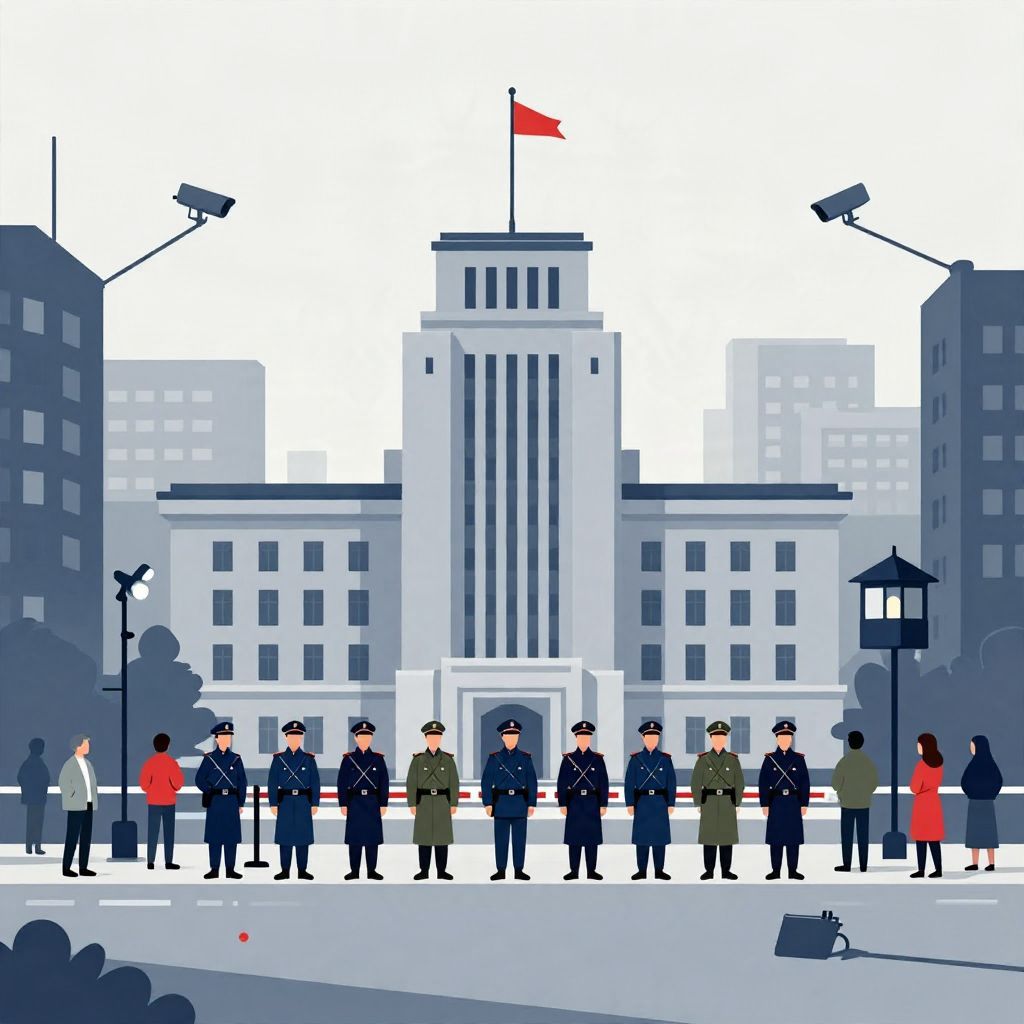
What is a police state? The term usually describes a government that relies on surveillance, coercion, and police power to control society, often limiting civil liberties, political opposition, and personal privacy. It is not a formal legal category with one fixed definition, but a historical and political concept used to describe systems of rule that depend heavily on intimidation and enforcement.
The idea became especially important in the modern era, when states developed larger bureaucracies, secret police forces, and new technologies of monitoring. Yet the roots of the concept go back much further, to older debates about tyranny, order, and the power of rulers over subjects.
What Is a Police State?
A police state is a government in which the authorities use policing, surveillance, and coercion to maintain control, often at the expense of political freedom and legal protections. The phrase usually implies that the police or security apparatus has become central to governing, not just to fighting crime.
Core features historians look for
- Widespread surveillance of citizens, opponents, or suspected dissidents
- Restrictions on speech, assembly, and press
- Use of arrest, detention, or intimidation to silence opposition
- Weak checks on executive power and limited judicial independence
- Political policing, meaning law enforcement is used to protect the regime, not only public safety
In practice, historians and political scientists use the term cautiously. Some states are openly authoritarian; others preserve elections or courts while still using extensive surveillance and coercion. The phrase is often applied by critics, so context matters.
Where Did the Idea Come From?
The concept developed gradually, but the modern phrase “police state” emerged in Europe in the eighteenth and nineteenth centuries, when governments expanded their administrative reach. The word “police” once meant something broader than crime control; it referred to public order, administration, and the regulation of society.
From “police” as order to “police” as control
In early modern Europe, rulers increasingly claimed the right to manage trade, religion, morals, movement, and public behavior. In German-speaking lands, thinkers used terms such as Polizeistaat to describe a state that organized society through administrative power. At first, this did not always carry the same negative meaning it has today. Some reformers saw strong state regulation as a way to create stability and prosperity.
Over time, however, the term took on a darker sense as people associated it with surveillance, censorship, and arbitrary power. By the nineteenth and twentieth centuries, “police state” usually meant a regime that governed through fear and constant monitoring.
How Did Police States Develop Historically?
Police states did not appear all at once. They emerged when rulers gained stronger bureaucracies, standing armies, secret informants, and more effective systems for collecting taxes, tracking populations, and suppressing dissent. Modern communications and technology later made such control even more extensive.
Ancient and premodern precedents
Ancient empires such as Assyria, Qin China, and some Roman imperial regimes used harsh surveillance, collective punishment, and informers to secure obedience. These should not be called police states in the modern technical sense, but they show that political control through fear is much older than the phrase itself.
Premodern monarchies also used local officials, spies, and religious authority to enforce loyalty. What changed in the modern period was scale: governments became more centralized, more bureaucratic, and better able to gather information about ordinary people.
The early modern turning point
From the sixteenth to eighteenth centuries, European states expanded their administrative machinery. Absolutist monarchies, military competition, and tax collection encouraged rulers to build more intrusive systems of governance. At the same time, religious conflict and rebellion made many governments suspicious of dissent.
By the nineteenth century, industrialization, urban growth, and mass politics created new pressures. States could now use police forces, identity papers, postal monitoring, and censorship to watch populations more closely than ever before.
Police States in the Modern Age
The modern idea of a police state is most strongly associated with the twentieth century, especially with dictatorships that combined propaganda, secret police, and mass surveillance. These regimes often claimed to defend national security, revolution, or social order while suppressing opposition.
Examples often discussed by historians
- Nazi Germany, where the Gestapo and other agencies enforced terror and political conformity
- Stalinist Soviet Union, where the secret police, purges, and surveillance helped sustain one-party rule
- Fascist Italy, which used police power and political repression, though generally less extensively than Nazi Germany or the Soviet Union
- East Germany, where the Stasi developed one of the most extensive surveillance systems in modern history
These regimes differed in ideology, structure, and scale, but they shared a reliance on coercive institutions to shape behavior and eliminate opposition. Historians often stress that a police state is not defined only by brutality; it is defined by the systematic use of state power to monitor and control society.
How Is a Police State Different from Other Forms of Authoritarian Rule?
Not every dictatorship is equally a police state. Some authoritarian governments rely more on patronage, military rule, or one-party institutions than on constant street-level surveillance. A police state is distinguished by the depth and reach of coercive control.
Key distinctions
- Authoritarian state: a broader term for governments with limited political freedom
- Totalitarian state: a more extreme form that seeks to control many areas of life, including ideology, culture, and private behavior
- Police state: a regime especially dependent on policing, surveillance, and repression
These categories overlap, and scholars do not always use them in exactly the same way. A state may be authoritarian without being a full police state, and a police state may exist within a larger authoritarian or totalitarian system.
Why Do Governments Become Police States?
Historically, governments have expanded coercive power for several reasons: war, revolution, fear of internal enemies, colonial rule, economic crisis, and the desire to preserve elite control. Leaders often justify surveillance and repression as necessary for stability or security.
Common historical causes
- War and emergency — crises often lead rulers to suspend normal liberties
- Revolutionary fear — new regimes may suppress rivals to secure power
- Colonial domination — empires often used policing to control subject populations
- Ideological rule — states that claim to embody a single truth may treat dissent as treason
- Weak institutions — when courts, legislatures, or civil society cannot check power, coercion expands
In many cases, the move toward a police state is gradual. Emergency measures become normal, surveillance expands, and people begin to censor themselves. The result is not just fear of arrest, but a broader culture of caution and silence.
What Are the Historical Consequences?
Police states often leave deep long-term damage. They can weaken trust between citizens, corrupt law enforcement, destroy independent institutions, and distort public life. Even after such regimes fall, societies may struggle with trauma, missing records, destroyed opposition groups, and lingering habits of fear.
Lasting effects
- Reduced trust in government and neighbors
- Damage to free press and academic life
- Normalization of surveillance and self-censorship
- Difficulty rebuilding independent courts and civil society
At the same time, the memory of police states has influenced modern constitutionalism. Many democratic systems strengthened protections for speech, due process, privacy, and limits on executive power precisely because earlier generations had seen what unchecked coercive power could do.
Why the Term Still Matters Today
The phrase “police state” remains powerful because it captures a fear that state power can grow beyond accountability. It is often used in contemporary debates about surveillance technology, emergency powers, border control, and political repression. But historically, the term should be used carefully and with evidence.
Not every increase in policing creates a police state, and not every security policy is repression. Historians ask whether coercive power is restrained by law, whether opposition can organize freely, and whether citizens are protected from arbitrary state action.
Conclusion
A police state is a government that depends heavily on surveillance, coercion, and political policing to control society. The concept developed from older ideas about public order, but it became especially important in the modern age, when bureaucratic states gained the power to monitor and discipline populations on a large scale. If you want more context, see related discussions of political ideology and revolution, both of which help explain why states expand power and why people resist it.