
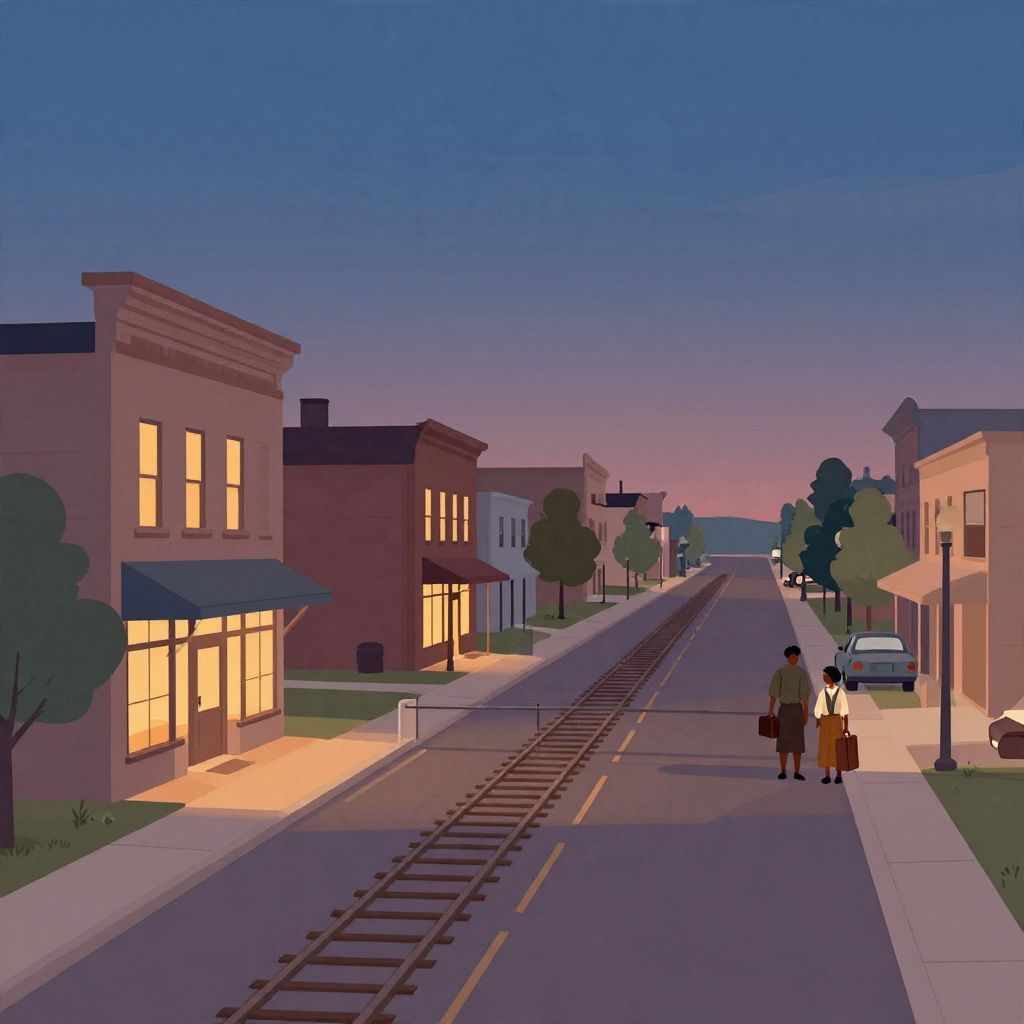
What are sundown towns? They were towns, suburbs, and neighborhoods in the United States that excluded Black people and other minorities, especially after dark, through intimidation, violence, local rules, and unwritten custom. The term reflects a system of racial exclusion that shaped where people could safely live, work, travel, or even stop for the night.
Though the phrase sounds informal, sundown towns were a serious part of American racial history. They were not limited to the Deep South; many were found in the North, Midwest, and West, where segregation often took different forms but produced the same result: enforced racial separation and fear.
What Are Sundown Towns?
Sundown towns were places that deliberately kept out nonwhite residents, visitors, or workers—most often Black Americans—through threats, harassment, police enforcement, discriminatory housing practices, or signs warning people to leave by sunset. The term is used by historians to describe a broad pattern of racial exclusion, especially in the late 19th and 20th centuries.
The basic idea
The name comes from the warning that Black people should be gone by sundown. In some places, that warning appeared on signs; in others, it was conveyed through local custom, rumors, violence, or the behavior of police and white residents. A town did not need a posted sign to function as a sundown town. If people understood that minorities were unwelcome after dark, the town operated as one.
Where Did Sundown Towns Come From?
Sundown towns developed out of the long history of white supremacy in the United States, especially after Reconstruction. As slavery ended and Black freedom expanded, many white communities responded by creating new ways to control where Black Americans could live, travel, and work. These practices were part of a wider effort to preserve racial hierarchy outside the formal institution of slavery.
Reconstruction and the backlash against Black freedom
After the Civil War, Black Americans sought citizenship, land, education, and political participation. That progress triggered violent backlash. In the South, white supremacy was enforced through Black Codes, racial terror, and later Jim Crow segregation. In other regions, exclusion often took a different form: communities that claimed to be “free” or “progressive” still pushed Black people out entirely rather than allowing integrated life.
The role of migration and settlement
As Black families moved during the Great Migration, especially from the 1910s through the 1970s, they encountered towns that refused to sell housing, hire openly, or tolerate overnight stays. Some towns used intimidation to prevent Black settlement; others became sundown towns after a sudden episode of racial violence or after local leaders made exclusion a civic norm.
How Did Sundown Towns Work?
Sundown towns relied on a mix of formal and informal power. Some had explicit ordinances or posted warnings, but many used less visible methods: real estate discrimination, police harassment, threats from white mobs, exclusion from schools or businesses, and the simple knowledge that crossing the town line after dark could be dangerous. The system worked because people understood the risk.
Common methods of exclusion
- Signs and warnings: some towns posted notices telling Black people to leave by sundown.
- Violence or threats: lynching, beatings, arson, and mob intimidation drove people away.
- Police enforcement: local authorities sometimes stopped, questioned, or arrested Black visitors without cause.
- Housing discrimination: restrictive covenants, steering by real estate agents, and refusal to sell homes kept towns racially homogeneous.
- Social pressure: white residents enforced exclusion through gossip, surveillance, and community pressure.
Not just a Southern story
Although racial segregation is often associated with the South, sundown towns were widespread in the North and Midwest as well. Illinois, Indiana, Ohio, Michigan, and parts of the West had many such communities. This matters historically because it shows that racial exclusion was not confined to one region or one legal system; it was a national pattern adapted to local conditions.
When Were Sundown Towns Most Common?
Sundown towns were most common from the late 19th century into the mid-20th century, especially between about 1890 and 1960. Some persisted later, though often in less openly declared forms. Their decline was gradual and uneven, shaped by civil rights activism, court decisions, federal fair housing laws, and changing demographics.
A rough timeline
- Post-Reconstruction era: racial exclusion expands as white communities react against Black freedom.
- Late 19th and early 20th centuries: many towns formalize exclusion through violence, custom, and housing discrimination.
- Great Migration era: Black migrants encounter exclusion in many northern and western communities.
- Civil rights era: legal segregation weakens, but local exclusion often lingers.
- After 1968: fair housing laws and broader civil rights enforcement reduce overt exclusion, though legacies remain.
Why Did Communities Become Sundown Towns?
Communities became sundown towns for several overlapping reasons: racism, fear of social change, competition over jobs and housing, and the desire of white residents to maintain political and economic control. Exclusion was often justified with stereotypes about crime, morality, or “order,” but the underlying motive was racial hierarchy.
Race, property, and power
Many white residents believed that excluding Black people would protect property values, preserve “community character,” or keep labor and politics under white control. These arguments were common in many places, but they masked a deeper truth: racial exclusion was a tool for maintaining privilege. In practice, it denied Black Americans basic rights of mobility and residence.
Fear and rumor
Sundown towns also grew from fear—fear of integration, fear of social equality, and fear of losing dominance. Rumors about crime or disorder often circulated to justify exclusion. Yet these claims were not neutral observations; they were part of a racial ideology that treated Black presence itself as a threat.
How Do Historians Study Sundown Towns?
Historians study sundown towns through census records, local histories, oral testimony, newspaper reports, real estate patterns, and evidence of violence or exclusionary ordinances. Because many towns did not advertise their policies openly, proving sundown status can be difficult. In some cases, historians can document explicit signs or laws; in others, they infer exclusion from consistent patterns of absence and testimony.
Why the evidence can be hard to find
One challenge is that sundown practices were often unofficial. A town might never pass a written law, yet still be known as a place where Black people were unwelcome after dark. That means historians must distinguish between documented policy, remembered custom, and later interpretation. The absence of Black residents in a census does not by itself prove a sundown town, but it may be an important clue.
Avoiding oversimplification
Not every all-white town was necessarily a sundown town, and not every place with racial tension functioned in exactly the same way. Some communities excluded Black people very aggressively; others were less rigid but still discriminatory. The term is most useful when it identifies a sustained pattern of exclusion, not simply a lack of diversity.
What Was the Impact of Sundown Towns?
Sundown towns had lasting effects on housing, wealth, education, and safety. They limited where Black families could live, forced longer commutes, restricted access to jobs and services, and helped create segregated metropolitan regions. Their legacy can still be seen in patterns of racial geography, property ownership, and community memory.
Effects on Black mobility
For Black travelers, sundown towns made ordinary movement dangerous. A road trip, job search, or family visit could require careful planning around where it was safe to stop. This was not a minor inconvenience; it shaped daily life and freedom. The need to avoid certain towns was part of the broader architecture of racial control in the United States.
Effects on communities and wealth
By excluding Black residents, sundown towns helped lock in racial inequality. When Black families were prevented from buying homes in certain places, they were denied opportunities to build intergenerational wealth through property ownership. These patterns contributed to the long-term racial wealth gap and to segregated schools and neighborhoods that persisted even after formal barriers weakened.
Did Sundown Towns Disappear?
Openly declared sundown towns became less common after the civil rights movement, especially following the Fair Housing Act of 1968. But the end of explicit signs did not mean the end of exclusion. Some communities shifted to subtler forms of discrimination, such as zoning, policing, school district boundaries, and biased housing practices. The legacy of sundown towns continues in many places.
From open exclusion to quieter barriers
After civil rights reforms, many towns no longer said the quiet part out loud. Instead of overt warnings, exclusion could operate through unequal lending, selective policing, or social hostility. That shift made the system less visible, but not necessarily less real. Historical change often works this way: formal rules disappear before the underlying inequalities do.
Why the History of Sundown Towns Still Matters
Understanding sundown towns helps explain why racial inequality in the United States is not only a matter of individual prejudice but also of place, policy, and historical memory. These towns were part of a broader system that shaped who could belong where. Their history is essential to understanding segregation beyond the South and beyond slavery.
In the end, sundown towns were not just isolated local prejudices; they were a widespread mechanism of racial exclusion that shaped American life for generations. Learning about them reveals how communities can turn custom, law, and violence into barriers that outlast the era that created them. For related context, see the history of land, displacement, and belonging and Martin Luther King Jr. and the struggle against segregation.