
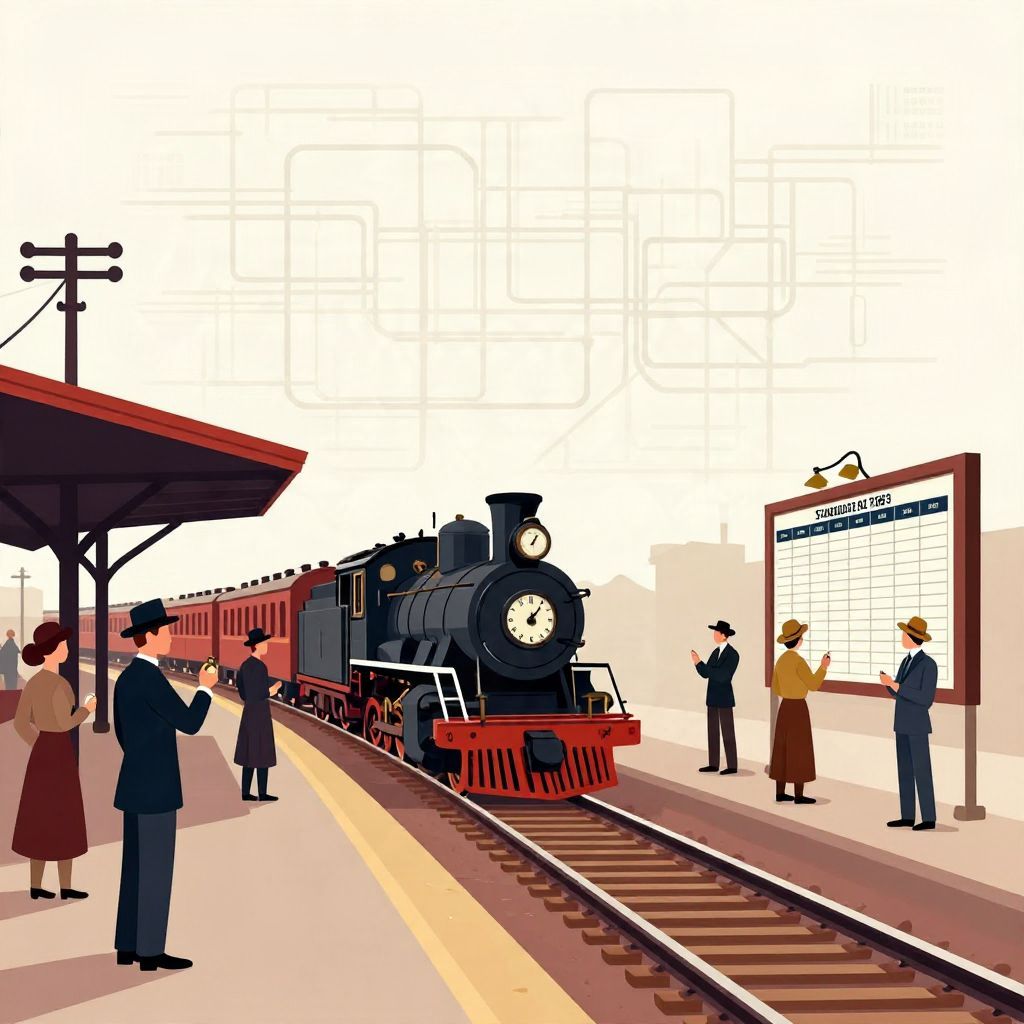
Which best explains how railroad companies were able to standardize their timetables in 1883? The short answer is that they did it by creating a shared system of time zones, backed by railroad coordination and the practical need for safer, more efficient train scheduling. Before that change, hundreds of local times made rail travel confusing and dangerous.
The 1883 timetable reform did not come from a single law passed by Congress. It came from railroad companies themselves, which adopted a standardized North American time system on November 18, 1883, after years of planning and pressure from rail traffic, telegraph communication, and business demands.
Which best explains how railroad companies were able to standardize their timetables in 1883?
The best explanation is that railroad companies coordinated through a common time-zone system, using telegraph networks and industry agreements to replace thousands of local solar times with a small number of standard times. This made train schedules readable across long distances, reduced collisions and confusion, and gave railroads a practical reason to act before governments fully standardized civil time.
Why railroad timetables had become a problem before 1883
In the early and mid-19th century, most towns kept their own local time based on the sun’s position. Noon was when the sun reached its highest point in that place. That worked fine for everyday life in a single town, but it became a major problem once railroads connected distant communities at high speed.
A train could leave one city on local time and arrive in another city where the clocks were several minutes different, even if the towns were only a short distance apart. As rail lines expanded, the differences became harder to manage. A timetable that looked simple in one place could become confusing or misleading in another.
Local time created real operational risks
Railroad companies had to coordinate departures, arrivals, passing tracks, and connections between lines. Without a common time standard, the same train might appear to be “on time” in one town and “late” in another. That was more than an inconvenience. It increased the chance of missed connections, scheduling errors, and accidents.
By the 1870s and early 1880s, the railroad system had grown too large for purely local timekeeping. The more trains moved across regions, the more the industry needed a uniform way to tell time.
The direct answer: standardization came from railroad industry coordination
Railroad companies were able to standardize their timetables in 1883 because they agreed to adopt a shared set of time zones and to synchronize clocks across the rail network. The key was not technology alone, but organization: railroads used telegraph lines, timetable committees, and cooperation across companies to make the change work on the same day.
This was an industry solution to an industry problem. Governments later adopted similar standards more broadly, but the first large-scale timetable standardization in North America was led by the railroads themselves.
How the 1883 railroad time reform happened
The move toward standard time developed over several years. Railroads in the United States and Canada had already experimented with regional time standards before 1883. Different railroad groups recognized that they could not keep operating efficiently if every station used a different local clock.
In 1883, railroad companies in North America coordinated the adoption of five continental time zones, often associated with the “General Time Convention” and related railroad planning. The system took effect on November 18, 1883, a date sometimes called “The Day of Two Noons” because many towns reset their clocks at noon local time.
What changed on November 18, 1883
- Railroads switched from local town time to standardized railroad time.
- Clocks were adjusted to match one of several broad time zones rather than each town’s own solar time.
- Train schedules became easier to print, read, and coordinate across long distances.
- Railroad employees had a clearer rule for departures, arrivals, and transfers.
The change did not instantly erase local time in everyday life. Many communities continued to use their own clocks for a while. But railroads were so important to commerce and travel that their timetable system strongly influenced the rest of society.
Why telegraphs mattered so much
Telegraph technology made standardized timetables practical. Railroads already depended on telegraph lines to send messages about train movement, delays, and dispatching. Because telegraphs could transmit time signals quickly over long distances, they helped railroads keep clocks synchronized.
Before telegraph-based coordination, it would have been much harder to maintain a consistent time system over thousands of miles. The telegraph did not create standard time by itself, but it made a coordinated time system workable in daily railroad operations.
Technology plus organization
The important point is that standardization was not simply a scientific discovery waiting to happen. It required both technology and agreement. Railroads needed:
- a way to transmit time accurately,
- a shared schedule structure,
- buy-in from multiple railroad companies,
- and enough authority to make the system widely followed.
Railroads had all of those ingredients. They were among the largest and most connected businesses of the era, and they had strong incentives to cooperate.
Who made the system happen?
Several railroad leaders and organizations helped shape standard time in North America. One of the most important figures was William F. Allen, a railroad engineer and editor who played a major role in promoting railroad time reform. Railroad executives, timetable committees, and transportation officials all contributed to the final system.
It is important not to oversimplify the story into one heroic inventor. Standard time was a collective achievement. It emerged from meetings, planning, and compromise among railroad companies that recognized the need for a common standard.
Not a federal mandate at first
Another common misconception is that the U.S. government imposed railroad standard time in 1883. In fact, the initial change was voluntary and industry-led. Federal law came later. The railroads acted first because they had the strongest immediate need for a workable timetable system.
This is one reason 1883 is so significant in the history of timekeeping: it shows how a private industry can reshape everyday life when its networks become large enough.
Why standard timetables mattered for railroads
Standard timetables made rail travel safer and more efficient. They reduced confusion for passengers and employees, improved coordination between connecting lines, and helped railroads manage traffic on increasingly crowded routes.
Before standard time, a train schedule could be difficult to interpret because the same clock time meant different things in different towns. After standardization, a timetable could be printed with confidence that “10:00 a.m.” meant the same thing throughout a given time zone.
Practical benefits of standardization
- Safety: fewer scheduling mistakes and less risk of train conflicts.
- Efficiency: easier dispatching and better use of rail lines.
- Communication: simpler instructions for conductors, station agents, and telegraph operators.
- Passenger convenience: more predictable departures and connections.
- Business coordination: smoother freight movement and commercial planning.
These benefits explain why railroads were willing to make a major change even before all local governments had fully accepted it.
How the railroad time system influenced modern time zones
The railroad standardization of 1883 was one of the most important steps toward the modern global time-zone system. It helped normalize the idea that large regions should share a common clock rather than each town using its own local solar time.
Later, governments formalized time zones more broadly. In the United States, the Standard Time Act of 1918 eventually gave federal legal backing to standard time and daylight saving time. But the railroad decision of 1883 had already shown that the system worked in practice.
From railroad necessity to national habit
What began as a transportation solution gradually became part of daily life. Schools, newspapers, businesses, and city governments increasingly adopted the railroad standard because it was simpler and more useful than local time. In that sense, the railroads did more than organize train schedules: they helped reorganize how people thought about time itself.
Historical significance of the 1883 timetable change
The 1883 standardization of railroad timetables matters because it reveals how industrial society changed the rhythm of everyday life. Railroads were among the first systems to need time to be measured uniformly across large distances. Their solution became a model for modern coordination.
It also shows the power of infrastructure to shape culture. A timetable may seem like a technical detail, but it affected how people traveled, worked, and understood distance. Once railroads adopted standard time, local timekeeping began to lose ground across North America.
Why historians still pay attention to it
Historians treat the 1883 change as a turning point in the history of modern timekeeping because it linked transportation, technology, and social organization. The reform was not inevitable. It happened because railroads needed it, could coordinate it, and had enough influence to make it stick.
That is the clearest answer to the question: railroad companies were able to standardize their timetables in 1883 because they cooperated to adopt standard time zones, using telegraph-based synchronization and industry-wide agreement to replace fragmented local times with a practical system for rail travel.
For related reading, you may also be interested in broader historical context at HistoryOrg or other timeline-based history coverage such as What Happened in 2013?