
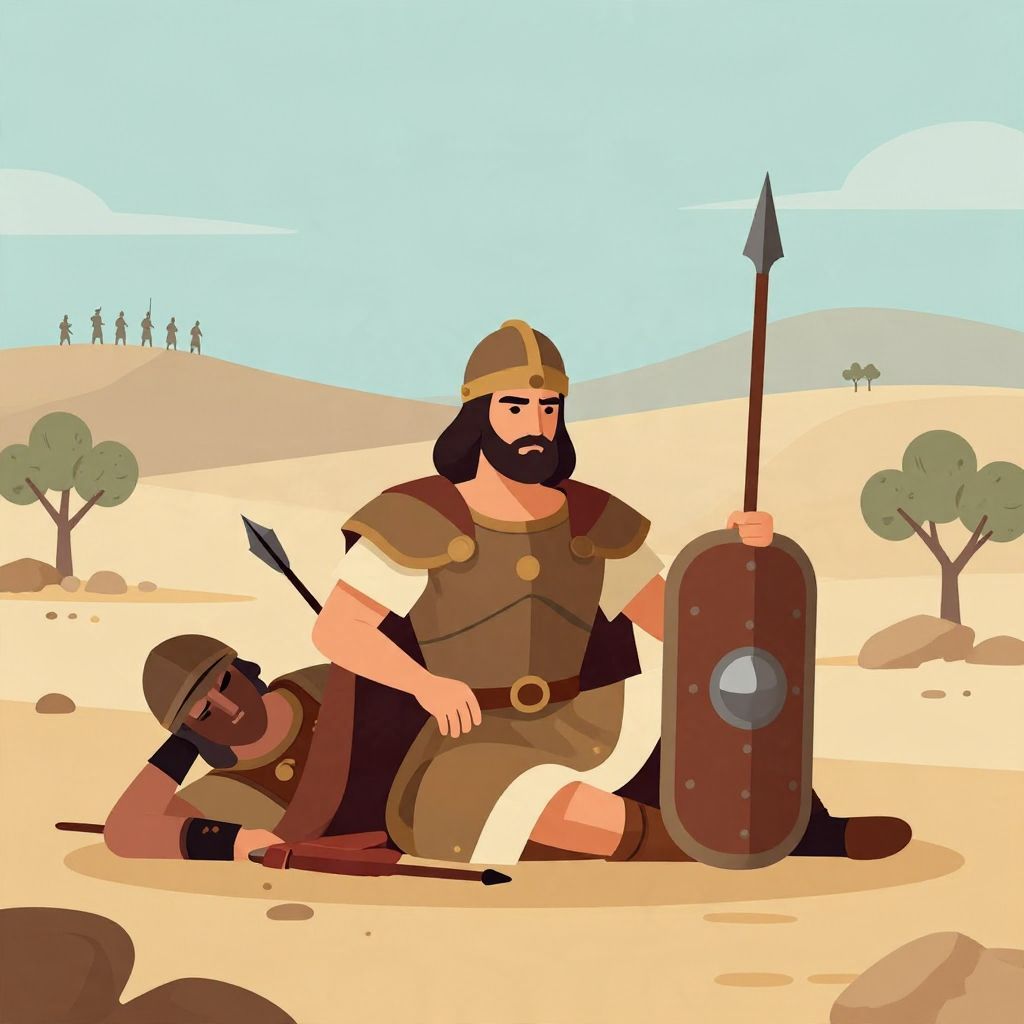
King Saul’s death is one of the most dramatic moments in the biblical history of ancient Israel. The story appears in the books of 1 Samuel and 1 Chronicles, where Saul’s final battle, his wounds, and the fall of Israel’s first king are described in detail.
So, how did King Saul die? According to the biblical account, Saul died during the battle of Mount Gilboa after being badly wounded by Philistine archers. Fearing capture and abuse, he asked his armor-bearer to kill him; when the man refused, Saul fell on his own sword. The exact details come from ancient texts, and some differences between accounts have led scholars to discuss the event carefully.
How Did King Saul Die?
King Saul died in battle against the Philistines on Mount Gilboa, likely around the early 10th century BCE. The main biblical account says he was struck by archers, became gravely wounded, and then killed himself by falling on his sword to avoid capture. A later narrative adds that an Amalekite claimed to have delivered the final blow.
The Final Battle at Mount Gilboa
Saul’s death took place during a major military defeat for Israel. The Philistines, a powerful coastal people and long-time rivals of the Israelites, pressed into the northern hill country. Mount Gilboa, in the Jezreel Valley region, became the site of the decisive clash.
Why the battle mattered
This was not just the death of a king; it was a political collapse. Saul’s army was broken, his sons were killed, and the Philistines gained a major victory. In the biblical narrative, the battle marks the end of Saul’s reign and the opening for David’s rise to kingship.
The sequence of events
- The Philistines attacked Israelite forces at Mount Gilboa.
- Saul’s sons, including Jonathan, were killed in the fighting.
- Saul was hit by enemy archers and badly wounded.
- He asked his armor-bearer to kill him so the Philistines would not abuse him.
- When the armor-bearer refused, Saul took his own life by falling on his sword.
What the Biblical Text Says
The main death account appears in 1 Samuel 31. There, Saul is wounded by archers, fears humiliation if captured alive, and dies by suicide. The text presents this as the tragic end of a king who had once been chosen to lead Israel but who had lost divine favor in the biblical storyline.
The armor-bearer’s role
Saul’s armor-bearer is a small but important figure in the story. Saul asks him to kill him, but the man is afraid and will not strike the king. This refusal leaves Saul to die by his own hand. The episode emphasizes the desperation of the moment and the collapse of royal authority on the battlefield.
The Philistines’ aftermath
After the battle, the Philistines recovered Saul’s body and the bodies of his sons. According to the text, they displayed Saul’s armor in a temple and fastened his body to the wall of Beth-shan, a public humiliation meant to demonstrate victory. Later, Israelite inhabitants of Jabesh-gilead retrieved the bodies and gave them burial.
Why the Account Differs in 1 Samuel and 2 Samuel
There is a notable difference between the accounts in 1 Samuel 31 and 2 Samuel 1. In 2 Samuel, an Amalekite messenger tells David that he found Saul wounded and then killed him at Saul’s request. This version has led to long discussion among historians and biblical scholars.
How scholars understand the difference
Many scholars view the Amalekite’s story as either a false claim, an attempt to gain favor with David, or a different retelling of the same event. The surrounding narrative suggests that the man expected reward for reporting Saul’s death, but David instead ordered his execution for claiming to have killed the Lord’s anointed king.
What is most likely historically
From a historical standpoint, the most secure conclusion is that Saul died in the battle at Mount Gilboa after suffering severe wounds. Whether he died immediately from those wounds or by suicide after the battle became hopeless is the central interpretive issue. The biblical tradition strongly preserves the image of Saul taking his own life to avoid capture.
Was Saul’s Death Suicide, Murder, or Battlefield Wound?
The simplest answer is that the biblical tradition presents Saul’s death as suicide after a fatal battlefield wound. However, the presence of the Amalekite story means that the tradition is not uniform in every detail. The most careful reading is that Saul was already dying or mortally wounded when he ended his life.
Why the distinction matters
In the ancient world, kings were symbols of divine favor and national strength. A ruler dying by his own hand on the battlefield carried heavy meaning. It suggested defeat, shame, and the end of an era. The story also sets up a contrast with David, who is portrayed as respecting Saul’s office even while Saul had pursued him.
Historical and Religious Context
Saul is remembered as Israel’s first king in the biblical tradition, a transitional figure between the tribal period and the monarchy. His reign is usually placed in the early Iron Age, though exact dates are uncertain. The biblical books present him as a complex ruler: chosen, troubled, militarily active, and ultimately undone by conflict and disobedience.
The Philistines and Israel
The Philistines were among the most formidable opponents of early Israel. Their military strength and control of key lowland routes made them a constant threat. Saul’s final battle reflects this broader struggle for survival and regional power in the southern Levant.
Saul’s sons and the collapse of his house
Saul’s death was compounded by the deaths of his sons, including Jonathan, who had a close bond with David in the biblical narrative. This meant the fall of Saul was not only personal but dynastic. It weakened his family line and accelerated the transition to David’s rule.
The Aftermath of Saul’s Death
Saul’s death had immediate political consequences. His defeat created a power vacuum that David would eventually fill, though not instantly and not without conflict. The northern tribes did not all accept David at once, and the transition to a united monarchy was gradual and contested.
David’s response
In the biblical account, David mourns Saul and Jonathan rather than celebrating Saul’s death. This is important to the narrative because it presents David as a legitimate successor who does not gain the throne through open treachery. His lament is one of the most memorable expressions of grief in the Hebrew Bible.
Burial and memory
The recovery and burial of Saul’s remains by the people of Jabesh-gilead gave him a final honor in death. This act of loyalty also linked Saul’s memory to one of the communities he had once rescued, showing that his kingship was remembered with both tragedy and gratitude.
What King Saul’s Death Means in History
King Saul’s death is important because it marks the end of Israel’s first monarchy under a single ruler and the beginning of the Davidic era in biblical history. It is a story of military defeat, personal desperation, and political transition. For readers of the Bible, it also raises enduring questions about leadership, legitimacy, and the cost of war.
Why the story still matters
Saul’s end has remained influential because it is more than a death scene. It is a turning point in the larger narrative of Israel’s early kings. The text uses his final moments to explain how one kingdom fell and another rose, while preserving the tragedy of a man who began with promise and ended in ruin.
In short, King Saul died after the battle of Mount Gilboa, wounded by Philistine archers and, according to the main biblical account, by his own hand. The story is preserved in more than one form, but all versions agree that his death was the result of a catastrophic defeat. For related biblical history, see also how King David died and how King Herod died.