
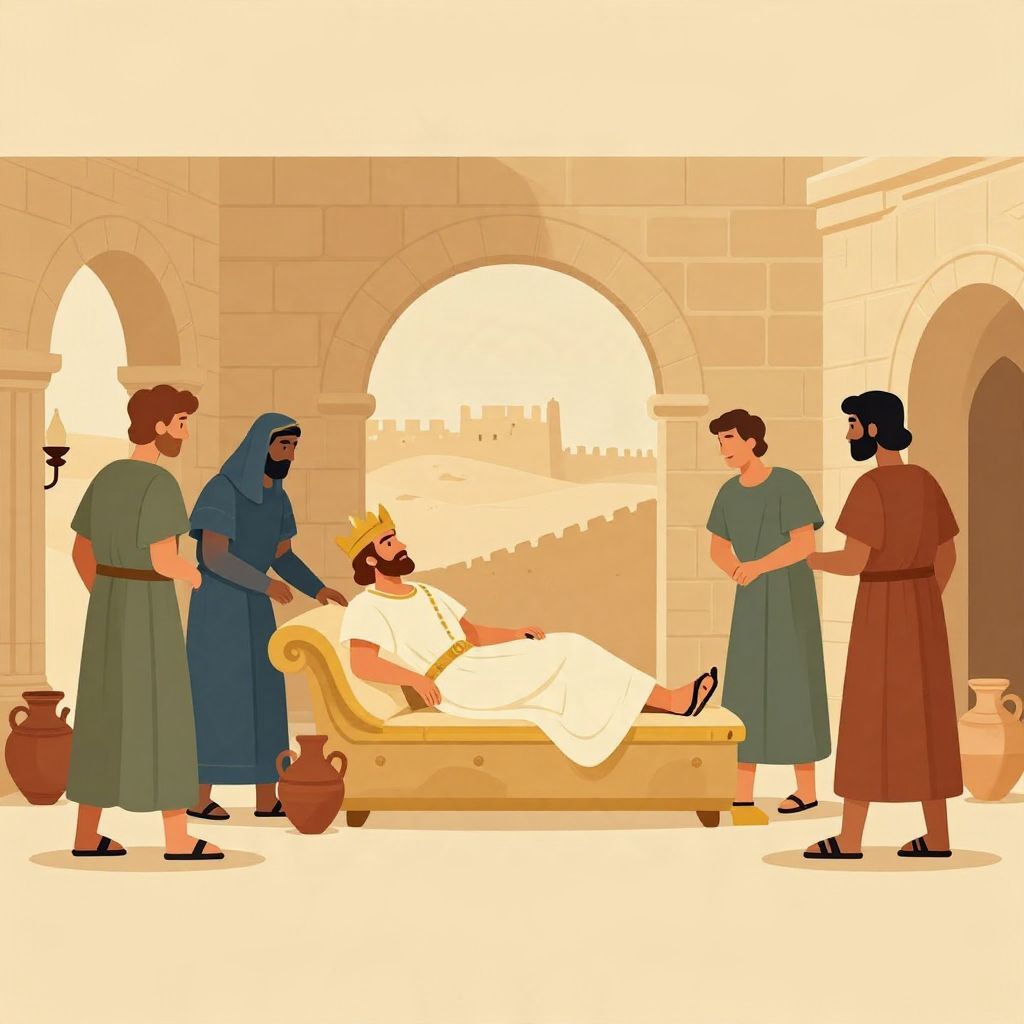
How did King Herod die? The short answer is that Herod the Great, ruler of Judea under Roman patronage, died in 4 BCE after a severe and prolonged illness. Ancient writers describe a painful decline marked by fever, bodily swelling, sores, and mental distress, though the exact diagnosis is uncertain.
His death was politically important as well as personal: it triggered a succession crisis, family conflict, and a major reordering of power in Judea. Because Herod appears in both Jewish history and the New Testament, his final days have long attracted attention, but the evidence comes mainly from the historian Josephus, not from modern medical records.
How Did King Herod Die?
King Herod died in 4 BCE after what ancient sources describe as a painful disease that worsened over time. The most detailed account, written by Josephus, says Herod suffered fever, itching, swelling, abdominal pain, and gangrene-like symptoms before dying at Jericho. Historians cannot confirm a single cause, but many think he likely had a severe chronic illness complicated by infection.
What the Ancient Sources Say About Herod’s Death
Our main narrative source is Josephus, a Jewish historian writing in the first century CE. In Jewish Antiquities and The Jewish War, he describes Herod’s final illness in dramatic detail. Herod’s body reportedly swelled, his skin became inflamed, and he experienced intense suffering. Josephus also says Herod became increasingly irritable and paranoid before dying at Jericho shortly before Passover.
Josephus and the limits of the evidence
Josephus is valuable, but he was not a physician and wrote decades after the event. His account reflects both historical memory and literary shaping. That means historians treat the symptoms seriously while remaining cautious about exact diagnosis. Ancient authors often emphasized moral lessons when describing rulers’ deaths, especially tyrants or feared kings.
Why the diagnosis remains uncertain
Modern scholars have suggested several possibilities, including:
- chronic kidney disease
- severe intestinal infection
- gangrene or a widespread bacterial infection
- complications from a long-term vascular or metabolic illness
No diagnosis can be proven. The symptoms Josephus lists are broad enough to fit more than one condition, and ancient medical descriptions are not precise by modern standards.
What Happened in Herod’s Final Days?
Herod’s death was not sudden. Ancient accounts suggest a long decline, during which he remained politically active and deeply anxious about succession. Even while ill, he reportedly continued making harsh decisions, including actions against family members and rivals. This combination of physical decline and political fear shaped the last phase of his reign.
A ruler in pain and in control
Herod was known for ruthless political instincts, and his final illness did not erase that reputation. According to Josephus, he tried to manage the kingdom’s future even as his health collapsed. He understood that his death would open a struggle over who would inherit power, and he acted accordingly.
The succession crisis
Herod had many sons and a complicated household. He had already executed or sidelined several relatives over suspicions of conspiracy. Near the end of his life, he altered his will more than once. After his death, Rome had to decide how much of his kingdom would go to his heirs, which led to the division of Judea among his sons rather than a single unified succession.
Where Did King Herod Die?
Herod died at Jericho, in his winter palace area near the Jordan Valley. Jericho was one of his favored residences, especially in the colder months. It was also strategically important: close enough to Jerusalem for political control, but warm and comfortable compared with the hill country.
Why Jericho mattered
Jericho was more than a retreat. Herod had invested heavily in building projects across his realm, and his palaces reflected his desire to project royal power in a Roman world. Dying there placed his death within the landscape of his own political and architectural legacy.
The Date of Herod’s Death and Why It Matters
Most historians place Herod’s death in 4 BCE, though a minority have argued for a later date. The 4 BCE date remains the standard because it fits Josephus’s chronology and the broader sequence of events tied to lunar and political markers in the ancient record. This date matters because it affects how historians reconstruct the reigns of Herod’s successors and the timeline of early Roman Judea.
Connection to the New Testament
Herod is also remembered in Christian tradition as the king associated with the infancy narrative in the Gospel of Matthew. Because that story places Herod alive during the birth of Jesus, Herod’s death date has been used in debates about the chronology of Jesus’ early life. Historians generally note that the biblical account and Josephus can be read together only with caution, since the sources come from different genres and purposes.
Was Herod Poisoned or Murdered?
There is no solid historical evidence that Herod was poisoned or assassinated. Such ideas appear in later speculation and popular retellings, but the surviving ancient sources do not support them. Instead, the evidence points to a natural death after a severe illness, even if the exact medical cause remains unknown.
Why rumors of foul play persist
Herod’s court was full of fear, intrigue, and violent purges. Because he had enemies and because his death came after years of brutality, later readers sometimes assumed conspiracy. But historians distinguish between a politically suspicious atmosphere and actual proof. In Herod’s case, the latter is lacking.
How His Death Changed Judea
Herod’s death changed Judea immediately. He had ruled as a client king under Roman authority, balancing local traditions with imperial interests. After he died, Rome did not simply hand power to one heir. Instead, his kingdom was divided, weakening centralized rule and increasing Roman influence over the region.
Division of the kingdom
Herod’s sons received different territories, though not all with the same status. This division reduced the power of the Herodian dynasty and made Judea more fragmented politically. Over time, Roman oversight grew stronger, eventually leading to direct administration in parts of the region.
Long-term significance
Herod’s death marked the end of one of the most important local monarchies in the eastern Mediterranean under Rome. His reign had been defined by grand building projects, political violence, and careful cooperation with imperial power. His death exposed how dependent his kingdom was on his personal authority rather than on a stable succession system.
Why Herod’s Death Still Draws Attention
Herod’s death remains famous because it sits at the intersection of politics, religion, and biography. He was a major figure in the history of Judea, a controversial ruler in Jewish memory, and an important name in Christian tradition. The details of his final illness are vivid enough to invite medical theories, yet incomplete enough to keep historical debate alive.
What historians can say with confidence
- Herod the Great died in Jericho.
- His death is usually dated to 4 BCE.
- He appears to have died after a serious illness, not from a clearly documented assassination.
- His death led to a succession crisis and the partition of his realm.
So, how did King Herod die? He died after a painful and prolonged illness, probably in 4 BCE at Jericho, and the aftermath reshaped Judea’s politics. The exact disease is unknown, but the historical consequences are clear: his death ended a highly personal style of rule and opened the door to Roman-managed succession. For more on famous historical deaths, see how Marie Antoinette died or how John Wayne Gacy died.