
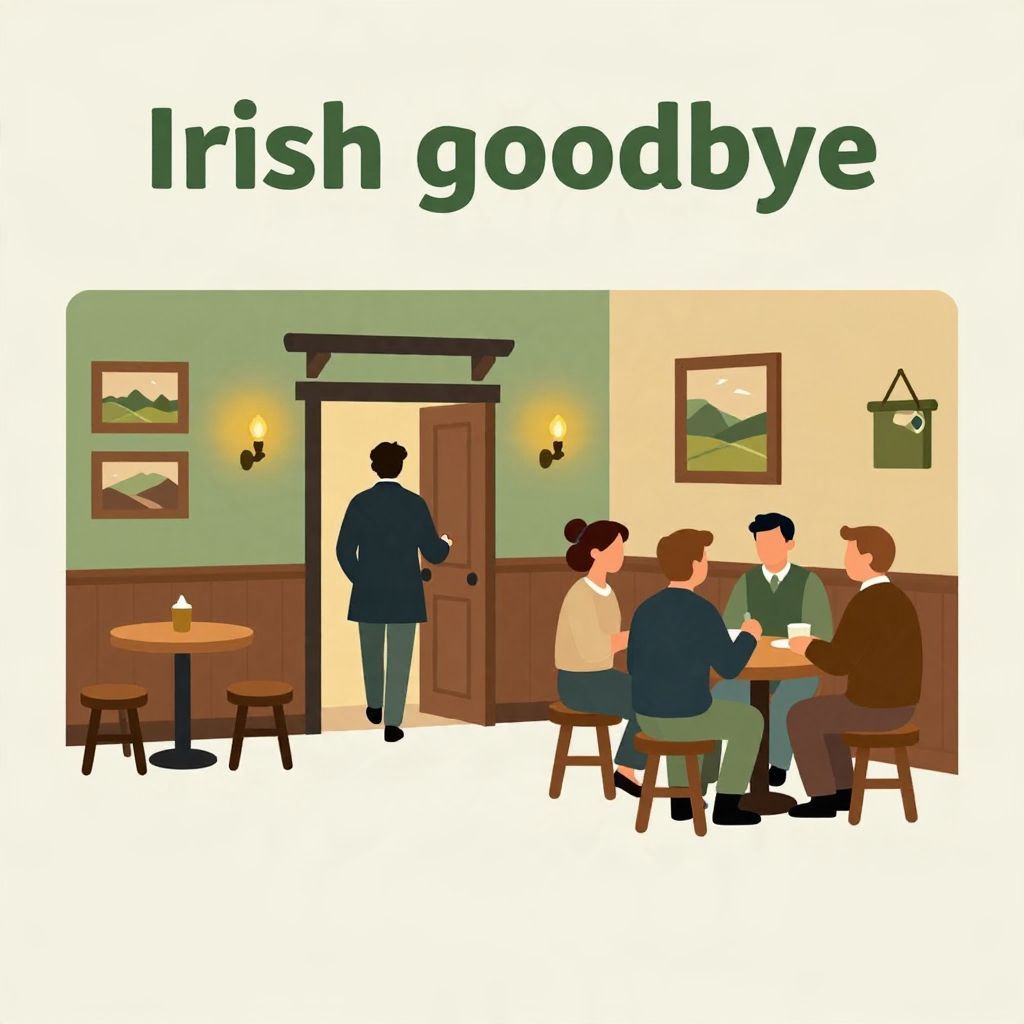
What is the Irish goodbye? In modern English, it means leaving a social gathering without saying goodbye to everyone, or sometimes without saying anything at all. The phrase is common in the United States and other English-speaking places, but it is not a neutral historical label: it reflects stereotypes, humor, and changing ideas about etiquette.
To understand it historically, we need to look at both the phrase itself and the older social custom behind it. The behavior is much older than the wording, and the wording has a complicated cultural history shaped by migration, prejudice, and everyday social life.
What Is The Irish Goodbye?
An Irish goodbye is an informal expression for leaving a party, pub, wedding, or other gathering quietly, without going around to say farewell. The phrase usually describes the act of slipping out unnoticed, not a literal Irish tradition. Historically, the term is more about social behavior and slang than about Ireland itself.
Where Did The Phrase Come From?
The exact origin of the phrase is unclear, but it appears to be a relatively modern bit of English-language slang, likely popularized in the 20th century. Like many ethnic labels attached to habits or manners, it probably grew from joking stereotypes rather than from any documented Irish custom. The phrase should be treated as cultural slang, not historical fact about Irish people.
Why “Irish”?
English has long used national labels in idioms that assign a habit to a people, often without evidence. Some are affectionate, some are mocking, and some are plainly prejudiced. In this case, “Irish goodbye” likely emerged because Irishness was already a familiar ethnic marker in Anglophone popular culture, especially in places with large Irish immigrant communities such as Britain and the United States.
Is it really Irish?
There is no solid historical evidence that leaving without farewells is uniquely Irish. In fact, the behavior is universal: people leave early for practical reasons, avoid long leave-taking, or simply do not want to interrupt a conversation. The “Irish” part of the phrase is best understood as a social stereotype attached to a common human habit.
The History Behind the Behavior
Although the phrase is modern, the custom it describes is ancient. In many societies, formal farewells could be lengthy, emotionally demanding, and socially important. In small communities or tightly structured households, leaving a gathering often required multiple goodbyes, blessings, or expressions of respect. A quiet exit could save time, avoid awkwardness, or prevent a scene.
Why people left quietly
- Convenience: A person may not want to interrupt several conversations just to announce departure.
- Politeness: In some settings, leaving quietly can feel less disruptive than drawing attention to oneself.
- Emotion: Farewells can be difficult, especially at weddings, funerals, or reunions.
- Practicality: In crowded or noisy places, a formal goodbye may be impossible.
In other words, the “Irish goodbye” is not a special historical ritual. It is a modern name for a very old social behavior: the discreet exit.
How Etiquette Shaped the Meaning
Social rules around departure have changed over time. In elite European and American society, the proper goodbye could be highly structured. One was expected to visit, announce departure, thank the host, and possibly exchange repeated assurances of future contact. In such a world, leaving quietly could be seen as rude, even if it was understandable.
From formal manners to casual slang
As social life became less rigid in the 19th and 20th centuries, especially in urban settings, people became more tolerant of informal behavior. The phrase “Irish goodbye” fits that shift. It captures a tension between older etiquette, which prized visible courtesy, and modern life, which often values efficiency and informality.
Related expressions
English has several similar expressions, including “slipping out,” “ghosting” in a modern digital sense, and “French leave,” an older phrase with a similar meaning. These expressions show that many cultures have tried to name the same behavior while attaching it to different national stereotypes.
What Is The Irish Goodbye’s Connection to “French Leave”?
The closest historical cousin of “Irish goodbye” is “French leave,” a much older English idiom meaning to leave without permission or without proper farewell. That phrase appears in English usage by the 18th century and reflects a long tradition of blaming another nation for a social habit. “Irish goodbye” belongs to this same family of ethnicized expressions, though it is later and more casual.
Why these phrases spread
Such expressions spread because they are vivid and memorable. They also allow speakers to make a joke about behavior without directly criticizing the person doing it. But they often rely on stereotypes that flatten real cultural differences. Historically, that matters: language can preserve prejudice even when it sounds playful.
Irish Immigration and the American Context
The phrase likely became especially familiar in the United States, where Irish immigrants and their descendants were a major part of urban life in the 19th and 20th centuries. Irish Americans faced discrimination, and ethnic humor often turned national identity into a punchline. In that environment, a phrase like “Irish goodbye” could circulate as a light joke while still drawing on older anti-Irish attitudes.
Ethnic humor and social ranking
In immigrant societies, humor often marks who belongs and who does not. National labels can be used affectionately within a community, but they can also reinforce outsider status. The phrase “Irish goodbye” sits in that ambiguous space: some people use it casually and without malice, while others may not realize it echoes a history of stereotyping.
How the Phrase Is Used Today
Today, “Irish goodbye” is widely understood as a playful term for leaving without saying goodbye, especially at parties, bars, and weddings. It is often used self-deprecatingly: someone may admit to being “bad at goodbyes” or joke that they pulled an Irish goodbye after a long evening. In casual conversation, the phrase has become common enough that many speakers no longer think about its historical baggage.
Modern etiquette and changing attitudes
Contemporary social norms are more flexible than in the past. Some hosts expect a quick text later rather than a formal farewell in person. In that sense, the Irish goodbye has become easier to defend as a practical choice. Still, in some settings—especially intimate gatherings—it can be seen as inconsiderate because it denies closure to the host or other guests.
Is “Irish Goodbye” Offensive?
Whether the phrase is offensive depends on context, audience, and intent. Many people use it innocently, but it does rely on an ethnic label to describe a behavior that is not uniquely Irish. Because of that, some listeners may hear it as a stereotype rather than a harmless joke. Historically, it belongs to a broader pattern of assigning everyday habits to national identities.
A useful way to think about it
If the phrase is used descriptively among friends, it may pass without comment. But in a historical or cultural discussion, it is worth recognizing that the wording is not neutral. The custom is real; the ethnic framing is the part that should be treated carefully.
The Historical Significance of the Irish Goodbye
The Irish goodbye matters because it shows how language turns ordinary behavior into social meaning. A simple act—leaving a room quietly—can become a named custom, then a joke, then a marker of identity. That process reveals how etiquette, migration, and stereotype interact in everyday speech. It also shows how national labels can survive long after their original context is forgotten.
What it tells us about history
- People have always negotiated the tension between politeness and practicality.
- English slang often turns social habits into ethnic stereotypes.
- Immigration and cultural mixing shape everyday language as much as formal politics do.
- Modern expressions can preserve older prejudices even when they sound casual.
So, What Is The Irish Goodbye?
The Irish goodbye is the act of leaving a social event without formally saying goodbye, and the phrase itself is a modern slang term built on older patterns of ethnic labeling. Its history is less about Ireland than about etiquette, humor, and the way English speakers have long used nationality to describe everyday habits.
In historical terms, the behavior is universal, while the phrase is culturally specific. That distinction is the key to understanding it: the custom is ordinary, but the wording reflects a long and revealing history of social language.