
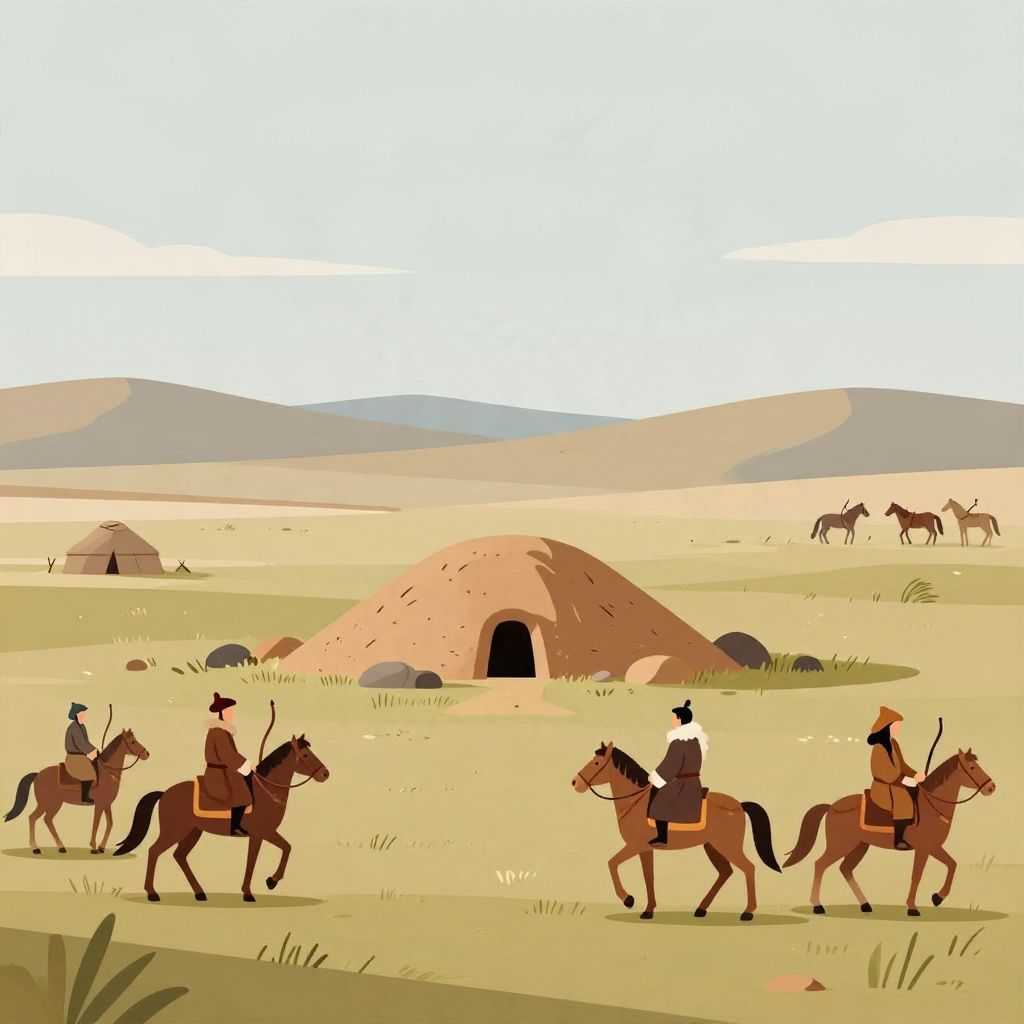
Where is Genghis Khan buried? The short answer is that no one knows for certain. The most widely accepted historical view is that he was probably buried somewhere in or near the Burkhan Khaldun region in northeastern Mongolia, but the exact grave has never been confirmed. His burial was meant to remain secret, and that secrecy has shaped the mystery ever since.
The result is one of history’s most famous unknowns: a ruler who built the largest contiguous land empire in history left behind no verified tomb. Scholars, archaeologists, and local traditions have all offered clues, but none has produced conclusive proof.
Where Is Genghis Khan Buried?
Genghis Khan is believed to be buried somewhere in Mongolia, most often associated with the Burkhan Khaldun area, but the exact location has never been found. Historical sources suggest his burial was deliberately hidden, and later traditions reinforced the idea that the grave should remain undisturbed. Because of that, there is no confirmed tomb, mausoleum, or archaeological site that can be identified with certainty as his burial place.
Why His Burial Place Remains Unknown
The mystery begins with the circumstances of his death in 1227. Genghis Khan died while campaigning against the Western Xia kingdom in northwestern China. According to the broad historical tradition, his body was returned to Mongolia for burial, but the funeral was arranged in a way designed to keep the site secret. That secrecy was not accidental; it reflected political power, reverence, and the Mongol elite’s desire to protect the memory and sanctity of their leader.
A burial meant to be hidden
Later accounts describe a funeral escort that killed anyone who witnessed the procession and then concealed the grave. These stories are difficult to verify in detail, but they fit a consistent historical pattern: the burial was intended to be inaccessible. Whether every dramatic element is true or embellished, the outcome is the same. The grave was lost, hidden, or both.
No confirmed archaeological evidence
Unlike many famous rulers, Genghis Khan left no universally accepted tomb inscription, burial chamber, or royal monument that can be tied to him with confidence. Archaeological work in Mongolia has uncovered many important nomadic-era sites, but not a verified burial of the khan himself. This absence is one reason the question remains open after eight centuries.
The Most Likely Burial Location: Burkhan Khaldun
Among historians, the most commonly cited likely burial area is Burkhan Khaldun, a sacred mountain in northeastern Mongolia. This region is strongly associated with Genghis Khan’s early life, spiritual beliefs, and political identity. It appears in Mongol tradition as a place of deep significance, and many scholars think his burial was probably placed somewhere in this broader landscape rather than in a marked tomb.
Why Burkhan Khaldun matters
Burkhan Khaldun was not just a geographic landmark. It was a sacred place in Mongol memory, linked to protection, ancestry, and divine favor. Genghis Khan’s rise was closely tied to the steppe world of eastern and central Mongolia, and a burial in this region would have fit both practical and symbolic needs. It would also have been easier to conceal in a remote, rugged landscape than in a settled urban center.
A protected cultural landscape
Today, the broader Burkhan Khaldun area is recognized for its historical and cultural importance. That does not mean the grave has been found there; rather, it means the region remains central to the search and to Mongolian heritage. The mountain and surrounding territory are part of why many people still associate Genghis Khan’s final resting place with Mongolia rather than China, Russia, or another neighboring region.
What Historical Sources Say About His Funeral
Information about Genghis Khan’s death and burial comes from a mix of Mongol tradition, later chronicles, and outside observers. The most important early Mongol source is the Secret History of the Mongols, though it does not provide a clear modern-style map to the grave. Later Persian and Chinese accounts add details, but those accounts were written after the events and sometimes reflect political or literary motives.
What can be stated with confidence
- Genghis Khan died in 1227.
- He was almost certainly buried in the Mongol homeland, not in the territory he had conquered.
- The burial site was intentionally hidden or left unmarked.
- No verified tomb has ever been identified.
What remains uncertain
- The exact route of the funeral procession.
- The precise burial method.
- Whether the grave is in a single identifiable location or part of a wider sacred zone.
- How much of the later burial story is literal fact versus tradition.
Because the sources are incomplete and sometimes contradictory, historians are careful not to present speculation as certainty. The best-supported answer is not a precise coordinate but a historical probability: the grave is somewhere in Mongolia, likely in a sacred and secluded area connected to Burkhan Khaldun.
Why the Mongols May Have Hidden the Grave
In steppe politics, the burial of a ruler could carry enormous symbolic weight. A hidden grave may have served several purposes at once. It protected the khan’s remains from enemies, prevented the site from becoming a target, and reinforced the idea that his authority transcended ordinary death. For a ruler who unified the Mongol tribes and created a vast empire, secrecy itself may have been part of the message.
Political and spiritual reasons
Some historians think the burial was hidden to prevent rival groups from using the site as a political symbol. Others emphasize spiritual beliefs: sacred places were not always meant for public display, and the dead could be honored without a monumental tomb. In a nomadic empire, where mobility and landscape mattered more than stone architecture, a concealed burial would not have seemed unusual.
Why no grand tomb?
People often expect emperors and conquerors to have monumental graves, but that expectation comes mainly from settled civilizations with durable building traditions. The Mongol world was different. Wealth and power were expressed through movement, tribute, horses, and military organization, not necessarily through mausoleums. That cultural difference helps explain why Genghis Khan’s burial may have been left unmarked.
Searches, Legends, and Modern Interest
Over the centuries, many stories have grown around the lost grave. Some legends place it under a river, others in a remote mountain, and still others in a sealed chamber protected by curses or guardians. These tales are part of the cultural fascination with Genghis Khan, but they should be treated as folklore unless supported by evidence.
Archaeological efforts
Modern researchers have searched for the burial site using surveys, remote sensing, and fieldwork. These efforts have improved knowledge of Mongol-era landscapes and settlements, but they have not produced a universally accepted tomb. In Mongolia, the search is also sensitive because many people believe the grave should remain undisturbed if it is ever found.
Ethical concerns
The search for Genghis Khan’s burial is not just a historical puzzle; it is also an ethical question. For some, locating the grave would be a major archaeological achievement. For others, opening it would violate a sacred resting place and disturb a figure deeply embedded in national memory. That tension helps explain why the mystery persists.
How the Burial Mystery Shapes Genghis Khan’s Legacy
The unknown location of Genghis Khan’s grave has become part of his historical image. It reinforces the scale of his influence and the reach of Mongol tradition. A ruler whose empire stretched across Eurasia left behind a final resting place that resists easy discovery, reminding us that power in the medieval steppe world did not always leave the monuments familiar from other civilizations.
At the same time, the mystery encourages careful historical thinking. It shows how legends form around major figures, how limited sources can preserve some facts while obscuring others, and how national memory can preserve a place’s importance even when the physical evidence is missing. In that sense, the unanswered question is itself historically meaningful.
Bottom Line
So, where is Genghis Khan buried? The most accurate answer is that his grave has never been found, though it is widely believed to be somewhere in Mongolia, probably in or near the Burkhan Khaldun region. The uncertainty is not a failure of history; it is part of the historical record. For readers interested in the wider Mongol world, related context can be found in articles on Mongolia’s historical relationship with China and on what Prussia was.