
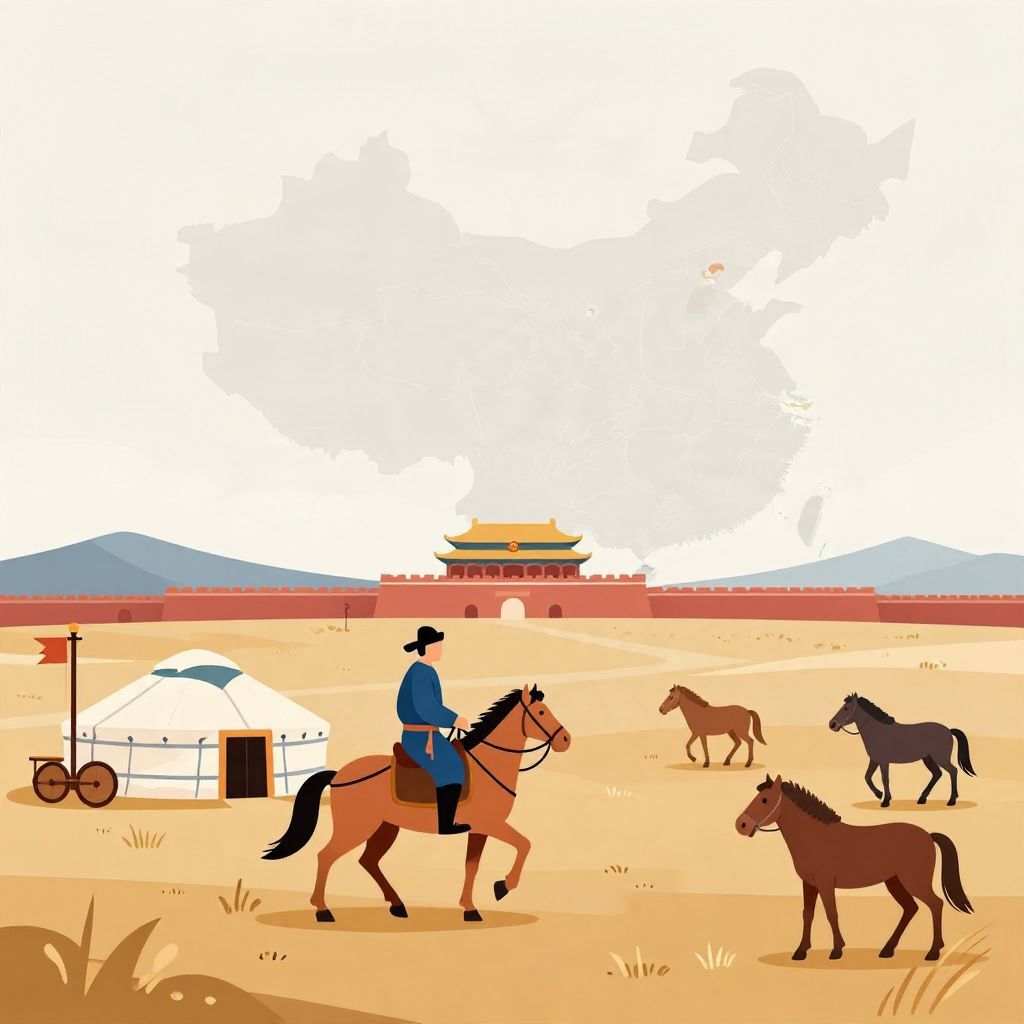
Is Mongolia part of China? The short historical answer is no: the modern independent state of Mongolia is not part of the People’s Republic of China. However, the question has a complicated history because Mongol lands were ruled by Chinese dynasties at some points, and today the region of Inner Mongolia is an autonomous region within China.
To answer this properly, we need to separate modern borders from older empires. Mongolia’s relationship with China has shifted over centuries through conquest, imperial rule, revolution, and international recognition.
Is Mongolia Part of China?
No. The sovereign state of Mongolia is an independent country, not part of China. It has been internationally recognized as a separate state since the mid-20th century. The confusion usually comes from the existence of Inner Mongolia, which is a Chinese autonomous region, and from earlier periods when Mongol territories were ruled by Chinese dynasties or included in larger imperial systems.
Why the Question Is Complicated
The answer depends on which “Mongolia” you mean and which historical period you are asking about. Today there are two main Mongol regions: Outer Mongolia, which is the independent country commonly called Mongolia, and Inner Mongolia, which is part of China. Historically, both regions were tied to the Mongol world, but they developed different political futures.
Outer Mongolia and Inner Mongolia
The terms are political and historical, not simply geographic. “Outer Mongolia” generally referred to the northern Mongol lands, while “Inner Mongolia” referred to southern Mongol areas closer to China proper. These labels became especially important in the late Qing period, when the Manchu-led Qing dynasty governed both regions differently.
The Mongol Empire and Chinese Rule in History
Mongolia was not always separate from China, nor was it always under Chinese rule. In the 13th century, the Mongols created a vast empire under Genghis Khan and his successors. Later, the Mongol-led Yuan dynasty ruled China from 1271 to 1368. In that era, the Mongols were the ruling elite of China rather than subjects of it.
When the Mongols Ruled China
The Yuan dynasty is important because it shows that the relationship ran both ways in history. The Mongols conquered China and governed from Beijing and other centers of power. This was not “Mongolia becoming part of China” in the modern sense; instead, it was a Mongol empire ruling Chinese territory as one part of a much larger imperial system.
After the Yuan Dynasty
When the Yuan dynasty fell in 1368, the Ming dynasty took control of China proper. Mongol groups remained powerful on the steppe north of the Great Wall, but they were no longer the rulers of China. Over the following centuries, the steppe frontier remained a zone of diplomacy, warfare, trade, and shifting alliances rather than a fixed national border.
Qing Rule and the 20th-Century Break
In the 17th and 18th centuries, the Manchu-led Qing dynasty expanded across Inner Asia and brought Mongol territories under its control. By the 1700s, much of what is now Mongolia was administered within the Qing imperial system. This is one reason some people assume Mongolia was “part of China,” though the Qing Empire was larger than China alone and governed multiple peoples and regions differently.
How the Qing Governed Mongolia
The Qing did not treat all lands as a single Chinese nation-state, because that kind of state did not yet exist. Mongol banners, princes, and religious institutions retained some autonomy under Qing oversight. The empire managed Mongol territories separately from the Chinese provinces, even while asserting overall imperial authority.
The Fall of the Qing and Mongolian Independence
When the Qing dynasty collapsed in 1911, Mongolian nobles and Buddhist leaders declared independence in Outer Mongolia. The new Republic of China did not fully accept this separation, and the issue remained contested for years. Russian influence, civil conflict, and regional instability shaped Mongolia’s path toward independence.
How Mongolia Became an Independent Country
Outer Mongolia’s independence became more secure in the 20th century. In 1921, Mongolian revolutionaries, with Soviet support, established a new government after defeating forces tied to Chinese and White Russian interests. In 1924, the Mongolian People’s Republic was proclaimed, making Mongolia a socialist state closely aligned with the Soviet Union.
International Recognition
For decades, Mongolia’s status was politically sensitive. The Republic of China continued to claim sovereignty over the territory for a time, while the Soviet-backed Mongolian government functioned as an independent state in practice. After World War II, international recognition widened. In 1945, a referendum in Mongolia supported independence, and the Republic of China formally recognized Mongolia in 1946. The People’s Republic of China later recognized Mongolia after its own founding.
Modern Mongolia
Today, Mongolia is a fully sovereign country with its own government, constitution, foreign policy, and membership in international organizations. It is bordered by Russia to the north and China to the south, but it is not governed by either country.
What About Inner Mongolia?
Inner Mongolia is the main reason for ongoing confusion. It is an autonomous region of China, established in 1947 before the founding of the People’s Republic of China in 1949. It has a significant Mongol population, but most residents are Han Chinese, and it is administered as part of China.
Inner Mongolia vs. the State of Mongolia
- Mongolia: an independent country, formerly called Outer Mongolia in many historical contexts.
- Inner Mongolia: an autonomous region within China.
- Shared heritage: both regions are connected to Mongol history, language, and steppe culture.
Because the names are so similar, many people assume the whole Mongol homeland belongs to China. Historically, though, the modern border reflects 20th-century state formation, not a simple continuation of one ancient political unit.
Historical Facts and Evidence to Keep in Mind
Several facts help clarify the issue. First, the Mongol Empire once ruled China through the Yuan dynasty. Second, the Qing Empire controlled Mongol territories, but the Qing was a multiethnic empire, not simply “China” in the modern national sense. Third, Outer Mongolia became an independent state in the 20th century and remains so today.
Common Misunderstandings
- “Mongolia has always been part of China.” This is incorrect. Mongol territories were often independent, imperial, or separately administered.
- “Because the Qing ruled Mongolia, it was the same as modern China.” This oversimplifies a premodern empire and ignores later independence.
- “Inner Mongolia and Mongolia are the same place.” They are historically related but politically separate today.
Why This Question Still Matters
The question “Is Mongolia part of China?” touches on more than borders. It reflects how empires become nations, how historical memory shapes modern identity, and how terms like “China,” “Mongolia,” “Outer Mongolia,” and “Inner Mongolia” can mean different things in different centuries. The answer changes depending on whether you are discussing empire, ethnicity, geography, or modern sovereignty.
In historical terms, Mongolia was sometimes ruled by Chinese dynasties or incorporated into larger empires, but the modern country of Mongolia is not part of China. The clearest takeaway is that today’s border is the result of a long and contested history, not a simple uninterrupted tradition. For related reading, explore the history of the Mongol Empire and the rise and fall of the Qing dynasty.