
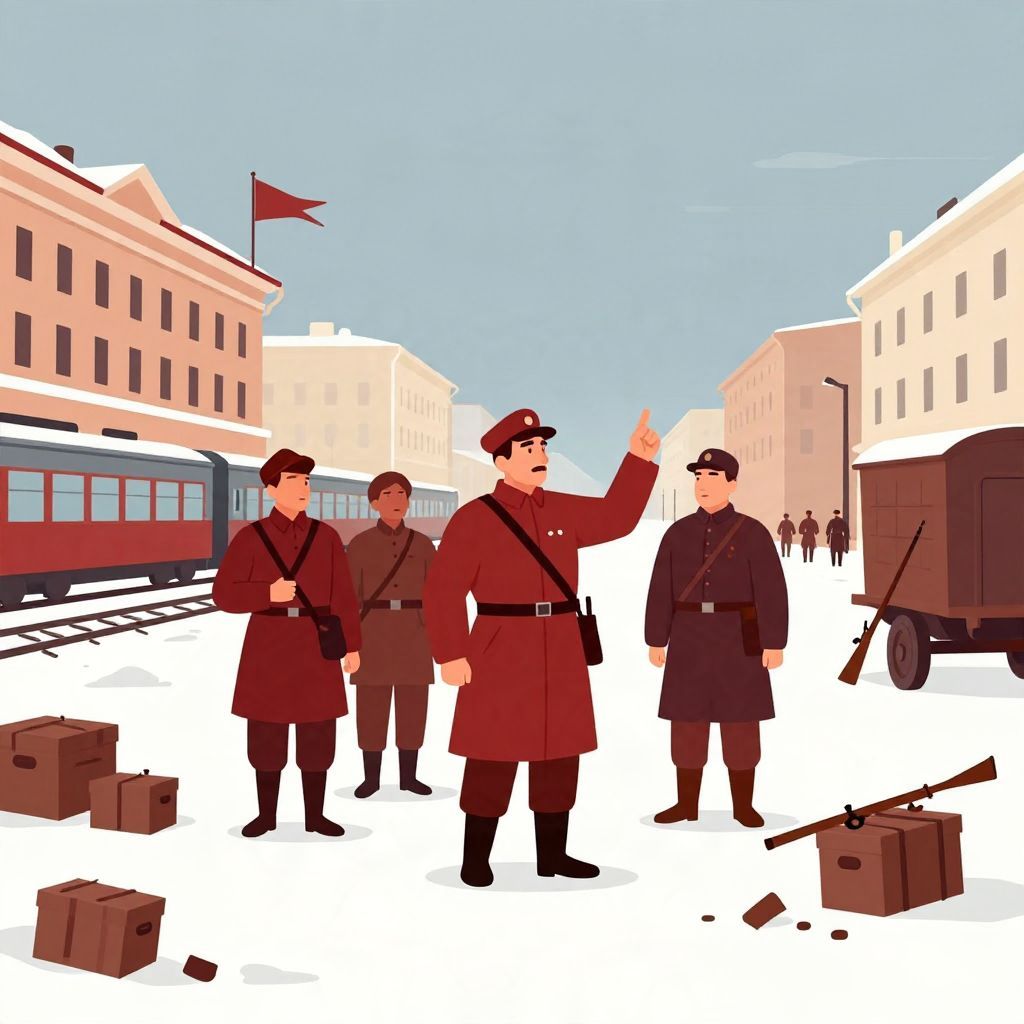
Why did Russia leave the war? In the context of World War I, the answer is that Russia withdrew because military defeat, economic collapse, political revolution, and war weariness made continued fighting impossible. The Russian Empire had been strained by years of battlefield losses and shortages, and by 1917 the old regime could no longer hold together.
The decision to exit the war was not sudden or simple. It unfolded through revolution, the fall of the tsar, the rise of the Bolsheviks, and the harsh peace settlement known as the Treaty of Brest-Litovsk in 1918.
Why did Russia leave the war?
Russia left World War I because the country was exhausted by enormous casualties, food shortages, transport breakdowns, and political upheaval. After the February Revolution toppled Tsar Nicholas II, the Provisional Government kept fighting, but the army and public support collapsed. The Bolsheviks then seized power and made peace with Germany to save their revolution.
The long crisis before Russia withdrew
Russia’s exit from World War I was the result of a deep crisis that had been building for years. The empire entered the war in 1914 with major weaknesses: poor industrial capacity, an underdeveloped rail network, and a huge peasant army that was often badly equipped. Early enthusiasm quickly gave way to disaster as defeats piled up on the Eastern Front.
Military failures and mass casualties
Russian armies suffered severe losses against Germany and Austria-Hungary. The defeats at Tannenberg and the Masurian Lakes in 1914 were especially damaging, and later campaigns brought more dead, wounded, and captured soldiers. By 1917, millions had been killed, injured, or taken prisoner. This scale of loss shattered morale and made continued war increasingly unpopular.
Economic breakdown at home
War placed impossible pressure on the Russian economy. Factories struggled to produce enough weapons and supplies, railways could not move food efficiently, and inflation eroded wages. Cities faced bread shortages, while peasants often withheld grain because money had lost value and transport was unreliable. Hunger and cold became everyday realities for many Russians.
Political instability and loss of trust
The tsarist government lost credibility as the war dragged on. Nicholas II even took personal command of the army in 1915, which tied the monarchy more directly to military failure. At home, ministers changed rapidly, corruption rumors spread, and the court’s reputation suffered badly. Many Russians came to believe the government was incapable of winning the war or solving the crisis.
The revolution that changed Russia’s course
The decisive turning point came in 1917. The February Revolution forced Tsar Nicholas II to abdicate, ending centuries of Romanov rule. A Provisional Government replaced the monarchy, but it made a critical choice: it stayed in the war. That decision proved disastrous because most Russians wanted peace, not another offensive.
Why the Provisional Government could not continue the war
The Provisional Government faced a nearly impossible task. It wanted to preserve Russia’s alliance with Britain and France, but the army was disintegrating and public patience was gone. Soldiers deserted, workers struck, and local authority weakened. When the government launched a new offensive in the summer of 1917, it failed quickly and deepened the sense that the war could not be won.
The Bolsheviks and the promise of peace
The Bolsheviks, led by Vladimir Lenin, understood that peace was one of the most powerful demands in Russia. Their slogans promised “peace, land, and bread,” linking the war to the suffering of soldiers, peasants, and workers. When they seized power in the October Revolution of 1917, ending the war became one of their first priorities.
Why the Bolsheviks made peace with Germany
The Bolsheviks did not leave the war because they had achieved victory or because conditions had improved. They left because they believed the revolution itself would collapse if Russia kept fighting. Lenin argued that the new Soviet government needed time to survive, even if that meant accepting a humiliating peace.
Revolution first, war second
For Lenin and his allies, the war was not just a military conflict but a threat to socialist revolution. They feared that continued fighting would allow enemies of the Bolsheviks to overthrow the new regime. Ending the war, even at a terrible cost, was seen as necessary to consolidate power and rebuild the state.
Army collapse and the need for immediate withdrawal
By late 1917, the Russian army was no longer a reliable fighting force. Soldiers were leaving the front in huge numbers, and discipline had eroded. In practical terms, the Bolsheviks had little ability to continue the war even if they had wanted to. Peace negotiations were therefore driven by both ideology and military reality.
The Treaty of Brest-Litovsk
Russia formally left World War I with the Treaty of Brest-Litovsk, signed on 3 March 1918. The treaty was extremely harsh. Russia gave up vast territories and resources, including areas that later became part of independent or contested states. It was a humiliating settlement, but the Bolsheviks accepted it because they believed survival mattered more than territory.
What Russia lost
The treaty stripped Russia of major western lands and influence. It affected regions in the Baltic area, Poland, Ukraine, and elsewhere, depending on how one measures control and later political changes. The exact long-term map changed again after the war and the Russian Civil War, but Brest-Litovsk clearly represented a dramatic retreat from the old imperial frontier.
Why Germany accepted the treaty
Germany wanted to remove Russia from the war so it could shift troops to the Western Front. From the German perspective, Russia’s collapse created a strategic opportunity. The treaty was therefore not only a Russian surrender but also part of Germany’s broader wartime strategy. That advantage, however, proved temporary once the United States entered the war and Germany failed in its 1918 offensives.
Was Russia forced out of the war?
In a broad sense, yes. Russia was forced out by a combination of internal collapse and external pressure. But it was also a political choice made by the Bolsheviks, who decided that peace was essential to preserve their new government. The withdrawal was therefore both an act of desperation and a calculated revolutionary decision.
Historians often emphasize three overlapping causes
- Military exhaustion after repeated defeats and massive losses
- Social and economic collapse caused by shortages, inflation, and transport failures
- Political revolution that destroyed the old regime and then brought the Bolsheviks to power
These causes worked together. No single event explains Russia’s exit on its own. The war weakened the empire, the empire’s weakness fueled revolution, and the revolution produced a government willing to make peace at almost any price.
What happened after Russia left the war?
Russia’s withdrawal changed the wider war, but it did not bring peace to Russia itself. Instead, the country plunged into civil war between the Bolsheviks and their opponents. Foreign intervention, internal fighting, and state collapse continued for years after 1918. Leaving World War I solved one crisis while opening another.
Effects on the wider war
Russia’s exit allowed Germany to transfer forces westward in 1918, though this did not lead to final victory. The Eastern Front effectively disappeared, reshaping the military balance in Europe. At the same time, Russia’s withdrawal alarmed Allied leaders, who feared revolutionary ideas would spread and that the war might become even more unstable.
Effects inside Russia
The peace treaty did not bring immediate stability. The Bolsheviks faced opposition from monarchists, liberals, nationalists, and other socialist groups. The Russian Civil War became one of the most violent conflicts of the early twentieth century. In that sense, leaving World War I was less an ending than a transition into a new and brutal phase of upheaval.
Why Russia’s exit matters historically
Russia’s departure from World War I is important because it shows how war can destroy a state from within. It also demonstrates how revolution and foreign policy can become inseparable. The same crisis that ended the Romanov monarchy also helped create the Soviet state, which would shape world history for decades.
In short, Russia left the war because the old empire could no longer sustain it, and the new Bolshevik government believed peace was necessary for survival. If you want to explore the wider context, see why Russia left World War I and, for later twentieth-century state power and repression, what the Gestapo was.