
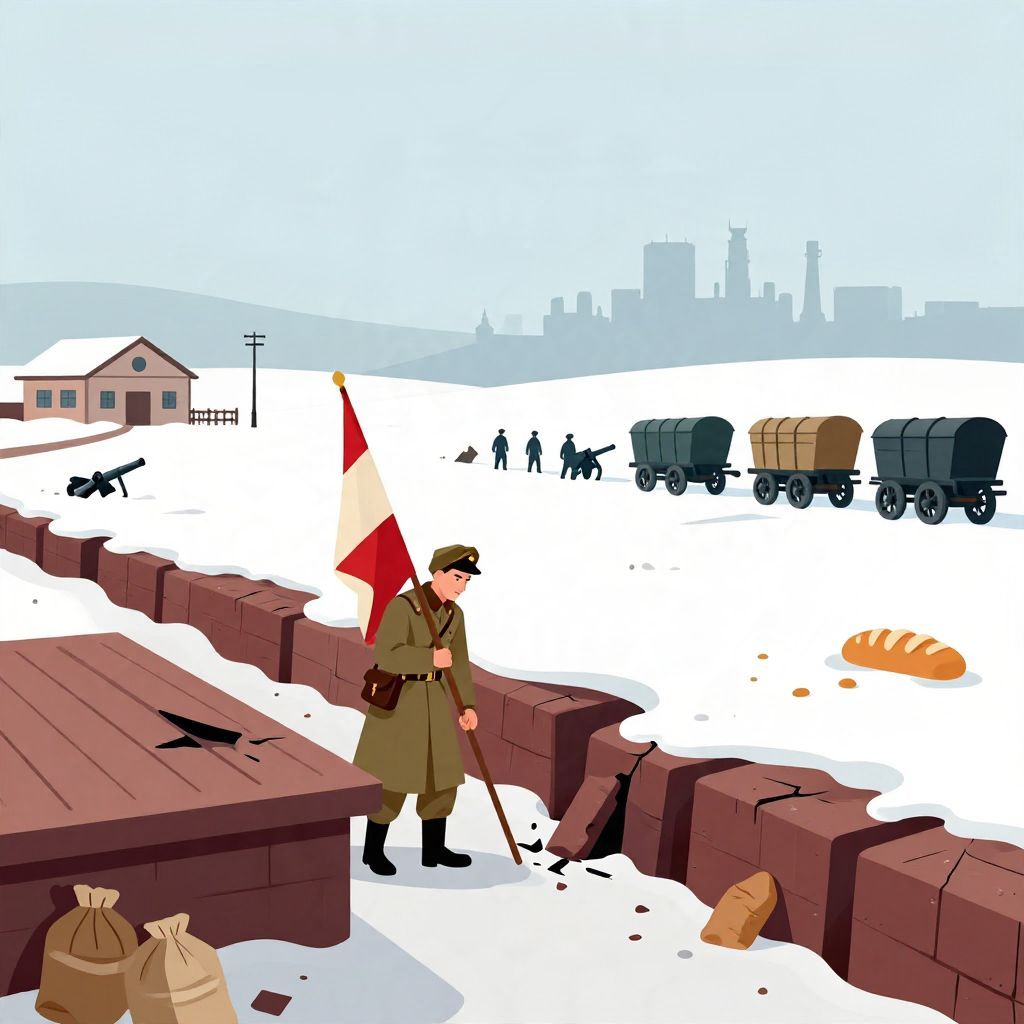
Russia left World War I because the war had become politically, militarily, and economically unsustainable. By 1917, massive battlefield losses, food shortages, collapsing transport, and anger over the Tsarist regime had produced revolution at home. The new Bolshevik government then sought peace quickly, even at the cost of giving up huge territories.
Russia’s exit was not a single decision but the result of two years of crisis that destroyed the old state and made continued fighting impossible.
Why Did Russia Leave WW1?
Russia left World War I because the war overwhelmed the empire. Military defeats, shortages, inflation, and public unrest triggered the 1917 revolutions, which toppled Tsar Nicholas II and then brought the Bolsheviks to power. The Bolsheviks wanted peace immediately, so they signed the Treaty of Brest-Litovsk in March 1918.
The War Exposed Russia’s Weaknesses
Russia entered World War I in August 1914 with deep structural problems. It was a huge empire with a largely peasant population, uneven industrial development, weak infrastructure, and a political system that offered little room for reform. The war did not create all these weaknesses, but it magnified them dramatically.
Military defeats shattered confidence
Russian armies fought hard, but they were often poorly equipped and badly supplied. Early defeats against Germany and Austria-Hungary, especially in East Prussia and Poland, cost Russia enormous numbers of men. Even when Russia won some victories, the losses were severe and the army’s morale steadily declined.
By 1916, the Russian army still existed, but its effectiveness was eroding. Soldiers lacked rifles, ammunition, boots, and reliable food supplies. Many units were exhausted. Desertion increased as men grew less willing to die for a government they no longer trusted.
The home front collapsed under wartime pressure
Russia’s economy was not prepared for a long industrial war. Railways were overstretched, making it difficult to move grain, coal, and weapons where they were needed. Cities faced food shortages because supplies could not be transported efficiently, while inflation made wages worth less and less.
In Petrograd and other urban centers, workers stood in long bread lines and endured cold, overcrowded conditions. In the countryside, peasants were frustrated by requisitions, labor shortages, and the absence of millions of men serving at the front. The war touched nearly every household, and resentment spread widely.
How the 1917 Revolutions Changed Russia’s Course
The decisive turning point came in 1917. The war had weakened the monarchy so badly that political crisis became revolution. Once the old regime fell, Russia’s ability to continue the war became even more uncertain. The question was no longer only how to win, but whether the state could survive at all.
The February Revolution ended the Tsarist system
In March 1917, according to the Gregorian calendar then used in much of Europe, protests in Petrograd over bread shortages and war exhaustion escalated into mass strikes and mutiny. Nicholas II abdicated, ending centuries of Romanov rule. A Provisional Government replaced the monarchy, but it chose to keep fighting the war.
This decision proved disastrous. Many Russians wanted peace, land, and bread, not more sacrifice. The Provisional Government lacked strong authority, while soldiers, workers, and peasants increasingly looked to soviets, or councils, for leadership and solutions.
Continuing the war deepened the crisis
The Provisional Government believed Russia had to honor its alliance commitments and preserve national credibility. But continuing the war only made the government more unpopular. A failed summer offensive in 1917 further damaged morale and showed that Russia could not easily recover militarily.
By autumn, the government was losing control. The Bolsheviks, led by Vladimir Lenin, gained support by promising “peace, land, and bread.” Their appeal was powerful because it matched the demands of a population exhausted by war and deprivation.
Why the Bolsheviks Wanted Out of the War
When the Bolsheviks seized power in the October Revolution of 1917, they faced a stark reality: Russia could not continue the war in its existing condition. Lenin and his supporters saw peace as essential to keeping the revolution alive. They believed that if the war continued, the new government would collapse.
Peace was a revolutionary priority
The Bolsheviks were not simply trying to end fighting for humanitarian reasons, though that mattered to many supporters. They also wanted to consolidate power. Ending the war would help them win backing from soldiers and workers, weaken their political opponents, and allow them to focus on internal transformation.
Lenin was willing to accept harsh peace terms because he believed the revolution needed time to survive. In his view, territory could be lost and regained later; the immediate danger was the destruction of Soviet power.
The army could no longer be relied upon
By late 1917, the Russian army had become politically unreliable. Soldiers were deserting, refusing orders, or supporting radical slogans. A state cannot wage a major war effectively if its army no longer believes in the cause or trusts the government. This was one of the clearest reasons Russia left World War I.
The Treaty of Brest-Litovsk
Russia formally left World War I with the Treaty of Brest-Litovsk, signed on 3 March 1918 between Soviet Russia and the Central Powers, especially Germany. The treaty was extremely severe. Russia gave up vast territories and resources, including parts of modern-day Poland, Ukraine, the Baltic region, and areas in the Caucasus.
Why the treaty was so costly
The Central Powers had the military upper hand in negotiations. The Bolsheviks had little leverage, because they had already ordered an end to the war and could not easily resume large-scale fighting. The treaty reflected desperation more than diplomacy.
Many Russians, including opponents of the Bolsheviks, viewed the agreement as humiliating. Yet from the Bolshevik perspective, it was the price of survival. The treaty ended Russia’s participation in the war, but it did not end the violence inside Russia. A brutal civil war soon followed.
Main Causes of Russia’s Exit from World War I
Russia left World War I because several pressures came together at once. No single cause explains the exit on its own. The war became impossible to sustain politically, socially, and militarily.
- Military failure: repeated defeats and enormous casualties weakened the army.
- Economic breakdown: shortages, inflation, and transport failures disrupted daily life.
- Political collapse: the Tsarist regime fell in the February Revolution of 1917.
- Public unrest: workers, peasants, and soldiers demanded peace and relief.
- Bolshevik strategy: the new government prioritized ending the war to protect the revolution.
Was Russia Defeated or Did It Choose to Leave?
Historically, the answer is both. Russia was not simply “beaten out” of the war in a single battlefield collapse, but it was worn down until continuing became impossible. The state fractured from within, and the revolution changed the country’s goals. The Bolsheviks chose to leave because they believed the alternative was worse.
That distinction matters. Russia’s exit was not only a military defeat, though defeat played a major role. It was also a political revolution that transformed the meaning of the war for Russia itself.
What Russia’s Exit Meant for the War
Russia’s withdrawal had major consequences for World War I. It allowed Germany to transfer troops from the Eastern Front to the Western Front in 1918, briefly strengthening the Central Powers. At the same time, the treaty’s harshness exposed the fragility of the new Soviet state and fueled opposition inside Russia.
In the longer term, Russia’s exit helped shape the twentieth century. It marked the collapse of the old imperial order, the rise of Soviet power, and the beginning of a new era of ideological conflict. The decision to leave the war was therefore both an ending and a beginning.
Conclusion
Russia left World War I because the war destroyed the old regime, strained the economy beyond repair, and made continued fighting politically impossible. The February Revolution removed the Tsar, and the Bolsheviks then chose peace to preserve their revolution. If you want more context on the forces that made the war so destructive, see how imperialism led to WW1 and how militarism led to WW1.