
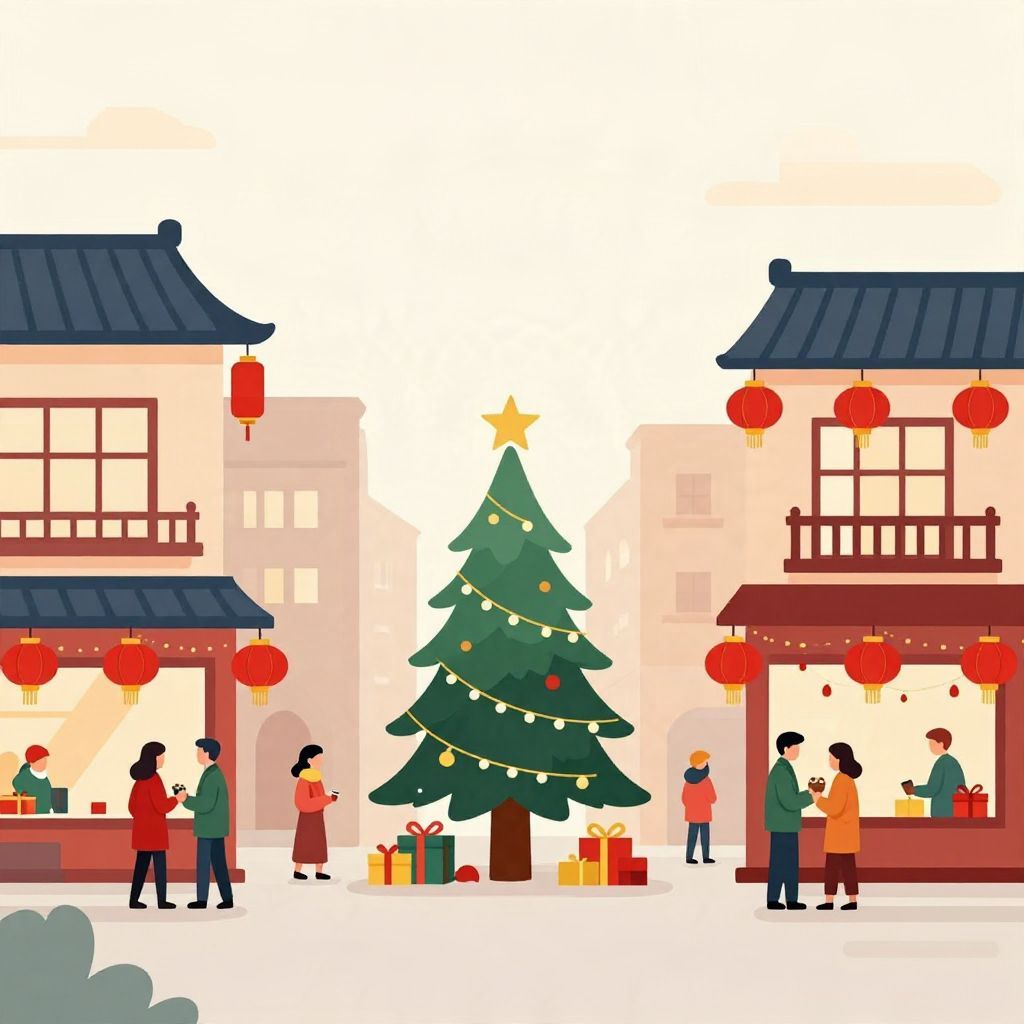
Do Chinese celebrate Christmas? The historical answer is yes, but not in the same way Christmas is celebrated in countries with long Christian traditions. In China, Christmas has been adopted unevenly: as a religious feast for a small Christian minority, and more broadly as a commercial, social, and urban seasonal event.
Its meaning has changed over time. What began as a foreign Christian observance entered China through missionaries, treaty ports, and modern consumer culture, then took on new forms in the 20th and 21st centuries.
Do Chinese Celebrate Christmas?
Yes, many people in China celebrate or acknowledge Christmas, but mostly as a secular or commercial holiday rather than a nationwide religious festival. Christians in China may attend church services and mark the birth of Jesus, while many non-Christians exchange gifts, go shopping, or enjoy festive decorations without religious observance.
How Christmas Arrived in China
Christmas came to China through Christian missions, especially from the 16th century onward, but it remained limited for centuries. Jesuit missionaries in the late Ming period introduced Christian ideas to elite circles, yet Christmas did not become a broad public holiday. Its wider visibility grew much later, during the 19th and early 20th centuries, when Western influence expanded through ports, schools, and churches.
Early missionary contact
Jesuits such as Matteo Ricci worked in China from the late 1500s and early 1600s, but they focused on courtly learning, astronomy, and diplomacy more than public holiday-making. Christianity existed in small communities, and Christmas was observed privately where it was observed at all. For most people in imperial China, it remained unfamiliar.
Treaty ports and urban change
In the 1800s, after the Opium Wars and the opening of treaty ports, foreign merchants, missionaries, and institutions became more visible in cities such as Shanghai, Tianjin, and Guangzhou. Churches, schools, hotels, and department stores helped make Christmas more noticeable. By the early 20th century, urban elites and students could encounter Christmas as part of a modern, international city life.
Religious Christmas in China
Among Chinese Christians, Christmas is a genuine religious holiday centered on worship, prayer, and family gatherings. China has both Catholic and Protestant communities, though the exact size of the Christian population is difficult to measure precisely because of differences between official registration, house churches, and local practice. For these believers, Christmas is about the nativity of Jesus, not just gifts or decorations.
Church services and family observance
In many churches, Christmas Eve and Christmas Day include special services, hymns, and nativity scenes. Families may share meals afterward, exchange small gifts, or visit relatives. In some places, especially in larger cities, churches hold well-attended holiday services despite periodic regulation and local variation in how public religious activity is managed.
Christianity as a minority tradition
It is important to remember that Christians remain a minority in China. That means Christmas has never functioned like a universal national holiday in the way it does in some Western countries. Its religious meaning is real, but it belongs mainly to specific communities rather than to the whole population.
Christmas as a Secular and Commercial Holiday
For many Chinese people today, Christmas is closer to a winter festival of consumption than a religious feast. Shopping malls, restaurants, hotels, and entertainment districts often use Christmas imagery to attract customers. This is especially common in major cities, where global consumer culture has made Christmas a visible part of the year-end season.
Why businesses promoted Christmas
Christmas became attractive to businesses because it offered an imported festive atmosphere that could boost sales in December. Decorations, themed promotions, and gift-giving campaigns fit well with modern retail culture. In this sense, Christmas in China developed less as a church tradition than as a commercial and urban lifestyle event.
What non-Christians may do
Many non-Christian Chinese people do not treat Christmas as a religious day, but they may still participate in parts of it. Common activities can include:
- shopping for gifts or seasonal promotions
- eating at restaurants or cafes with holiday decorations
- taking photos with Christmas trees or lights
- meeting friends for a festive night out
- sending simple holiday greetings
These practices show that Christmas in China is often social and aesthetic rather than devotional.
How Chinese Christmas Differs from Western Christmas
Chinese Christmas is not a single fixed tradition. It varies by region, religion, and generation. In many Western countries, Christmas is tied to family ritual, church attendance, public holiday schedules, and long-established customs. In China, by contrast, the holiday has been selectively adopted and reshaped by modern urban life.
Different symbols, different meanings
Santa Claus, Christmas trees, lights, and gift exchanges are widely recognized in Chinese cities, but their meanings are often detached from Christian theology. A decorated tree in a mall may signal fun, romance, or shopping rather than the Nativity. This is a good example of how a global holiday can be reinterpreted in local culture.
Not a traditional national holiday
Christmas is not one of China’s major state holidays. The country’s official holiday calendar centers on New Year, Spring Festival, Qingming, Labor Day, Dragon Boat Festival, Mid-Autumn Festival, and National Day. Christmas therefore occupies a cultural space that is visible but not central in the national calendar.
Historical and Political Context
The history of Christmas in China cannot be separated from China’s encounter with the West. In the 19th century, Christianity was often associated with foreign power, unequal treaties, and imperial pressure. That history made Christian symbols more complicated than in places where Christianity had developed locally over many centuries.
Missionary history and local suspicion
Because missionaries sometimes arrived alongside foreign political and military influence, Christianity could be viewed with suspicion. This did not prevent conversion or cultural exchange, but it did shape how Christmas was received. In some periods, the holiday was seen as foreign, elite, or urban rather than broadly Chinese.
20th-century disruptions
In the mid-20th century, especially after 1949, public religious life changed dramatically under the new socialist state. Religious practices were restricted in various ways, and public Christmas celebration declined in many settings. Later economic reforms and urban consumer growth allowed Christmas to reappear more visibly, though usually in secularized form.
Christmas in Modern Chinese Cities
Today, Christmas is most visible in major urban centers such as Shanghai, Beijing, Shenzhen, Guangzhou, and Chengdu. These cities have large youth populations, international businesses, foreign residents, and strong retail sectors. As a result, Christmas has become part of a cosmopolitan city calendar even for people with no Christian background.
Youth culture and dating culture
For some young people, Christmas Eve is treated as a romantic evening, similar to Valentine’s Day in function if not in origin. Couples may dine out, exchange small gifts, or visit festive public spaces. This is a modern social custom rather than a historical Chinese tradition, but it helps explain why Christmas has become popular in certain circles.
Regional differences
Christmas is less prominent in rural areas and in places with fewer international businesses or Christian communities. In smaller cities and villages, it may pass with little notice. That unevenness is important: “Chinese Christmas” is not one uniform national practice but a patchwork of religious, commercial, and urban habits.
What Chinese People Actually Mean by “Celebrating Christmas”
When people ask whether Chinese celebrate Christmas, they may mean different things. If they mean “Is Christmas a major traditional Chinese religious festival?” the answer is no. If they mean “Do some Chinese people observe Christmas in churches or in family settings?” the answer is yes. If they mean “Is Christmas visible in Chinese cities and consumer culture?” the answer is also yes.
Three historical layers
- Religious Christmas for Christians, introduced through missionary history and maintained in churches.
- Commercial Christmas in malls, restaurants, and entertainment districts, especially in cities.
- Social Christmas among young people and urban residents who use the holiday as a seasonal outing or romantic occasion.
These layers overlap, but they are not the same thing.
So, Do Chinese Celebrate Christmas?
Yes, Chinese people do celebrate Christmas in several ways, but the celebration is diverse and usually not rooted in the same religious tradition that shaped Christmas in Europe or North America. Historically, Christmas entered China through Christianity and foreign contact; in modern times, it has been reshaped by urban life, commerce, and youth culture. That is why Christmas in China is best understood as a borrowed holiday with local meanings, not a single national tradition.
For readers interested in how religions and foreign cultural practices spread and adapt over time, you may also find how Islam spread and how imperialism led to World War I useful for broader historical context.