
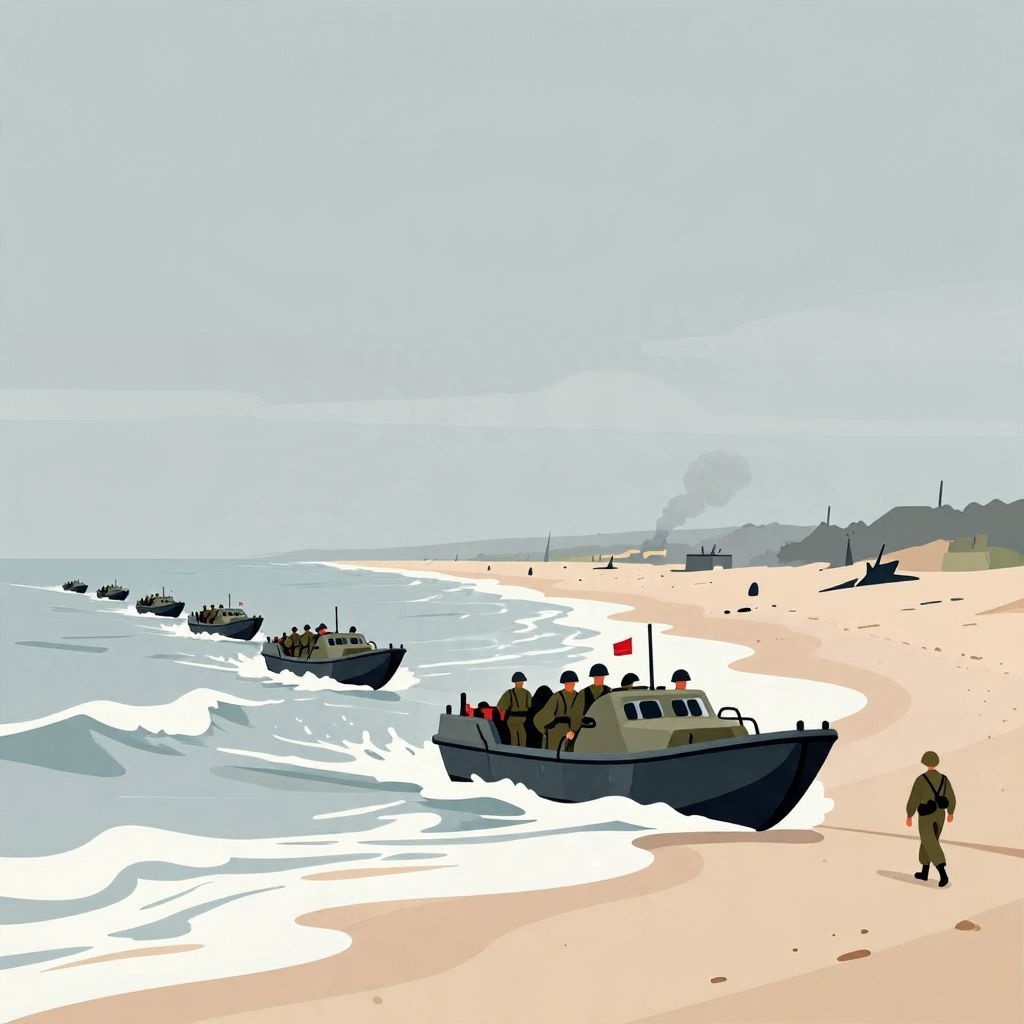
How many Americans died on D-Day? The short answer is that about 2,500 American service members were killed on June 6, 1944, the first day of the Allied invasion of Normandy. That figure is usually given as an estimate because wartime records were compiled in different ways and some deaths were reported after the day itself.
D-Day was the opening assault of Operation Overlord, and the American losses were heaviest at Omaha Beach, where German defenses were strongest and the landing force faced difficult terrain, rough seas, and intense fire.
How many Americans died on D-Day?
Roughly 2,500 Americans were killed on D-Day, June 6, 1944. Historians commonly cite a range of about 2,500 to 2,500-plus deaths for U.S. forces on that day, with the most widely repeated total being around 2,499 killed. The exact number can vary slightly depending on whether a source counts men who died later from wounds received on June 6.
This total refers to American deaths during the first 24 hours of the invasion in Normandy, not the entire Battle of Normandy, which lasted weeks and caused far higher casualties.
Why the number is an estimate
Wartime casualty figures were not always finalized immediately. Some soldiers who were wounded on D-Day died later, and some records separated those deaths from those killed outright on June 6. For that reason, historians often use rounded figures rather than a single perfectly fixed number.
What the total usually includes
- Soldiers, sailors, and airmen killed during the landings and airborne operations on June 6
- Men who died from wounds received that day, if counted in a broader D-Day total
- Deaths from the initial assault phase of Operation Overlord
So when you see a number such as 2,499, it is best understood as a carefully used historical estimate rather than a mathematical claim that every record was identical.
Where American deaths were highest on D-Day
The worst American losses occurred at Omaha Beach. The beach was defended more strongly than planners had expected, and the assault units landed under heavy machine-gun, mortar, and artillery fire. Many landing craft were hit before troops even reached the shore, and some soldiers drowned in rough water or were killed while trying to cross exposed sand and obstacles.
Omaha Beach and the cost of the assault
Omaha became the most dangerous of the five invasion beaches for U.S. forces. Difficult geography, strong German positions, and delays in armor support made the first hours especially deadly. American casualties there were far higher than at Utah Beach, where the landings were more successful and losses were much lighter.
Other American sectors
- Utah Beach: comparatively light American losses
- Airborne drops: significant casualties among paratroopers and glider troops
- Naval and support units: deaths also occurred among crews and support personnel
Even though Omaha dominates the memory of D-Day, American deaths were spread across the invasion force, including airborne troops who landed inland before dawn.
What was D-Day, and why did it matter?
D-Day was the code name for June 6, 1944, the day Allied forces launched the Normandy invasion against Nazi-occupied France. It was the largest amphibious assault in history and a turning point in World War II in Western Europe. The operation opened a second major front against Germany and began the long campaign to liberate France and push into Germany itself.
For the United States, D-Day was not a single isolated battle but the beginning of a massive military effort involving land, sea, and air forces. The American dead on that day were part of a much larger Allied sacrifice.
How many Americans were wounded or missing?
Deaths were only part of the cost. On D-Day, thousands more Americans were wounded, missing, or captured. Exact totals depend on the source and whether the count covers only June 6 or the opening phase of the Normandy invasion. The wounded far outnumbered the dead, especially in the hardest-hit sectors.
These figures matter because they show that D-Day was not simply a successful military operation; it was also a day of severe human loss. Many survivors carried injuries for life, and many families received news of missing relatives before they learned whether those men had survived.
How D-Day casualties compare with the rest of the war
D-Day was one of the most famous days of World War II, but it was only one day in a war that cost the United States far more lives overall. More than 400,000 Americans died in World War II across all theaters of war. D-Day deaths were a small fraction of that total, but their symbolic importance has made them central to public memory.
The landing at Normandy also had a ripple effect. Success on June 6 did not end the fighting; instead, it made possible the long and costly liberation of Western Europe. The battle for Normandy continued for weeks, and American casualties mounted well beyond D-Day itself.
Why the American losses on D-Day are remembered so strongly
D-Day remains one of the most studied and commemorated military operations in modern history because it combined extraordinary planning, enormous risk, and visible sacrifice. The image of young men storming beaches under fire has become a powerful symbol of the Allied effort against Nazi Germany.
The American dead are remembered not only as statistics but as individuals—infantrymen, paratroopers, medics, sailors, and airmen whose service helped change the course of the war. Their losses were part of a broader Allied campaign that required courage, coordination, and endurance on an immense scale.
Why the number still matters
- It shows the human cost of opening the Western Front
- It helps distinguish D-Day from the wider Normandy campaign
- It explains why Omaha Beach became such a lasting symbol of sacrifice
Historical takeaway
So, how many Americans died on D-Day? The best historical answer is about 2,500, with small variations depending on how the records are counted. That number marks only the first day of the Normandy invasion, but it represents one of the most consequential and costly moments in American military history. For related context, see how many Americans died in World War II and, for a broader look at wartime loss in U.S. history, how many died in the Civil War.