
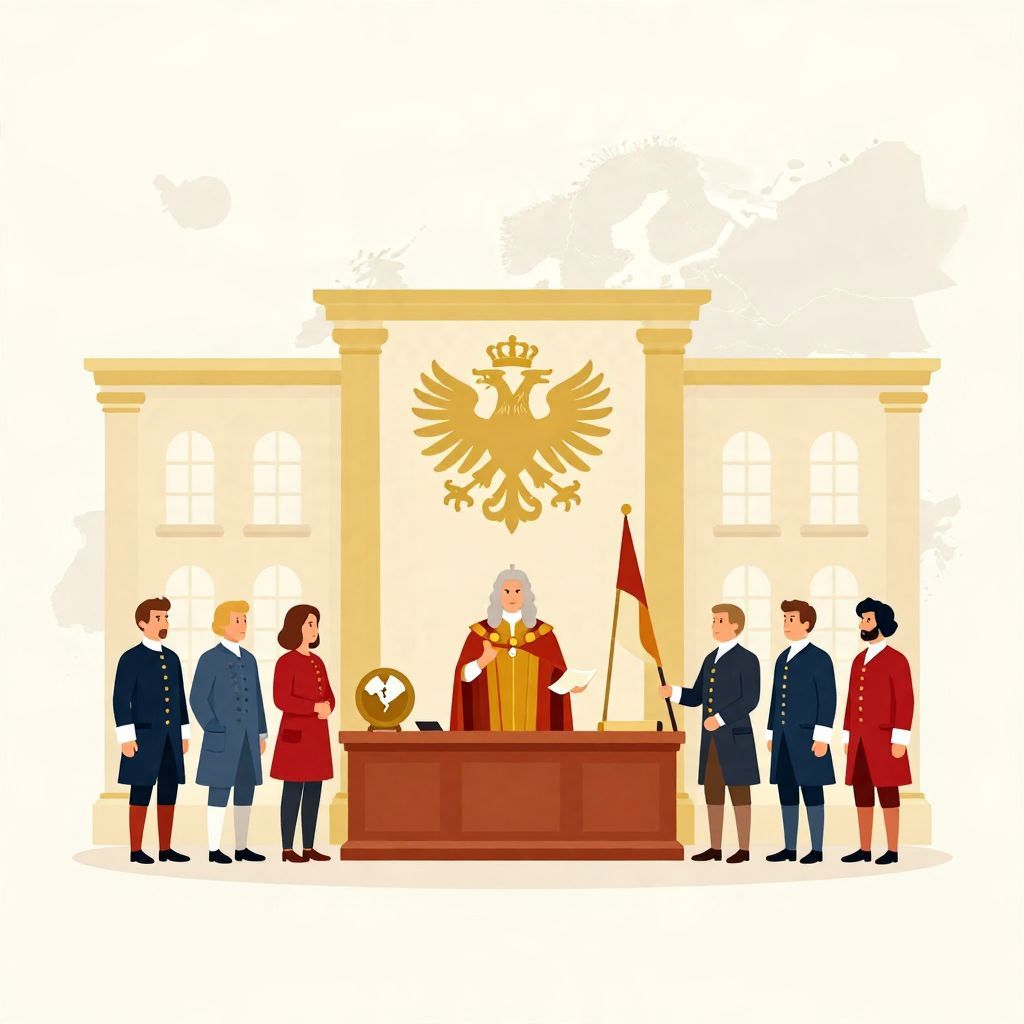
The Holy Roman Empire fell in 1806, when Emperor Francis II formally dissolved the empire on 6 August 1806. The collapse was not a single battlefield defeat but the end point of years of pressure from Napoleonic wars, territorial upheaval, and the loss of imperial authority in central Europe.
In practice, the empire had been weakening for centuries. In law and symbolism, however, 1806 is the accepted date of its end, because that was when the imperial office itself ceased to exist.
When did the Holy Roman Empire fall?
The Holy Roman Empire fell on 6 August 1806, when Francis II abdicated as Holy Roman Emperor and declared the empire dissolved. Historians treat this as the formal end of the medieval and early modern political structure that had existed, in changing form, since 962. By then, Napoleon’s victories had made the old imperial system impossible to sustain.
What happened in 1806?
The decisive moment came after Napoleon reorganized much of Germany under French influence. Following the defeat of Austria and its allies in the War of the Third Coalition, Francis II faced the reality that the empire could no longer function as a sovereign political framework. He renounced the imperial title and released the German states from their obligations to the Holy Roman Empire.
The immediate trigger: Napoleon’s rise
Napoleon’s military and diplomatic power transformed Europe. His victories over Austria and Russia, especially at Austerlitz in 1805, forced major changes in central Europe. French influence encouraged the creation of the Confederation of the Rhine, a group of German states that left the empire and aligned themselves with Napoleon. Once those states departed, the Holy Roman Empire lost much of its practical authority.
Francis II’s decision
Francis II had already taken a defensive step in 1804 by styling himself Emperor of Austria. That move anticipated the possibility that the old imperial structure might not survive. In 1806, after the Confederation of the Rhine was formed, he abdicated the ancient imperial title. This was not merely symbolic: it legally ended the Holy Roman Empire as an institution.
A brief timeline of the empire’s decline
The Holy Roman Empire did not collapse overnight. Its fall was the final stage of a long decline in centralized power. Here is the key sequence:
- 962 – Otto I is crowned emperor, often treated as the beginning of the medieval empire.
- 1648 – The Peace of Westphalia strengthens the independence of German princes and weakens imperial centralization.
- 1803 – The Reichsdeputationshauptschluss redistributes church lands and reshapes the empire after French victories.
- 1804 – Francis II becomes Emperor of Austria, signaling the declining relevance of the old imperial crown.
- 1805 – Austria is defeated at Austerlitz.
- 1806 – The Confederation of the Rhine is created; Francis II dissolves the Holy Roman Empire on 6 August.
Why did the Holy Roman Empire fall?
The empire fell because its structure had become too fragmented to resist modern warfare and centralized states. It was a loose federation of princes, bishops, cities, and kingdoms rather than a unified nation-state. Over time, emperors found it increasingly difficult to enforce laws, raise armies, or command loyalty across the empire’s many territories.
Weak central authority
Unlike France or Britain, the Holy Roman Empire never developed a strong centralized bureaucracy. The emperor’s power depended on negotiation with territorial rulers. That arrangement could function when imperial prestige was strong, but it became a liability as European politics changed. By the 18th century, many German princes acted almost like independent sovereigns.
Religious and political fragmentation
The Reformation and the religious wars of the 16th and 17th centuries deepened division. The empire remained an umbrella over Catholic and Protestant territories, but that pluralism made unified rule difficult. The Peace of Westphalia in 1648 preserved the empire while also confirming the autonomy of its constituent states. In effect, it legitimized fragmentation.
French revolutionary and Napoleonic pressure
The French Revolutionary Wars and the Napoleonic Wars exposed the empire’s weakness. French armies repeatedly crossed the Rhine and altered the balance of power in Germany. Napoleon’s creation of client states and alliances made the old imperial order obsolete. The empire’s institutions could not compete with the speed and force of French military organization.
Was the empire already “dead” before 1806?
Some historians argue that the empire had been politically hollow long before 1806. In this view, the dissolution was the formal end of a system that had already lost much of its power. Others emphasize that the empire still mattered legally and diplomatically until Francis II ended it. Both views are useful: the empire was weakened for centuries, but it was not officially gone until 1806.
The difference between decline and dissolution
Decline means loss of power and coherence over time. Dissolution means legal termination. The Holy Roman Empire experienced both. It gradually became less effective as a governing structure, especially after 1648, but it remained a recognized imperial framework until Francis II’s abdication. That is why 1806 remains the standard answer to the question of when it fell.
What was the Holy Roman Empire, exactly?
The Holy Roman Empire was a complex political entity in central Europe, centered on the German-speaking lands but extending beyond them at different times. It was neither “holy” in a modern religious sense nor “Roman” in the sense of ruling from ancient Rome. The title reflected medieval ideals of Christian empire and continuity with the legacy of the Roman Empire.
Why the name is misleading
The empire was not a single nation-state. It was a patchwork of duchies, bishoprics, free cities, principalities, and kingdoms under an emperor whose authority varied by period. The “Roman” part was a claim to legitimacy, not a geographic description. The “holy” part reflected its Christian character and the emperor’s role as protector of Christendom.
How it differed from later empires
Modern readers often imagine an empire as a centralized colonial power. The Holy Roman Empire was different. It was more like a constitutional order with layered rights and obligations. Its emperor ruled through compromise, tradition, and election, not absolute monarchy. That unusual structure helps explain both its longevity and its eventual vulnerability.
Key events that led to the end
Several developments made the empire increasingly fragile in the decades before 1806. Among the most important were:
- The rise of territorial states – Powerful rulers such as those in Austria, Prussia, and Bavaria built stronger administrations within the empire.
- The Peace of Westphalia – This settlement reduced imperial intervention and confirmed the independence of many princes.
- The 18th-century rivalry between Austria and Prussia – German politics became dominated by competition between these two powers rather than by imperial unity.
- French military dominance – Napoleon’s victories shattered the old balance of power.
- The Confederation of the Rhine – This new political arrangement removed many member states from imperial control.
What happened after the empire fell?
The end of the Holy Roman Empire did not immediately create a unified Germany. Instead, central Europe remained divided among many states. Austria continued as a separate empire, while Prussia grew in strength. The Napoleonic era accelerated political change, and the question of German unity would remain unresolved until the 19th century.
Long-term consequences
The dissolution of the empire helped reshape the map of Europe. It reduced the old medieval framework of overlapping jurisdictions and pushed German politics toward modern statehood. It also marked a symbolic turning point: the end of an empire that had claimed continuity with Rome for nearly a thousand years.
Why historians still care about 1806
Historians study the fall of the Holy Roman Empire because it shows how political systems can endure long after their original purpose has faded. The empire was often criticized as unwieldy, yet it survived for centuries because it adapted to changing circumstances. Its end reveals the power of war, reform, and state-building in early modern Europe.
The best answer to when did the Holy Roman Empire fall is simple: 6 August 1806. But the deeper story is one of gradual weakening, foreign pressure, and the transformation of Europe from a medieval imperial order into a continent of modern states. If you want more context on the German lands after 1806, related reading on Prussia can help, as can a broader look at later German state power and institutions.