
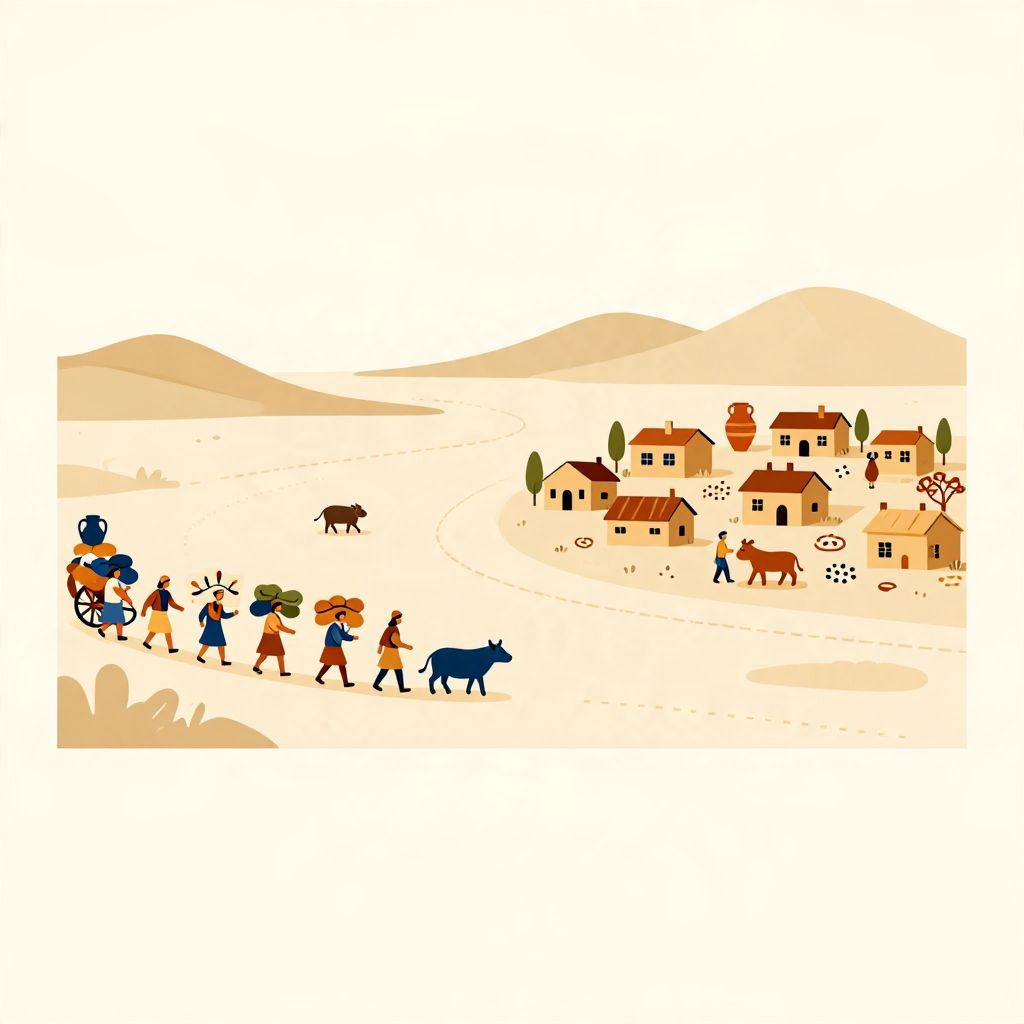
What is relocation diffusion? In history and geography, it is the spread of ideas, customs, technologies, or languages when people move from one place to another and carry their culture with them. Unlike diffusion that spreads through contact alone, relocation diffusion depends on migration.
This process has shaped empires, religions, cities, languages, and everyday life for thousands of years. From ancient trade settlements to modern refugee movements, relocation diffusion helps explain how cultures travel, adapt, and sometimes transform the places where migrants settle.
What Is Relocation Diffusion?
Relocation diffusion is the spread of cultural traits through the physical movement of people. When migrants, merchants, soldiers, refugees, or settlers move, they bring language, food, beliefs, skills, and social customs with them. Over time, these traits may take root in a new region, even if they fade in the place they left behind.
How it differs from other types of diffusion
Historians and geographers usually distinguish relocation diffusion from two related processes. In contagious diffusion, ideas spread outward through direct contact, like an infection moving from person to person. In hierarchical diffusion, ideas spread from a center of power or prestige to other places. Relocation diffusion is different because the carriers of culture actually move.
That difference matters. A religion can spread by missionaries, a language can spread through conquest or settlement, and a food tradition can travel with migrant communities. In each case, the movement of people is the engine of diffusion.
Why Did Relocation Diffusion Happen in History?
Relocation diffusion has been common throughout history because people have always moved for survival, opportunity, and security. Some migrated voluntarily in search of land, trade, or work. Others moved under pressure from war, famine, persecution, slavery, or empire-building. Wherever they went, they carried parts of their home culture with them.
Common historical causes
- Trade — merchants established communities abroad and introduced new goods and customs.
- Conquest — armies and settlers spread language, law, and religion into new territories.
- Forced migration — enslaved people, deported populations, and refugees carried culture under coercive conditions.
- Colonization — settlers transplanted institutions, farming methods, and social practices.
- Religious movement — missionaries and pilgrims spread beliefs into new regions.
Because migration is often tied to power, relocation diffusion can be both creative and disruptive. It may enrich a new region culturally, but it can also displace local traditions or create conflict over land, identity, and authority.
Origins and Historical Development of the Idea
The term relocation diffusion is modern, but the phenomenon is ancient. Historians have long observed that migration changes cultures. The formal vocabulary of diffusion became especially important in modern geography and anthropology, where scholars tried to explain how cultural traits spread across space.
In the twentieth century, cultural geographers used diffusion models to classify patterns of spread. Relocation diffusion became one of the standard categories because it helped explain historical change in a more precise way than broad statements about “influence” or “exchange.” The concept is now widely used in history, geography, sociology, and migration studies.
Why the concept matters historically
Relocation diffusion helps historians trace how societies changed without assuming that culture spread in only one direction. It shows that people are not passive recipients of ideas; they are carriers, adapters, and creators of culture. A migrating group may preserve some traditions, modify others, and blend them with local practices.
Examples of Relocation Diffusion in World History
Relocation diffusion appears in nearly every major period of history. Some of the clearest examples come from migration, empire, and diaspora communities. These cases show how movement reshapes both the migrants and the societies they join.
The spread of languages through migration
Languages often spread through relocation diffusion when speakers move into new areas. The expansion of Latin across the Roman Empire is a classic example. Roman soldiers, administrators, merchants, and settlers helped Latin take root in many provinces. Over centuries, local speech mixed with Latin and eventually contributed to the Romance languages, including French, Spanish, Portuguese, Italian, and Romanian.
Another example is the spread of Bantu languages across much of sub-Saharan Africa over a long and complex period, beginning roughly in the second millennium BCE and continuing for centuries. As communities migrated, they brought farming techniques, tools, and languages that influenced large regions of the continent.
Religions carried by migrating communities
Relocation diffusion has also shaped religious history. Jewish diasporas after the Babylonian exile and later after the Roman destruction of Jerusalem spread Jewish communities across the Mediterranean and beyond. These communities preserved religious traditions while adapting to local conditions.
Islam spread in part through migration and settlement, especially through merchants and scholars traveling across North and East Africa, the Indian Ocean, and Southeast Asia. In many places, conversion was gradual and connected to trade networks, intermarriage, and the influence of settled Muslim communities rather than conquest alone.
Christianity also spread through relocation diffusion. Missionaries, settlers, and migrants carried the faith across Europe, Africa, Asia, and the Americas. In some cases, migration created new centers of religious life far from the original homeland.
Trade diasporas and merchant communities
Merchant diasporas are among the most important historical carriers of relocation diffusion. Trading communities often settled in foreign ports and established neighborhoods that preserved their language, cuisine, dress, and business practices. Over time, these communities influenced local society while also adapting to it.
The Armenian, Chinese, Indian, Greek, and Arab diasporas all played major roles in spreading commercial practices and cultural traditions. Their impact was not limited to trade goods; they also helped move scripts, religious ideas, architectural styles, and family networks across long distances.
Colonization and settler societies
European expansion from the fifteenth century onward created many examples of relocation diffusion. Settlers in the Americas, southern Africa, Australia, and New Zealand brought languages, legal systems, crops, and religious traditions with them. In some regions, these traditions became dominant; in others, they mixed with Indigenous cultures in uneven and often violent ways.
This process was rarely simple cultural exchange. Colonization often involved conquest, disease, forced labor, and the suppression of local traditions. Relocation diffusion in colonial settings therefore must be understood alongside power and coercion.
How Relocation Diffusion Changes Culture
Relocation diffusion does not usually produce a perfect copy of the original culture. Once people settle in a new place, they adapt to local geography, climate, politics, and social relationships. As a result, the culture they carry often changes in the process of being transplanted.
Three common outcomes
- Preservation — migrants maintain traditions from their homeland, especially in religion, language, and family life.
- Adaptation — customs change to fit the new environment, such as foodways adjusted to local ingredients.
- Blending — migrant and local cultures combine, producing new forms of dress, speech, music, or belief.
This is why relocation diffusion is closely connected to cultural change. It can preserve memory, but it can also generate hybrid cultures. Cities with long histories of migration often show this most clearly in neighborhoods, festivals, cuisine, and multilingual life.
Relocation Diffusion in Modern History
Modern transportation, industrialization, and global conflict greatly increased the scale of relocation diffusion. Steamships, railroads, and later air travel made migration faster and more far-reaching. At the same time, wars, famine, and political upheaval displaced millions of people.
Migration in the age of empire and industry
During the nineteenth and early twentieth centuries, millions of Europeans migrated to the Americas, Australia, and parts of Africa. They carried languages, religious practices, political ideas, and labor traditions into new settings. Many communities maintained strong ties to their homelands while also becoming part of new national cultures.
Indentured labor migration also spread cultural practices across the Indian Ocean and the Caribbean. Workers from India, China, and other regions carried food traditions, religious observances, and family customs into plantation societies, where they interacted with local populations and colonial systems.
Refugees and forced displacement
The twentieth century saw relocation diffusion on a massive scale through forced migration. Refugees from war, genocide, and political repression reshaped societies across Europe, the Middle East, Africa, and Asia. Their movement often preserved endangered traditions in exile while also introducing those traditions to new countries.
At the same time, forced displacement can fracture communities and weaken cultural continuity. Relocation diffusion in these cases is not a neat or voluntary process; it is often a story of loss as well as survival.
Relocation Diffusion and Identity
One of the most important historical effects of relocation diffusion is the creation of new identities. Migrants rarely remain exactly as they were before moving, and host societies rarely remain unchanged. Over generations, new identities emerge from the interaction of memory, adaptation, and local belonging.
This is especially visible in diasporas, where people maintain a connection to an ancestral homeland while building lives elsewhere. Such communities may preserve festivals, religious law, family structures, or language use, but they may also develop new practices unique to their new setting.
Not all cultural spread works the same way
It is useful to remember that relocation diffusion is only one form of cultural spread. A musical style might spread through mass media without migration, while a religion might spread through both missionary movement and local conversion. Historical change often involves several forms of diffusion at once.
Still, relocation diffusion is especially important because it shows how human movement shapes history at ground level. It is not just about ideas traveling; it is about people rebuilding life in new places.
Why Relocation Diffusion Still Matters Today
Relocation diffusion remains highly relevant in the modern world. Migration continues to shape cities, politics, labor markets, food cultures, and religious landscapes. New migrants may establish schools, businesses, temples, mosques, churches, or community centers, all of which influence the wider society around them.
Understanding relocation diffusion also helps explain debates over assimilation, multiculturalism, and national identity. Many historical tensions over language policy, citizenship, and cultural rights are rooted in the movement of people and the cultural changes that follow.
Conclusion: The Historical Meaning of Relocation Diffusion
Relocation diffusion is the spread of culture through migration, and it has been one of the most powerful forces in history. It explains how languages expanded, religions traveled, diasporas formed, and new societies emerged from movement, contact, and adaptation. In the past and today, people have carried culture wherever they went.
To see how this process connects to broader patterns of exchange, you may also want to read about cultural diffusion and acculturation.