
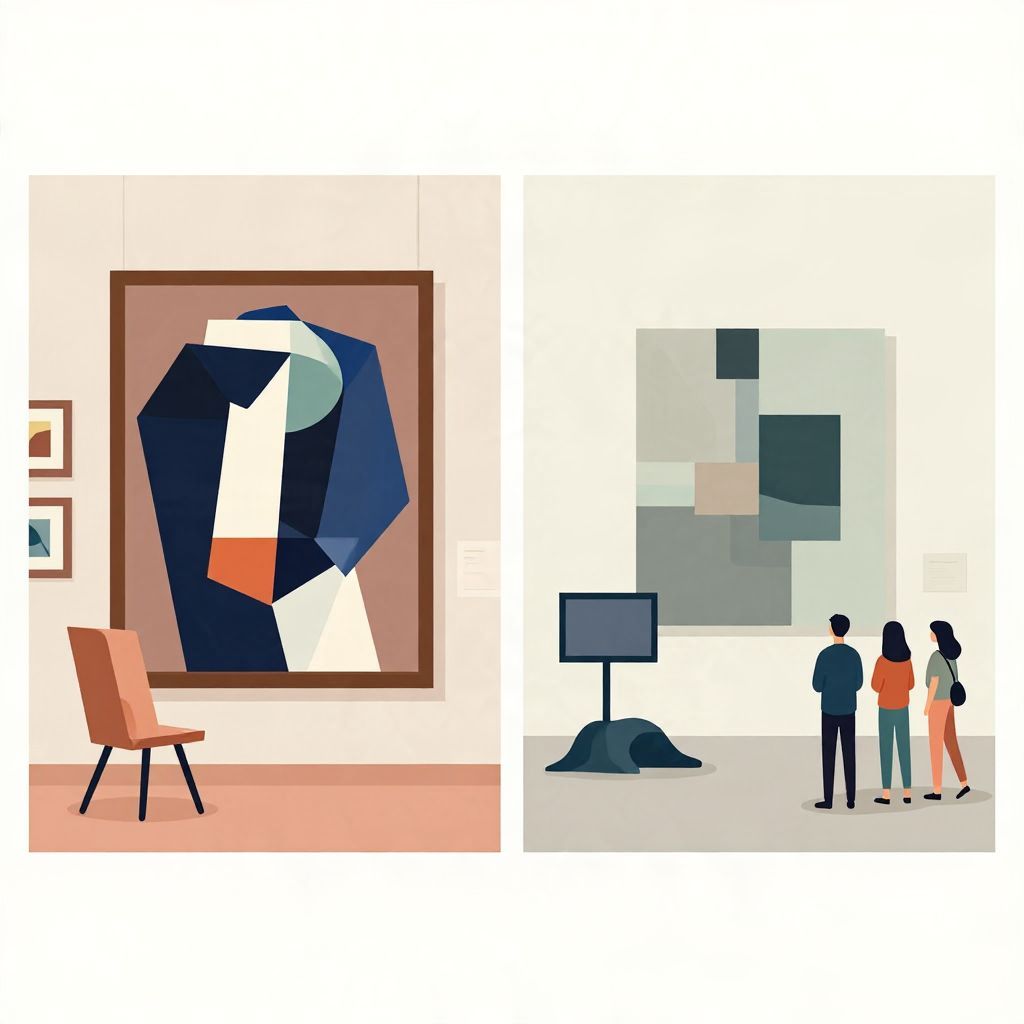
What is the difference between modern and contemporary art? The short answer is that modern art refers to a historical movement that developed roughly from the late 19th century through the mid-20th century, while contemporary art means art made in the present era, usually from the 1960s or 1970s onward to today.
The two terms are often confused because “modern” can sound like “current,” but in art history they mean different things. Modern art is now a specific historical period; contemporary art is the art of our own time.
What Is The Difference Between Modern And Contemporary Art?
Modern art is a historical category for art created during the modernist era, when artists broke away from academic traditions and experimented with form, color, perspective, and subject matter. Contemporary art refers to art made in the present period, often shaped by conceptual ideas, global exchange, digital media, installation, performance, and social commentary.
Modern Art: A Historical Movement, Not Just “Recent” Art
Modern art emerged in Europe and later spread internationally as artists responded to industrialization, urban life, photography, new political ideas, and the shock of rapid social change. It is usually associated with the period from the 1860s or 1870s through about the 1960s, though the exact boundaries vary by historian and region.
What defined modern art?
Modern artists often rejected the idea that art had to imitate reality exactly. Instead, they emphasized the artist’s vision and the formal qualities of the work itself. That led to movements such as Impressionism, Post-Impressionism, Fauvism, Cubism, Futurism, Abstract Expressionism, and other modernist styles.
Key features of modern art often include:
- Experimentation with color, line, and composition
- Interest in abstraction and distortion
- Rejection of traditional academic realism
- Focus on individual expression
- Engagement with modern life, industry, and speed
Why modern art mattered historically
Modern art was revolutionary because it challenged older assumptions about beauty, technique, and the purpose of art. Artists such as Claude Monet, Pablo Picasso, Wassily Kandinsky, Piet Mondrian, and Jackson Pollock helped redefine what painting and sculpture could be. Their work reflected a broader cultural shift: the modern world was changing, and art changed with it.
Contemporary Art: Art of the Present Era
Contemporary art usually refers to art made from the late 20th century to the present day. Unlike modern art, it is not defined by a single style or movement. Instead, it includes many approaches at once, from painting and sculpture to video, performance, installation, photography, digital art, and socially engaged projects.
What makes contemporary art different?
Contemporary art is often less about a unified style and more about ideas, context, and questioning the nature of art itself. Many contemporary artists explore identity, globalization, memory, technology, climate change, migration, race, gender, and politics. The work may be visual, but it may also involve participation, sound, text, or temporary environments.
Common characteristics of contemporary art include:
- Use of mixed media and new technologies
- Conceptual or idea-driven approaches
- Attention to social and political issues
- Global rather than purely European or American influence
- Blurring of boundaries between art, design, and activism
Modern vs Contemporary Art: The Main Historical Difference
The most important difference is chronological. Modern art is a past historical period; contemporary art is the art being made now. In museums and art history, “modern” does not simply mean “new.” It refers to a specific era that has already ended, while contemporary art continues to evolve.
A simple timeline
- Mid-19th century to early 20th century: Early modern movements develop, including Impressionism and Post-Impressionism.
- Early 20th century to mid-20th century: Major modernist movements flourish, including Cubism, Surrealism, and Abstract Expressionism.
- 1960s to present: Contemporary art emerges, including Pop art, Minimalism, Conceptual art, installation, performance, and digital practices.
This timeline is approximate. Different museums and scholars draw the line at different moments, especially because some modernist styles continued well into the 1960s and some contemporary practices began earlier.
How Modern Art and Contemporary Art Differ in Style and Purpose
1. Style
Modern art often has recognizable stylistic movements. For example, Cubism breaks objects into geometric forms, while Abstract Expressionism emphasizes gesture and emotional energy. Contemporary art, by contrast, may not have a single identifiable style at all. One artist may work in video, another in sculpture, another in conceptual text-based pieces.
2. Subject matter
Modern artists frequently focused on perception, form, and the experience of modern life. Contemporary artists often address broader cultural and political questions, including consumerism, identity, environmental crisis, and digital culture. Of course, there is overlap: modern art could also be political, and contemporary art can still be formal or abstract.
3. Materials and methods
Modern artists expanded traditional media such as painting and sculpture. Contemporary artists have pushed further, using found objects, live action, sound, video, software, social media, and interactive installations. The rise of new media is one reason contemporary art looks so different from earlier modernist work.
Why the Terms Are So Often Confused
People often use “modern” to mean “current,” but art history uses the word differently. That creates confusion in everyday conversation. A painting made in 2024 may be called “modern” in casual speech, but in art-historical terms it is contemporary.
There is also overlap in museum language. Some institutions have “modern art” departments and “contemporary art” departments, but the boundary can shift depending on the collection. A work from the 1950s may be considered late modern, early contemporary, or transitional, depending on the framework used.
Modernism and contemporary art are related, but not identical
Contemporary art did not appear out of nowhere. It grew partly from modernism’s challenge to tradition. Many contemporary artists inherited modernist freedoms: the idea that art does not have to look realistic, obey academic rules, or stay within one medium. But contemporary art often goes further by questioning whether the object itself is even the main point of the artwork.
Key Historical Shifts That Separate the Two
Several broad historical developments helped move art from modern to contemporary forms.
- World War II and its aftermath: The destruction and political upheaval of the mid-20th century changed artistic centers and intellectual priorities.
- The rise of the United States as an art center: After 1945, New York became especially important in the art world.
- Mass media and consumer culture: Television, advertising, and photography influenced art in new ways.
- Decolonization and globalization: Artists outside Europe and North America gained greater visibility, broadening the art world.
- Digital technology: New tools transformed how art is made, shared, and experienced.
These changes helped shift art away from the modernist search for formal innovation alone and toward a more pluralistic, global, and concept-driven contemporary scene.
Examples of Modern Art and Contemporary Art
Examples of modern art
Modern art includes works such as Monet’s impressionist landscapes, Picasso’s Les Demoiselles d’Avignon, Kandinsky’s abstract paintings, and Pollock’s drip paintings. These works are historically tied to the modernist period and its experiments with form and perception.
Examples of contemporary art
Contemporary art includes installations by artists like Ai Weiwei, performance-based work, large-scale conceptual projects, digital and video art, and socially engaged art practices. The category is broad, so the defining feature is not style but time period and context.
How Museums and Historians Use the Terms
Museums, galleries, and art historians use “modern” and “contemporary” as organizing categories, but they do not always agree on the exact cutoff date. In general, modern art collections cover the late 19th century through the mid-20th century, while contemporary collections begin around the 1960s or 1970s and continue to the present.
Because art history is not perfectly tidy, some artists and works sit between categories. A painter active in the 1950s and 1960s may be described as late modern or early contemporary. That ambiguity is normal and reflects the fact that cultural change happens gradually, not in neat calendar boxes.
Quick Comparison: Modern Art vs Contemporary Art
- Modern art: a historical movement from roughly the late 19th century to the mid-20th century
- Contemporary art: art made from the late 20th century to the present
- Modern art: often focused on formal innovation and breaking with tradition
- Contemporary art: often focused on ideas, context, identity, and new media
- Modern art: includes identifiable movements like Cubism and Surrealism
- Contemporary art: includes a wide range of practices with no single dominant style
Conclusion: The Historical Difference in One Sentence
The difference between modern and contemporary art is mainly historical: modern art belongs to the modernist era of experimentation and rupture, while contemporary art is the diverse art of the present, shaped by global culture, new media, and ongoing social change. For related reading, see what modernist sculpture is and what Bauhaus design is.