
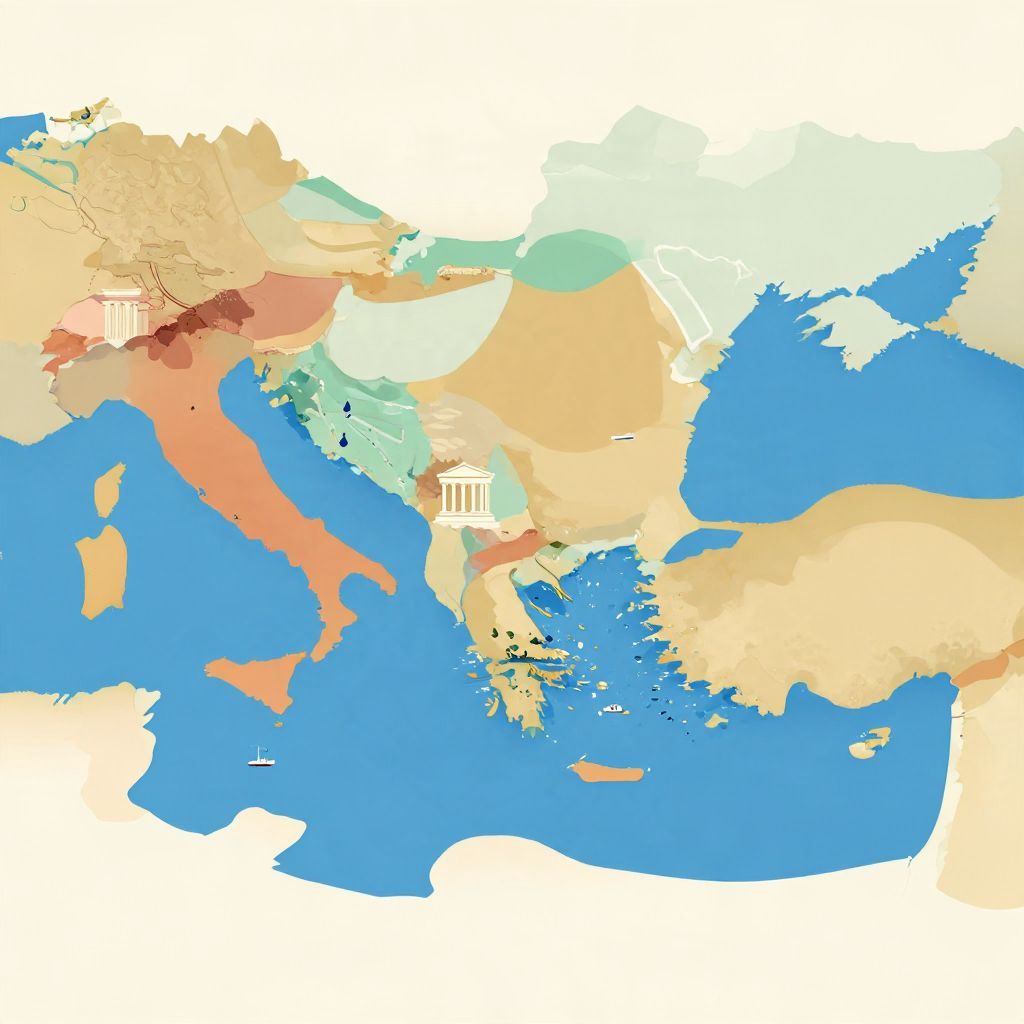
Is Greece in Italy? No—Greece and Italy are separate countries in southern Europe, divided by the Ionian Sea and the Adriatic Sea. Greece lies to the southeast of Italy, across the water, while Italy forms the boot-shaped peninsula extending into the Mediterranean.
The confusion is understandable because the two countries have been closely connected for thousands of years through trade, colonization, war, religion, and art. In antiquity, Greek settlements spread across parts of southern Italy, and later Roman culture absorbed much of Greek learning. But geographically and politically, Greece has never been part of Italy.
Is Greece in Italy?
No. Greece is not in Italy. Greece is an independent country in southeastern Europe, while Italy is a separate country in south-central Europe. They are neighbors across the Ionian Sea, but they have distinct borders, histories, and governments.
Where Greece and Italy Are Located
Modern Greece occupies the southern end of the Balkan Peninsula and many islands in the Aegean and Ionian seas. Italy stretches south from the Alps into the Mediterranean, including the Italian Peninsula and islands such as Sicily and Sardinia. The two countries are closest in the region around the Ionian Sea, especially between western Greece and southern Italy.
Geographic relationship at a glance
- Greece: southeastern Europe
- Italy: south-central Europe
- Separation: the Ionian Sea and parts of the Mediterranean
- Closest historical contact zone: southern Italy and Sicily
Why People Sometimes Think Greece Is in Italy
The idea usually comes from history rather than geography. Ancient Greek colonists founded many cities in southern Italy and Sicily, creating a region the Romans later called Magna Graecia, or “Greater Greece.” Because Greek language, religion, architecture, and philosophy were so influential there, the area could seem “Greek” even though it was never part of Greece itself.
Magna Graecia and Greek settlement in Italy
From roughly the 8th century BCE onward, Greeks established colonies along the coasts of southern Italy and Sicily. Cities such as Taras (modern Taranto), Sybaris, Croton, and Naples became important centers of Greek culture. These settlements were politically independent from mainland Greece, but they preserved Greek identity, making the region one of the most Hellenized parts of the western Mediterranean.
This is the main historical reason the question arises. A traveler reading about “Greek Italy” or “Greater Greece” may assume Greece itself was inside Italy, when in fact the phrase refers to Greek colonies located on Italian soil.
Ancient Greece and Ancient Italy Were Connected, Not the Same
Greece and Italy were separate regions in antiquity, but they interacted constantly. Greek city-states traded with Italic peoples, founded colonies in the west, and influenced local cultures. Meanwhile, the peoples of the Italian peninsula developed their own societies, including the Etruscans, Latins, Samnites, and others, before Rome rose to dominance.
The Roman conquest and Greek influence
By the 3rd century BCE, Rome had conquered much of southern Italy and later absorbed Sicily, Greece, and the eastern Mediterranean into its expanding empire. Roman elites admired Greek education, literature, and art, and many Greek teachers, physicians, and scholars worked in Roman society. This cultural borrowing was extensive, but it did not erase the difference between Greece and Italy.
Instead, Rome became a bridge between them. Greek culture deeply shaped Roman civilization, and Roman rule later spread Greco-Roman traditions across Europe and the Mediterranean. That long exchange is one reason the histories of Greece and Italy are often discussed together.
What About Greek Communities in Italy Today?
There are still small Greek-speaking or Greek-descended communities in parts of southern Italy, especially in areas of Calabria and Salento. These communities are remnants of long historical contact, though most Italians in those regions speak Italian or local dialects today. Their presence reflects centuries of migration, settlement, and cultural blending rather than any political connection to modern Greece.
Greek heritage in southern Italy
- Ancient Greek colonies left lasting linguistic and cultural traces
- Byzantine influence later reinforced eastern Christian traditions in parts of southern Italy
- Some local dialects preserve words and features linked to Greek history
- Modern Greek-Italian identity is cultural, not territorial
How the Byzantine and Medieval Worlds Kept the Connection Alive
After the fall of the Western Roman Empire in the 5th century CE, the eastern Roman, or Byzantine, Empire continued to use Greek as its main language. Byzantine rule and influence reached parts of southern Italy at different times, especially in coastal areas. This helped preserve Greek religious, artistic, and administrative traditions in the region.
During the Middle Ages, southern Italy became a zone of competition among Byzantines, Lombards, Normans, and later other powers. Greek monasteries, liturgical traditions, and place names survived in some areas, adding another layer to the region’s mixed heritage. Even so, these developments never made Greece part of Italy; they simply show how closely linked the Mediterranean world was.
Greece and Italy in the Modern Era
In the modern period, Greece and Italy emerged as separate nation-states. Italy unified in the 19th century, completing political unification in 1861 and later incorporating Rome in 1870. Greece won independence from the Ottoman Empire in the 1820s and 1830s, with international recognition following in the 1830s. Since then, both have existed as distinct sovereign states.
Modern political distinction
- Ancient era: Greek colonies appear in southern Italy
- Roman era: Rome rules both Italy and Greece separately within one empire
- Byzantine and medieval eras: Greek influence remains strong in parts of Italy
- 19th century: modern Italy and modern Greece form as separate nations
- Today: Greece and Italy are neighboring EU member states
Why the Confusion Matters Historically
Asking whether Greece is in Italy opens a useful historical question: how do cultures move without borders moving with them? The eastern Mediterranean and the Italian peninsula have been linked by migration, conquest, commerce, and religion for more than 2,500 years. Greek ideas helped shape Roman and later European civilization, while Italy became a major center of transmission for classical learning during the Renaissance.
That is why the two countries often appear together in history books. Their relationship is one of the most important examples of cultural exchange in the ancient and medieval Mediterranean world.
Direct Answer: Greece Is Not in Italy
To be clear, Greece is not in Italy geographically, politically, or historically. Greece is its own country in southeastern Europe. The confusion comes from the deep Greek presence in southern Italy, especially in the ancient colonies of Magna Graecia, and from the long, shared history of the Mediterranean world.
If you want to explore the wider context, you may also enjoy reading about what Greece is known for and why the Renaissance started in Italy. The short answer remains the same: Greece is not in Italy, but the two countries have been historically intertwined for millennia.