
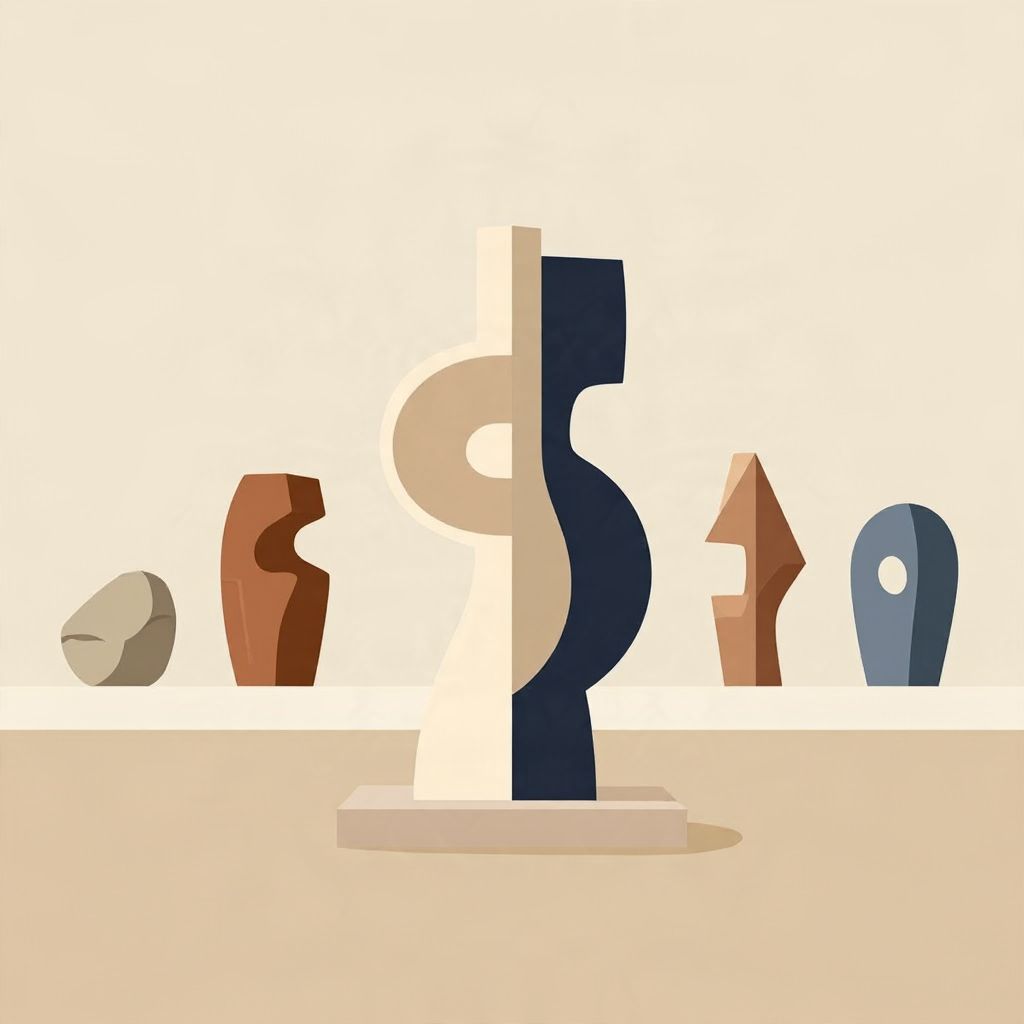
Abstract sculpture is one of the most important developments in modern art, but it can be hard to define at first glance. Unlike traditional sculpture, which usually depicts recognizable people, animals, or objects, abstract sculpture emphasizes shape, material, space, line, and form rather than direct imitation.
Its history is closely tied to the wider rise of modernism in the late 19th and early 20th centuries, when artists began questioning whether art had to copy the visible world at all. The result was a new sculptural language that changed how artists thought about representation, meaning, and the viewer’s experience.
What is abstract sculpture?
Abstract sculpture is three-dimensional art that does not aim to reproduce a realistic subject in a straightforward way. Instead, it uses simplified, distorted, non-representational, or geometric forms to express ideas, emotions, movement, or visual relationships. Some abstract sculptures hint at real objects, while others avoid recognizable imagery entirely.
How it differs from representational sculpture
Traditional sculpture often celebrates likeness: a portrait bust, a religious figure, a heroic monument, or an animal carved in stone. Abstract sculpture breaks from that tradition. It may still be inspired by nature, the human body, or architecture, but it transforms those sources into new forms that are not meant to be read as literal copies.
This distinction matters because abstraction is not simply “unfinished” realism. It is a deliberate artistic choice. The sculpture’s meaning may come from balance, tension, rhythm, scale, texture, or the relationship between solid mass and empty space.
Where did abstract sculpture come from?
Abstract sculpture emerged gradually in the late 19th and early 20th centuries, especially in Europe, as artists challenged academic traditions. Its roots lie in several overlapping developments: the loosening of realism in painting, the influence of non-Western art, new ideas about form and perception, and the broader modernist belief that art could be autonomous rather than purely imitative.
Late 19th-century beginnings
In the 1800s, many sculptors still worked within academic conventions, but some began simplifying form or emphasizing expressive surfaces. Auguste Rodin, for example, did not make abstract sculpture in the strict sense, yet his fragmented figures and expressive modeling helped open the door to less literal sculpture. His work showed that sculpture could prioritize emotional force and surface vitality over polished realism.
At the same time, modern art movements were moving away from strict naturalism. Painters experimented with color, perspective, and structure in ways that encouraged sculptors to think differently about form. The shift was not sudden; it developed through experiments that gradually reduced dependence on recognizable subject matter.
Early 20th-century modernism
By the early 1900s, abstraction became a major artistic idea. Cubism, developed by Pablo Picasso and Georges Braque in painting, had a strong impact on sculpture because it broke objects into geometric planes and multiple viewpoints. Sculptors such as Pablo Picasso, Alexander Archipenko, and later Jacques Lipchitz explored how three-dimensional form could be fragmented, simplified, or reassembled.
Another important influence came from the Russian avant-garde. Artists such as Vladimir Tatlin and Naum Gabo pushed sculpture toward construction, engineering, and industrial materials. Their work helped establish abstract sculpture as a field in which space, transparency, and structure could be as important as mass.
Why did abstract sculpture develop?
Abstract sculpture developed because artists wanted new ways to express modern life. Industrialization, urban growth, photography, and mass media all changed how people saw the world. If a photograph could record appearances, some artists felt sculpture no longer needed to compete with realism. Instead, it could explore ideas that realism could not easily capture.
Modernism and the search for new forms
Modernist artists often believed that older artistic conventions no longer fit the speed and complexity of the modern age. Abstraction allowed sculptors to focus on essential qualities rather than surface appearance. It also aligned with broader intellectual currents that valued experimentation, individual vision, and the breaking of inherited rules.
For many artists, abstraction was not a rejection of meaning but a different route to meaning. A sculpture could suggest movement without showing a moving figure, or evoke spiritual calm without depicting a saint. In this sense, abstract sculpture expanded what sculpture could communicate.
Influence of non-Western and ancient art
European modernists were also influenced by African, Oceanic, and ancient art forms, though often through unequal colonial contexts and incomplete understanding. They admired the power of stylization, symbolic form, and direct carving. These influences helped many artists move away from academic naturalism, although modern scholars also emphasize that such borrowing often involved appropriation and distorted interpretation.
Key stages in the history of abstract sculpture
The history of abstract sculpture is best understood as a sequence of experiments rather than a single invention. Different artists and movements pushed it forward in different ways.
- Late 19th century: sculptors begin loosening realism and emphasizing expression, surface, and fragment.
- 1900s–1910s: Cubism and avant-garde experimentation introduce geometric and fractured forms.
- 1910s–1920s: Constructivist and non-objective sculpture develops in Europe and Russia.
- 1930s–1950s: abstraction spreads internationally, including in Britain and the United States.
- Postwar era: abstract sculpture becomes central to museums, public art, and large-scale modern commissions.
Constructivism and non-objective sculpture
Constructivist artists treated sculpture as a built object rather than a carved imitation of nature. They used metal, glass, wood, and industrial materials to create works that emphasized structure and spatial relationships. Naum Gabo’s transparent constructions are especially important because they challenged the idea that sculpture had to be a solid mass.
At roughly the same time, some artists pursued non-objective art, meaning art that does not refer to visible objects at all. This was a major step in the history of abstraction, because it established sculpture as a medium capable of pure form.
Brancusi and the simplification of form
Constantin Brancusi is one of the most influential sculptors in the transition to abstraction. His works often begin with recognizable subjects—birds, heads, torsos, columns—but reduce them to elegant, distilled forms. Brancusi did not always abandon reference completely, yet his art showed how far simplification could go while still preserving meaning and presence.
His approach influenced later sculptors who saw abstraction not as chaos but as clarity. A form could become more powerful by removing detail rather than adding it.
Mid-century expansion
After World War II, abstract sculpture expanded dramatically. In the United States and Europe, artists such as Barbara Hepworth, Henry Moore, Isamu Noguchi, and David Smith explored abstraction in bronze, stone, steel, and wood. Their work often balanced organic curves with open space, making the surrounding environment part of the sculpture itself.
This period also saw large outdoor sculptures and monumental commissions. Abstract sculpture moved beyond galleries into plazas, campuses, and civic spaces, where it became part of public life and architectural settings.
What materials and techniques are used in abstract sculpture?
Abstract sculpture can be made from almost any material, but its modern history is closely linked to experimentation with both traditional and industrial media. The choice of material often shapes the meaning of the work as much as the form itself.
Common materials
- Stone: used for carving, especially in works that emphasize mass and permanence.
- Wood: valued for warmth, grain, and direct carving.
- Bronze: long associated with sculpture, often used for casting abstract forms.
- Steel and iron: important in modern and industrial sculpture, especially welded constructions.
- Glass, wire, plastic, and found objects: used in later 20th-century experimentation.
Methods that shaped abstraction
Some abstract sculptors carve directly into the material, allowing form to emerge from the block. Others build sculptures by assembling parts, welding metal, or constructing frameworks. These methods matter historically because they reflect different ideas about sculpture: carving suggests revealing form, while construction suggests making form from components.
In the 20th century, welding and fabrication became especially important. They allowed artists to create open structures, sharp angles, and precise linear forms that would have been difficult to achieve through traditional carving alone.
How do viewers understand abstract sculpture?
Abstract sculpture often asks viewers to look differently. Instead of identifying a subject immediately, the viewer notices proportion, movement, weight, negative space, texture, and the changing appearance of the work from different angles. Because sculpture occupies real space, the viewer’s own movement becomes part of the experience.
Meaning through form
Interpretation in abstract sculpture is usually less fixed than in representational art. One viewer may see calm and balance, another tension or instability. That openness is part of its historical importance. Abstract sculpture shifted art away from a single, agreed-upon narrative and toward a more active relationship between object and observer.
Still, abstraction is not meaningless. Artists often use it to explore spiritual ideas, social ideals, memory, or the experience of modern life. The meaning may be indirect, but it is rarely accidental.
Abstract sculpture in the wider history of art
Abstract sculpture belongs to the broader history of modern art, but it also changed sculpture itself. Before the modern period, sculpture was often tied to religion, commemoration, or decoration. Abstract sculpture helped establish sculpture as an independent field of formal experimentation.
Its influence spread into architecture, design, public monuments, and later installation art. Many contemporary sculptors continue to work abstractly, using digital fabrication, recycled materials, or site-specific installation. Even when artists return to recognizable figures, the legacy of abstraction remains visible in the emphasis on form, space, and conceptual intent.
Lasting significance
The lasting importance of abstract sculpture lies in its expansion of what sculpture can be. It showed that a sculpture does not need to imitate the visible world to be powerful, meaningful, or beautiful. It can be a construction, a gesture, a spatial experience, or a meditation on material itself.
In that sense, abstract sculpture is not just a style. It is a major historical shift in artistic thought, one that helped define modern and contemporary art. For readers interested in related developments, see what is a modernist sculpture and what is pointillism in art.