
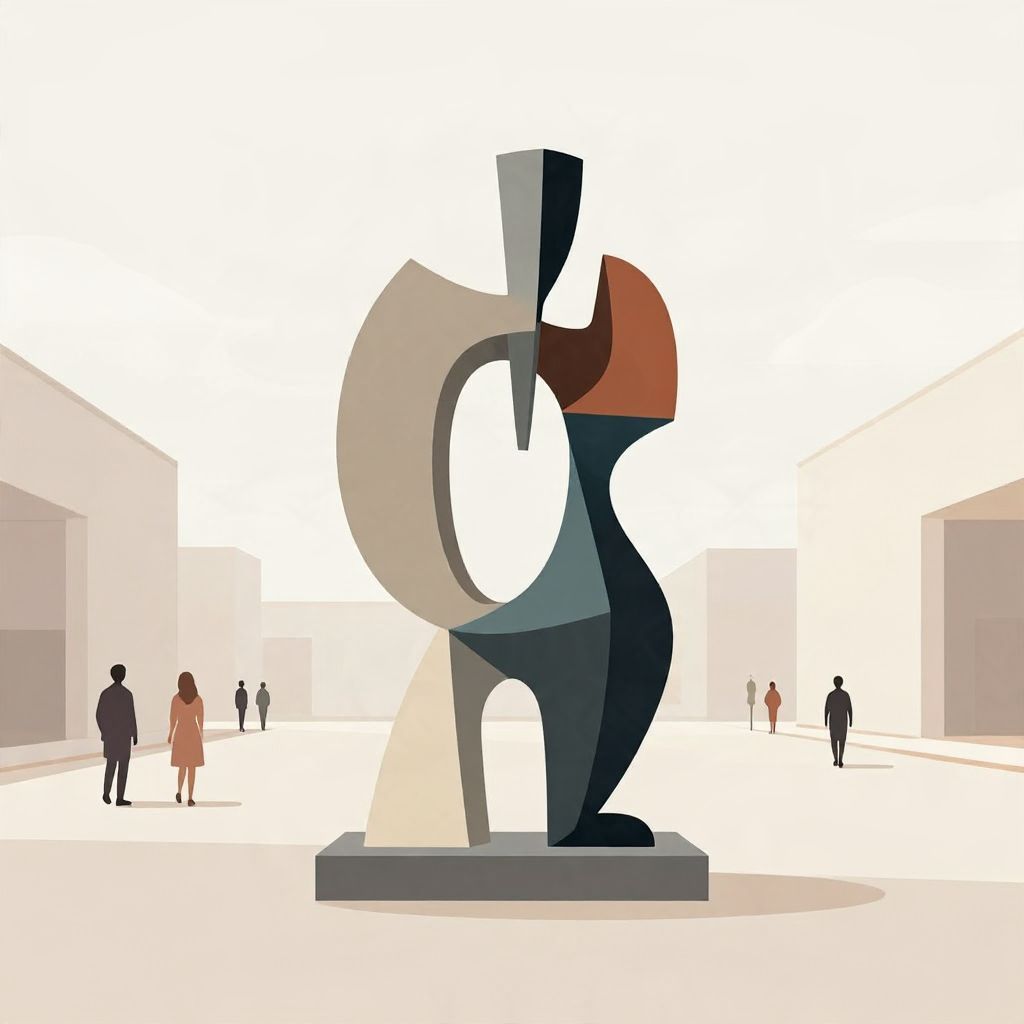
What is a modernist sculpture, and why did it matter so much in the history of art? The term refers to sculpture made within the broader modernist movement, especially from the late 19th century through the mid-20th century, when artists broke away from traditional realism, academic rules, and decorative expectations.
Modernist sculpture changed not only how art looked, but what sculpture could be. Instead of copying the human body or telling classical stories, modernist sculptors explored abstraction, materials, space, movement, and the experience of modern life.
What Is a Modernist Sculpture?
A modernist sculpture is a work of sculpture shaped by modernism’s rejection of academic tradition. It may be abstract or figurative, but it usually emphasizes experimentation, simplified form, new materials, and the artist’s personal vision rather than strict imitation of nature.
The basic idea
In traditional European sculpture, artists often aimed for lifelike anatomy, ideal beauty, or public commemoration. Modernist sculpture, by contrast, could fragment the body, reduce forms to geometric shapes, or leave tool marks visible. Its meaning often comes from form itself, not from a familiar narrative subject.
What makes it “modernist”?
- Experimentation: artists tested new ways of shaping space and form.
- Abstraction: many works moved away from realistic representation.
- Material honesty: stone, bronze, wood, steel, or found objects were often allowed to show their own character.
- Rejection of academic rules: artists challenged the standards of art schools and official salons.
- Engagement with modern life: industry, speed, urban life, and psychological tension became important themes.
Where Did Modernist Sculpture Come From?
Modernist sculpture developed in Europe in the late 19th century and spread internationally in the 20th century. It emerged as artists responded to industrialization, new philosophies, changing cities, photography, and the growing sense that older artistic traditions no longer fully described modern experience.
Late 19th-century roots
The movement did not begin all at once. In the late 1800s, sculptors such as Auguste Rodin began loosening the polished finish and idealized calm of academic sculpture. Rodin’s work still drew on the human figure, but his rough surfaces, emotional intensity, and unfinished-looking forms pointed toward modernism.
Influence of other modern art movements
Painting and sculpture influenced one another. Impressionism encouraged artists to think about light and perception rather than exact outlines. Cubism, beginning around 1907, had an especially strong effect on sculpture by encouraging fractured planes and multiple viewpoints. Later movements such as Futurism, Constructivism, Dada, Surrealism, and Abstract Expressionism further expanded what sculpture could be.
How Modernist Sculpture Changed Over Time
Modernist sculpture evolved through several phases rather than one single style. Some artists still made recognizable figures, while others eliminated representation almost entirely. The common thread was a willingness to break with inherited artistic conventions.
1. From realism to expressive form
Early modernist sculptors often began with the human figure but made it more expressive than realistic. They distorted proportions, emphasized emotion, or reduced surface detail. This allowed sculpture to communicate feeling and psychological depth instead of merely appearance.
2. Toward abstraction
By the early 20th century, some sculptors were moving toward abstraction. They explored pure shape, rhythm, balance, and voids as artistic elements. In this stage, sculpture could be understood less as a depiction of something and more as an object with its own visual logic.
3. New materials and industrial methods
Modernist sculpture also embraced materials associated with modern industry. Welded metal, wire, sheet steel, glass, plaster, and found objects became important. The use of these materials reflected a broader modernist interest in the realities of the machine age and in the possibilities of construction rather than carving alone.
Key Features of Modernist Sculpture
Although modernist sculpture includes many styles, several features appear repeatedly across the movement. These features help distinguish it from classical, Renaissance, or academic sculpture.
Abstraction and simplification
Many modernist sculptures reduce the body or object to essential forms. A head may become a block, a torso a curve, or a figure a series of planes. This simplification was not necessarily about making art easier; it was often a way to express structure, movement, or emotional force more directly.
Space as part of the artwork
Traditional sculpture often treated space as background. Modernist sculptors increasingly treated empty space as an active part of the composition. Openings, gaps, and negative space could be as important as solid mass. This shift changed how viewers moved around and experienced sculpture.
Visible process
Many modernist artists left evidence of making visible. Chisel marks, welded seams, rough surfaces, and assemblage techniques could all remain part of the final work. This was a deliberate challenge to the polished finish expected in academic sculpture.
Direct engagement with materials
Modernist sculptors often wanted the material itself to matter. A stone might remain heavy and rough; metal might retain an industrial look; wood might show its grain. Rather than disguising the medium, modernist sculpture frequently highlighted it.
Important Modernist Sculptors and Their Contributions
Modernist sculpture was shaped by many artists across Europe, the Americas, and beyond. A few figures are especially important in its development, though the movement was never limited to one country or school.
Auguste Rodin
Rodin is often seen as a precursor to modernist sculpture. Works such as The Thinker and The Gates of Hell show intense emotion, fragmented composition, and a willingness to leave forms unresolved. He helped free sculpture from strict academic polish and narrative clarity.
Constantin Brâncuși
Brâncuși pushed sculpture toward essential form. His works simplified birds, heads, and columns into elegant, distilled shapes. He is widely associated with the idea that sculpture can reveal the inner essence of a subject rather than its surface appearance.
Pablo Picasso
Although better known as a painter, Picasso’s sculptural experiments were crucial to modernism. His constructions and assemblages challenged the idea that sculpture had to be carved or cast in traditional ways. He helped open the door to collage-like and built sculpture.
Naum Gabo and Antoine Pevsner
Associated with Constructivism, these artists explored transparent materials, linear structures, and the relationship between mass and space. Their work reflected an interest in engineering, modern materials, and the idea that sculpture could be constructed rather than modeled in the old sense.
Alexander Calder
Calder transformed sculpture with his mobiles and stabiles. His moving works introduced motion as a sculptural element, making time and balance part of the experience. This was a major step beyond static monument-making.
Henry Moore
Moore became one of the most influential sculptors of the 20th century. His reclining figures and pierced forms combined abstraction with the human body. He showed how modernist sculpture could remain figurative while still being radically new in form.
Modernist Sculpture and the Break from Tradition
The rise of modernist sculpture was not just a stylistic change. It reflected broader historical shifts in society, politics, and culture. Artists were responding to a world transformed by industrialization, mass politics, war, and rapid technological change.
Industrialization and the modern city
Factories, railways, steel structures, and crowded cities altered daily life. Traditional monumentality no longer seemed adequate to many artists. Some modernist sculptors responded by using industrial materials or by creating forms that echoed machinery, speed, and urban fragmentation.
World War I and World War II
The two world wars deeply affected modern art. The scale of destruction made older ideas of heroic public sculpture seem unstable or even inadequate. Some artists turned toward abstraction, seeing it as a way to express the fractured modern condition. Others used sculpture to confront trauma, memory, and loss.
Changing ideas of the human body
Modernist sculpture often altered the body because modern culture itself was changing how the body was understood. Psychology, medicine, mass media, and new social realities all influenced artistic representation. The body could appear fragmented, symbolic, stylized, or incomplete, reflecting modern uncertainty.
Modernist Sculpture in Different Styles
Modernist sculpture was not one uniform movement. It included several overlapping styles, each with its own approach to form and meaning.
Abstract sculpture
Abstract sculpture removes direct reference to recognizable objects or figures. It focuses on line, mass, balance, texture, and spatial relationships. This became one of the most important directions in 20th-century sculpture.
Cubist sculpture
Cubist sculpture translated the visual ideas of Cubist painting into three dimensions. Forms are broken into planes and viewed from multiple angles at once. This style challenged the illusion of a single fixed viewpoint.
Constructivist sculpture
Constructivist artists emphasized construction, geometry, and modern materials. Their work often had a disciplined, engineered quality and reflected the optimism or ideological ambitions of early Soviet-era art and related avant-garde circles.
Surrealist sculpture
Surrealist sculpture explored dream imagery, irrational combinations, and uncanny forms. It often used unexpected materials or juxtapositions to disturb ordinary perception and reveal the unconscious mind.
Why Modernist Sculpture Still Matters
Modernist sculpture changed the definition of sculpture itself. It expanded the field from carving and casting lifelike monuments into a broad practice that could include abstraction, assemblage, movement, and industrial materials. Later contemporary sculpture, installation art, and environmental art all owe something to these innovations.
Lasting influence
Today, many artists still work with ideas first clarified by modernism: the importance of process, the role of space, the expressive power of materials, and the possibility that sculpture can be conceptual as well as physical. Even public monuments and figurative works often reflect modernist lessons about simplification and form.
Public understanding today
Because modernist sculpture can be nonrepresentational, it sometimes puzzles viewers expecting a traditional statue. Yet that uncertainty is part of its historical significance. Modernist sculptors asked audiences to see art differently and to accept that meaning could come from shape, texture, and structure rather than from obvious storytelling.
So, What Is a Modernist Sculpture in Historical Terms?
A modernist sculpture is a work that belongs to the artistic revolution of modernism: it questions tradition, experiments with form, and reflects the changing world of the late 19th and 20th centuries. Whether abstract or figurative, it marks a decisive shift away from academic imitation toward artistic innovation.
In historical terms, modernist sculpture is best understood as part of a larger cultural transformation, not just a style. It shows how artists responded to modern life by rethinking what sculpture could be, what materials it could use, and what ideas it could express. For related cultural history, you may also find what cultural preservation means in architecture and the arcade in Ottonian architecture useful comparisons for how artistic forms change across history.