
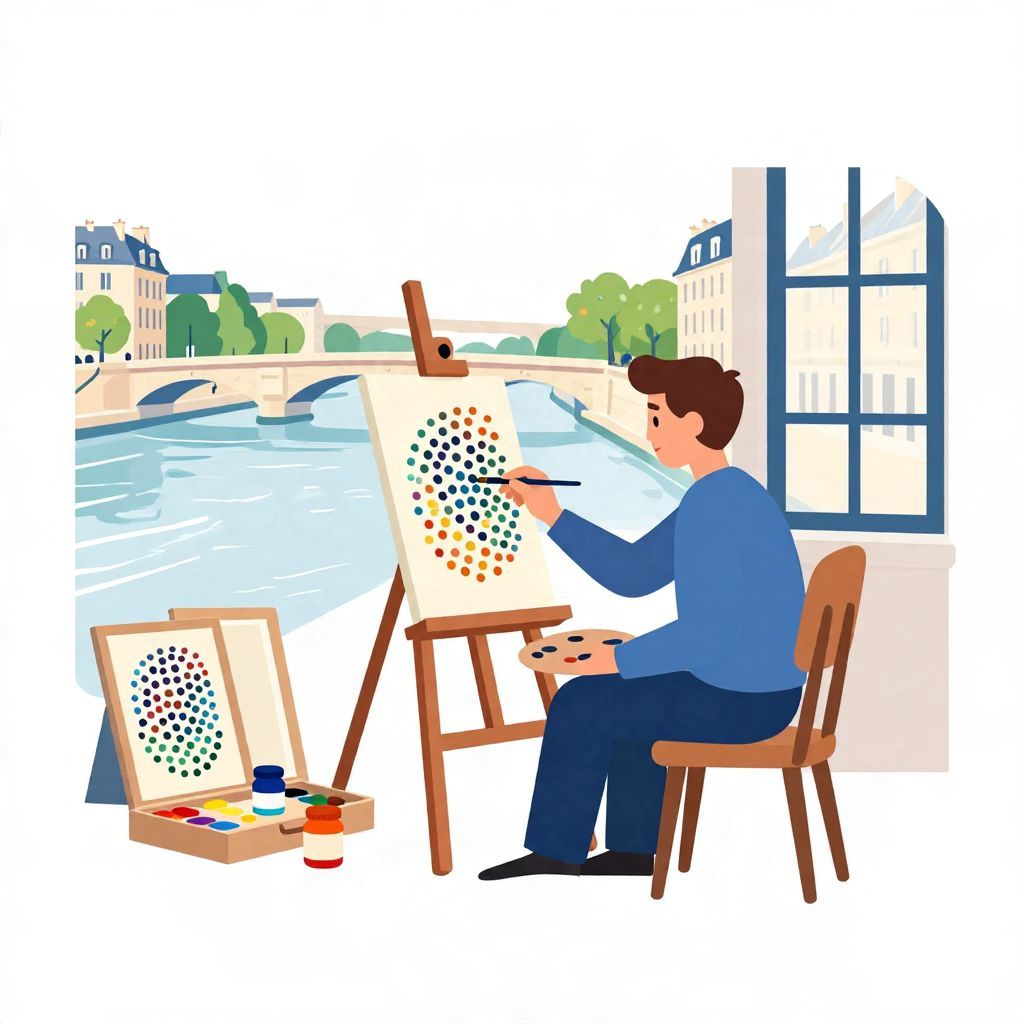
What is pointillism in art? It is a painting technique in which artists place tiny dots or small touches of pure color next to one another so the viewer’s eye blends them from a distance. Rather than mixing pigments on a palette, pointillist painters relied on optical mixing to create light, vibration, and luminous color.
Pointillism emerged in late 19th-century France as part of the broader development of modern art. It is most closely associated with Georges Seurat and Paul Signac, who applied scientific ideas about color perception to painting and helped turn a technical method into a major artistic movement.
What Is Pointillism in Art?
Pointillism is a painting method that uses many separate dots or dabs of color, usually in carefully planned patterns, to form an image. From a normal viewing distance, the dots visually merge into shapes, shadows, and blended tones. The technique is linked to Neo-Impressionism and became prominent in France in the 1880s.
Origins of Pointillism
Pointillism developed in the intellectual and artistic climate of late 19th-century Europe, when painters were questioning traditional academic techniques and experimenting with new ways to represent light and modern life. Its roots lie in both artistic rebellion and scientific theory, especially ideas about how the eye perceives color.
From Impressionism to Neo-Impressionism
Impressionist painters such as Claude Monet and Camille Pissarro had already broken with academic art by painting outdoor scenes, quick impressions of light, and everyday subjects. Pointillism went further by making the brushwork more systematic and controlled. Instead of loose strokes, artists used small, separate marks to build color and form.
This shift is why pointillism is usually discussed as part of Neo-Impressionism, a term associated with critics and later historians rather than a formal school with a single manifesto. The movement was not simply about dots; it was about structure, color theory, and a more deliberate approach to painting.
Scientific Color Theory
Pointillist painters were influenced by 19th-century studies of optics and color contrast, especially the work of scientists and theorists such as Michel Eugène Chevreul and Ogden Rood. These writings argued that colors appear differently depending on their neighbors and that optical mixing can produce intense visual effects. Artists adapted these ideas into paint.
In practice, this meant placing complementary colors side by side—such as blue next to orange or red next to green—so they would appear brighter and more vibrant when seen together. The method was meant to produce a more luminous image than pigments mixed physically, which can sometimes look duller.
Who Invented Pointillism?
Pointillism is most strongly associated with Georges Seurat, who developed the method in the 1880s, and Paul Signac, who became its leading advocate after Seurat’s early death in 1891. Seurat did not invent the idea of using dots in painting, but he systematized the technique into a distinctive artistic method.
Georges Seurat and the Making of the Style
Seurat’s major breakthrough was his careful, almost analytical approach to painting. He used small, distinct touches of color to construct scenes with a sense of stillness and balance. His best-known work, A Sunday Afternoon on the Island of La Grande Jatte (painted between 1884 and 1886), became the most famous example of the style.
That painting showed that pointillism could be used not only for decorative effects but also for large, ambitious compositions. Its figures, shadows, and landscape are built from countless tiny marks, yet the overall image remains precise and monumental. For many viewers then and now, it is the defining image of pointillism.
Paul Signac and the Spread of the Method
After Seurat’s death, Paul Signac helped explain and promote the technique. He wrote about color and composition, painted in a similar style, and extended its influence across Europe. Signac’s work often became brighter and more openly decorative than Seurat’s, showing that pointillism could evolve rather than remain fixed in one formula.
How Pointillism Works
Pointillism depends on a simple visual principle: the human eye blends separate touches of color when they are seen from a distance. Instead of mixing paint into one color before applying it, the artist places pure or near-pure colors side by side. The viewer then experiences a blended effect that can seem especially luminous.
Optical Mixing
Optical mixing is the key to understanding pointillism. If blue and yellow dots are placed close together, the eye may perceive green at a distance. If complementary colors are arranged carefully, the image can appear more intense than if the pigments were blended on a palette. This was one reason the method attracted artists interested in light and atmosphere.
Technique and Labor
Pointillism is highly time-consuming. Because the image is built from many small marks, it requires patience, planning, and a strong sense of composition. The technique can appear spontaneous from afar, but it is usually the result of careful calculation. That tension between apparent softness and exact method is part of its appeal.
Artists did not always use perfectly round dots. The term “pointillism” suggests dots, but in practice the marks could be tiny strokes, specks, or short touches of paint. The important feature was separation: the colors were kept distinct rather than blended into a continuous surface.
Pointillism and Neo-Impressionism
Pointillism is often treated as a subset of Neo-Impressionism, the broader movement that developed in France in the 1880s. Neo-Impressionist painters shared an interest in structure, color theory, and a more disciplined alternative to Impressionism’s looser handling of paint. Pointillism was the most recognizable technique within that movement.
Not Just a Style, but an Idea
For Seurat and Signac, pointillism was more than a visual trick. It represented a belief that painting could be organized according to rational principles. In that sense, it reflected the era’s wider fascination with science, measurement, and modern systems of knowledge. The method gave modern art a new kind of order.
At the same time, pointillism was not purely mechanical. Artists still made choices about subject matter, rhythm, balance, and emotional tone. Even within a highly structured technique, they could create calm, tension, movement, or social commentary.
Famous Pointillist Works and Artists
Several artists are central to the history of pointillism, though not all used the method in exactly the same way. The movement’s best-known figures include:
- Georges Seurat — the principal architect of the technique
- Paul Signac — Seurat’s collaborator and major promoter
- Camille Pissarro — an older Impressionist who briefly experimented with the method
- Henri-Edmond Cross — a later Neo-Impressionist who used brighter color and freer compositions
Seurat’s La Grande Jatte remains the most famous pointillist painting, but Signac’s harbor scenes and Cross’s radiant landscapes show how the technique could be adapted for different subjects. Their works helped establish pointillism as one of the most recognizable innovations in modern painting.
Why Pointillism Mattered in Art History
Pointillism mattered because it changed not only how paintings looked, but also how artists thought about making them. It linked art to modern science, challenged traditional brushwork, and helped move painting away from direct imitation toward a more constructed visual language. In that sense, it was an important step in modern art’s evolution.
Influence on Later Movements
Although pointillism as a strict method had a limited period of dominance, its influence lasted much longer. Its attention to color relationships and visual perception affected later modernists, including artists interested in abstraction, expression, and the emotional power of color. The technique also showed that a painting could be built from discrete units without losing coherence.
Some later artists borrowed pointillist effects without embracing the full theory behind them. Others rejected the method but retained its lesson: color could be used structurally, not just descriptively. That legacy made pointillism historically important even beyond its brief peak.
Common Misunderstandings About Pointillism
Pointillism is often simplified into “painting with dots,” but that definition misses its historical meaning. The technique was not a casual decorative style; it was a carefully reasoned approach to color, light, and composition. It also should not be confused with any image made of dots, since many such works belong to other traditions or later digital art forms.
Pointillism vs. Divisionism
The term divisionism is closely related and sometimes used interchangeably, but there is a subtle distinction. Divisionism refers more broadly to the separation of colors into distinct strokes or patches, while pointillism emphasizes the dot-like application of paint. In historical practice, the two terms often overlap, and scholars do not always use them in exactly the same way.
Not the Same as Digital Dots
Modern viewers sometimes compare pointillism to pixel-based digital images because both rely on small units that merge visually at a distance. The comparison is useful, but historical pointillism was created with paint, not computers, and it emerged from 19th-century theories of optics rather than electronic imaging.
The Lasting Meaning of Pointillism
Pointillism remains important because it shows how artistic innovation can arise from the meeting of science, technique, and imagination. It answered a historical question that many artists of the 1880s were asking: how can painting represent light more vividly and systematically? Seurat and Signac offered one influential answer.
Today, pointillism is remembered both as a distinctive style and as a milestone in the history of modern art. Its dots are more than a visual novelty. They represent a moment when painters began to treat perception itself as part of the artwork, reshaping how art could be made and understood.
In short, pointillism is a late 19th-century French painting method that uses separate dots or touches of color to create luminous images through optical mixing. It grew out of Neo-Impressionism, was pioneered by Georges Seurat and Paul Signac, and remains one of the most significant experiments in modern art history.