
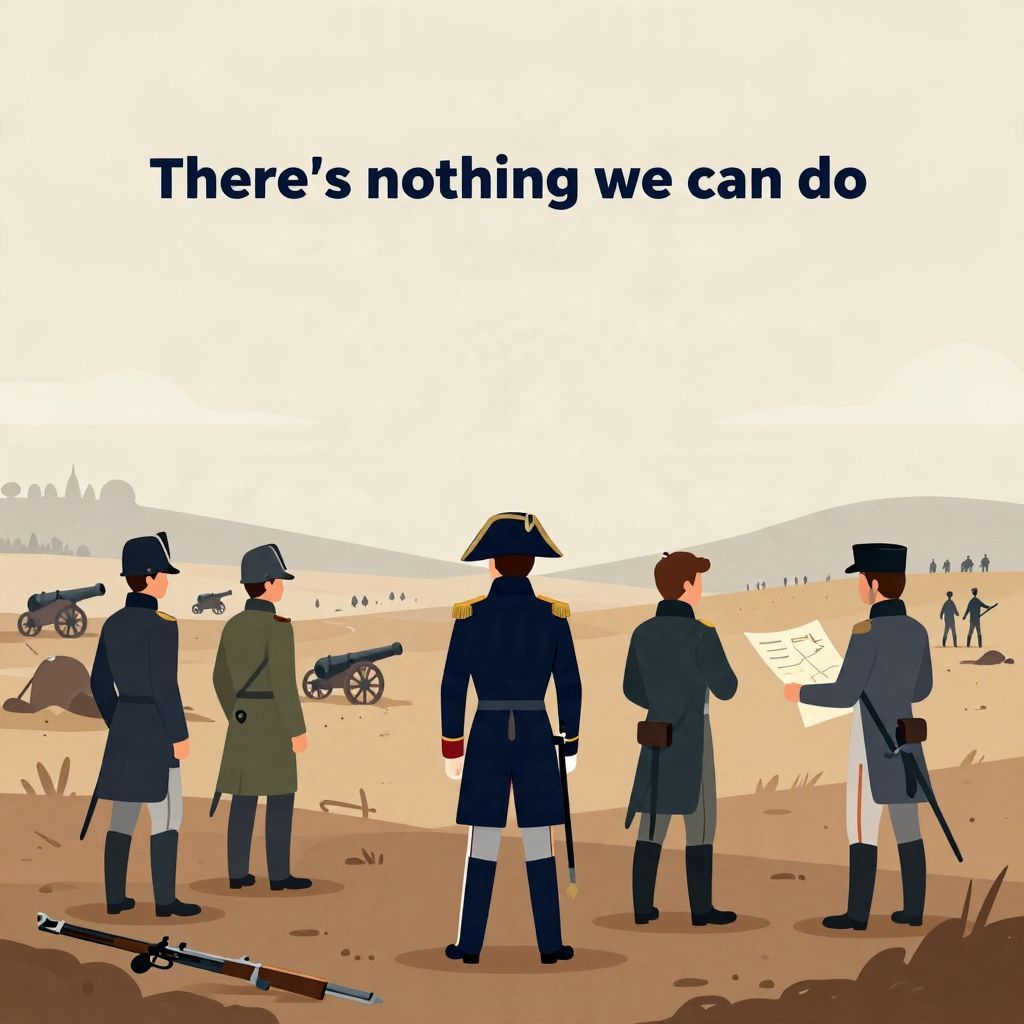
“Napoleon There’s Nothing We Can Do” is not a famous historical quote from Napoleon Bonaparte himself. It is a modern internet phrase, usually used as a meme or joke, and it often appears in contexts where people want to signal helplessness, inevitability, or dramatic surrender. Historically, the phrase has no direct connection to any authentic Napoleonic document or saying.
To understand why it is associated with Napoleon at all, it helps to look at Napoleon’s reputation, the wars of his era, and the way modern culture turns historical figures into symbols. The phrase draws on the image of Napoleon as an overwhelming force, not on a real quotation from the early nineteenth century.
What does “Napoleon There’s Nothing We Can Do” mean historically?
The phrase is best understood as a modern meme, not a historical statement. It uses Napoleon’s name to evoke unstoppable power, military dominance, and resignation in the face of events. There is no reliable evidence that Napoleon ever said, wrote, or was recorded as saying “there’s nothing we can do.”
Why Napoleon’s name is used
Napoleon Bonaparte became one of history’s most recognizable symbols of ambition, war, and state power. Because he reshaped Europe through conquest and reform, his name now functions in popular culture as shorthand for something large, forceful, or impossible to resist. That makes him a natural fit for ironic internet humor.
In other words, the phrase is less about Napoleon the man and more about Napoleon the idea: a figure associated with dramatic historical change, rapid military movement, and the sense that ordinary people could not easily stop the forces around them.
Where did the phrase come from?
The exact origin of the meme is difficult to pin down. Like many internet phrases, it likely developed through repeated joking use rather than a single identifiable creator. It belongs to the broader online habit of attaching exaggerated or absurd statements to famous historical figures for comic effect.
Internet culture and historical parody
Modern meme culture often takes a well-known name and places it in an unexpected phrase. This works because the audience already recognizes the historical figure and the seriousness attached to them. The humor comes from the mismatch between the grand historical image and the casual, sometimes defeatist wording.
With Napoleon, the joke often depends on his reputation as a commander who moved quickly, won major battles, and seemed, for a time, almost unstoppable. The phrase can be used to mock helplessness, bureaucratic failure, or a situation that has already slipped out of control.
Who was Napoleon Bonaparte?
Napoleon Bonaparte was a French military leader and ruler who rose during the upheaval of the French Revolution. Born in 1769 in Corsica, he became First Consul in 1799 and Emperor of the French in 1804. He dominated European politics until his final defeat in 1815.
From revolutionary officer to emperor
Napoleon’s rise was made possible by the French Revolution, which overturned the old monarchy and opened opportunities for talented military officers. He gained fame in the 1790s through campaigns in Italy and Egypt, then seized political power in the coup of 18 Brumaire in November 1799.
As ruler, Napoleon reorganized the French state, centralized administration, and promoted legal reforms. His most enduring legacy is often associated with the Napoleonic Code, which influenced legal systems beyond France, though it also reflected the limits and inequalities of his time, especially regarding women and colonial slavery.
How Napoleon became a symbol of inevitability
Napoleon’s historical image was shaped by both his victories and his defeats. During his peak years, many Europeans experienced him as a force that seemed to arrive suddenly and decisively. His armies moved across borders, defeated coalitions, and redrew political maps. That scale of transformation made him memorable long after his fall.
Military success and public fear
Between roughly 1805 and 1812, Napoleon won a series of major campaigns that altered the balance of power in Europe. His victories at Austerlitz in 1805 and elsewhere helped create the impression that resistance was futile. Even when states continued to fight him, they often did so in coalitions that required enormous effort and sacrifice.
This is one reason a modern phrase like “there’s nothing we can do” fits him so easily: it echoes the feeling of facing a superior force. But that feeling is a cultural interpretation, not a direct historical quotation.
Timeline of Napoleon’s rise and fall
To understand the historical background behind the meme, it helps to place Napoleon in sequence.
- 1769 — Napoleon is born in Corsica, shortly after the island passes from Genoese to French control.
- 1789 — The French Revolution begins, creating the political conditions for his rise.
- 1793 — He gains prominence at the siege of Toulon.
- 1796–1797 — He leads the successful Italian campaign.
- 1799 — He takes power in the coup of 18 Brumaire.
- 1804 — He crowns himself Emperor of the French.
- 1805 — He defeats Austria and Russia at Austerlitz.
- 1812 — The invasion of Russia becomes a disastrous turning point.
- 1813–1814 — Coalition forces push him back and enter Paris.
- 1815 — After the Hundred Days, he is defeated at Waterloo and exiled to Saint Helena.
This chronology matters because the meme depends on the contrast between Napoleon’s power at its height and the eventual collapse of his empire. The phrase captures the sense of a force that seems overwhelming in the moment, even though history shows that such power can unravel.
Did Napoleon actually say anything like this?
There is no trustworthy historical source for the phrase “There’s nothing we can do” as a Napoleon quotation. Many internet sayings are falsely attributed to famous figures because attaching a name makes a joke sound more authoritative or absurdly serious. In historical work, such claims should be treated cautiously unless supported by reliable documentation.
Why fake quotations spread
False quotations spread easily because they are memorable, brief, and emotionally useful. People often repeat them without checking whether they come from a letter, speech, memoir, or contemporary record. Napoleon, as one of the most quoted figures in history, is especially vulnerable to invented lines.
That does not mean every Napoleon quote online is false, but this particular phrase is best treated as a modern invention. It reflects internet humor more than archival evidence.
Historical significance of the Napoleon meme
Even though the phrase is not authentic, it is historically interesting because it shows how modern culture uses the past. Napoleon has become a symbol that can stand for empire, ambition, defeat, or inevitability depending on context. Memes like this reveal how historical memory survives outside textbooks.
What the meme tells us about memory
The popularity of the phrase suggests that Napoleon still occupies a powerful place in public imagination. He is not remembered only as a French ruler, but as a shorthand for dramatic historical change. That is why his name can be used in jokes about helplessness, authority, or unstoppable momentum.
In this sense, the meme is part of the afterlife of history. It shows how later generations reinterpret the past, often simplifying it into symbols that are easier to use in everyday speech.
Napoleon’s real historical legacy
Napoleon’s actual significance goes far beyond internet humor. He helped spread revolutionary principles, reorganized government, challenged old dynasties, and accelerated the transformation of Europe. At the same time, his rule was authoritarian, militarized, and deeply costly in human lives.
Lasting effects in Europe
His wars contributed to the rise of nationalism in several regions, including German-speaking lands and Italy, where resistance to French domination later fed unification movements. The defeat of Napoleon also helped shape the conservative postwar order at the Congress of Vienna in 1814–1815.
So while the meme reduces him to a punchline, the historical Napoleon was a far more complex figure: a product of revolution, a builder of institutions, a conqueror, and ultimately a defeated emperor whose impact lasted long after his exile.
Conclusion
“Napoleon There’s Nothing We Can Do” is a modern meme, not a verified historical quotation. Its meaning comes from Napoleon’s reputation as a powerful and seemingly unstoppable figure, even though the real historical record is more complicated. The phrase is useful as internet humor, but it should not be confused with authentic Napoleonic history. For related background, see what Prussia was and what revolution means in history.