
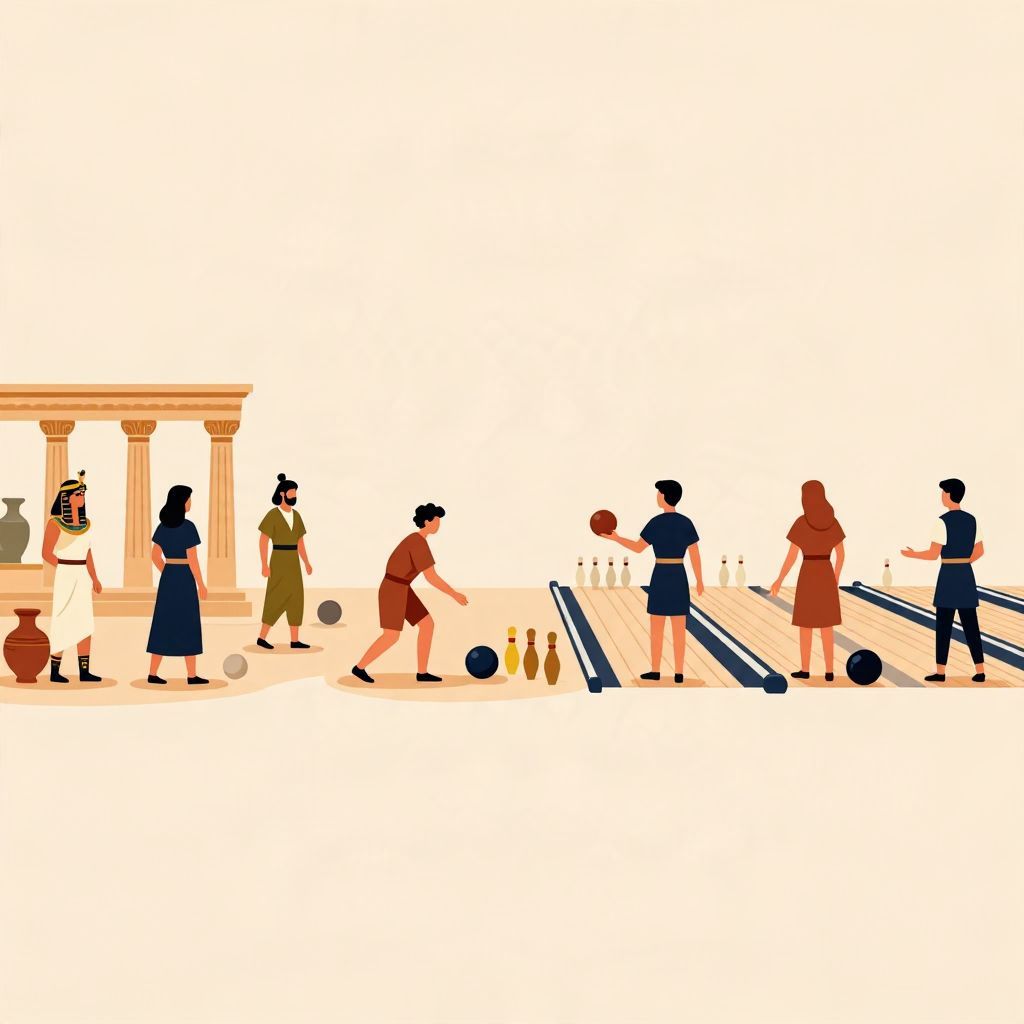
When was bowling invented? The short answer is that bowling is very old, with evidence of ball-and-pin games going back at least to ancient Egypt, around 3200 BCE. But the modern sport of bowling did not appear all at once. It evolved over thousands of years through different regional games, customs, and rules.
If you are asking when bowling became the game people recognize today, the clearest answer is the 19th century, especially in Germany, Britain, and the United States. That is when standardized rules, indoor lanes, and the familiar 10-pin version began to take shape.
When was bowling invented?
Bowling was not invented on a single date by one person. Its earliest known forms date to ancient Egypt, around 3200 BCE, where archaeologists found objects interpreted as part of a pin- or target-based game. The modern sport, especially ten-pin bowling, developed much later in Europe and North America during the 19th century.
The ancient roots of bowling
Egyptian evidence from thousands of years ago
The oldest commonly cited evidence comes from a child’s tomb in Egypt, where archaeologists found stone balls and objects that may have been used in a game resembling bowling. This does not prove that ancient Egyptians played bowling exactly as it is played today, but it does show that the basic idea of rolling a ball toward a target is extremely old.
Games involving rolling objects at standing targets likely appealed to many early societies because they were simple, portable, and easy to adapt. That makes bowling part of a broader family of ancient target games rather than a single invention with one fixed birthplace.
Other early forms in Europe
By the Middle Ages, versions of bowling-like games were being played in parts of Europe, especially in German-speaking lands and England. These games often involved throwing or rolling balls at wooden pins, but the number of pins, the size of the ball, and the rules varied from place to place.
In some areas, bowling was tied to religious or social customs. In others, it was played in village greens, courtyards, or taverns. Because the game existed in many forms, historians usually speak of bowling as an evolving tradition rather than a single invention.
How bowling developed into a modern sport
Medieval and early modern bowling
During the late medieval and early modern periods, bowling became more organized in Europe. In England, a game called bowls or lawn bowls involved rolling biased balls toward a target ball on grass. This is related to bowling in a broad historical sense, though it is not the same as modern indoor ten-pin bowling.
German regions also developed games with pins, and these traditions were especially important for the later history of ten-pin bowling. In some places, the game was associated with moral reform efforts because authorities worried that gambling and drinking often accompanied it.
Why rules mattered
One reason bowling changed over time is that rules were needed to make the game more consistent. Once people began playing in clubs, halls, and commercial spaces, standardization became important. A game with shifting local rules could not easily spread or become a formal sport.
This is one of the key turning points in bowling history: the move from folk pastime to organized recreation. That process was especially important in the 1800s, when urbanization and leisure culture expanded in Europe and the United States.
The rise of ten-pin bowling in the 1800s
From nine pins to ten pins
In the United States, early bowling commonly used nine pins. By the 19th century, however, nine-pin bowling became associated with gambling and regulation. In response, some places restricted or banned it. A widely repeated tradition says that adding a tenth pin helped evade such restrictions, though the exact story is more complicated than a simple legend.
What is clear is that ten-pin bowling emerged in the 1800s and became the dominant form in North America. The change in pin count helped distinguish the new game from older versions and contributed to its spread as a more standardized sport.
German immigrants and American bowling culture
German immigrants played a major role in bringing pin-based bowling traditions to the United States. In cities with large immigrant communities, bowling clubs and alleys became popular social spaces. Over time, the game moved from informal recreation into commercial entertainment.
By the late 19th century, indoor bowling alleys were increasingly common in urban areas. This shift mattered because it made bowling less dependent on weather and more suitable for year-round play. It also helped create the modern bowling experience: a polished lane, set pins, a scoring system, and league play.
A brief timeline of bowling history
- c. 3200 BCE — Archaeological evidence from ancient Egypt suggests early ball-and-target games.
- Middle Ages — Bowling-like games spread across Europe in various local forms.
- 1500s–1700s — Lawn bowls and pin games become established in parts of Britain and the European continent.
- 1800s — Ten-pin bowling develops in the United States and becomes more standardized.
- Late 1800s — Indoor alleys and organized clubs help bowling grow as a commercial sport.
- 1900s — Bowling becomes a major recreational activity, especially in the United States.
Was bowling invented in one place?
Probably not. The history of bowling is better understood as a chain of related games that appeared in different cultures over a very long period. Ancient Egypt provides some of the earliest evidence, but Europe shaped many of the rules and customs that eventually led to modern bowling.
That means there is no single inventor of bowling in the way there is, for example, a patent holder for a machine. Instead, bowling was gradually formed by many communities experimenting with similar ideas: rolling a ball, striking a target, keeping score, and competing for skill.
Popular myths and what historians can say with confidence
The “one inventor” myth
It is tempting to ask who invented bowling, but that question can be misleading. The game developed over centuries, so no single person can be credited with creating it from nothing. Claims that bowling began on one exact day or with one exact founder are not supported by the historical record.
The difference between ancient bowling and modern bowling
Another common confusion is treating ancient ball games as if they were the same as modern bowling. They were not. Ancient games may have used different equipment, different rules, and different playing spaces. Still, they show that the fundamental idea behind bowling is ancient: using a thrown or rolled object to hit a target.
Modern ten-pin bowling, by contrast, is a product of the 19th century. Its lane length, pin arrangement, scoring, and indoor setting belong to a much later sporting culture.
Why bowling became so popular
Accessibility and social appeal
Bowling spread because it was easy to learn, socially engaging, and adaptable to different settings. Unlike many sports that require large fields or expensive equipment, bowling could be played in a dedicated hall with relatively compact space. That made it attractive in growing cities.
Leagues, clubs, and competition
Once leagues and clubs formed, bowling gained a stronger identity as a sport rather than just a pastime. Organized competition encouraged regular play, better equipment, and standardized rules. These developments helped bowling survive changes in fashion and remain popular into the 20th century.
The historical significance of bowling
Bowling’s long history shows how a simple human activity can evolve across cultures and centuries. It began as a basic target game, became a folk pastime in Europe, and then developed into a modern indoor sport. That evolution reflects broader historical changes: urbanization, immigration, leisure culture, and the rise of organized recreation.
So, when was bowling invented? If you mean the earliest origins, the answer is around 3200 BCE in ancient Egypt. If you mean the modern game people usually picture today, the answer is the 19th century, when ten-pin bowling took shape and became standardized.
For readers interested in how everyday life changed over time, bowling’s story connects well with broader developments in leisure and technology, including topics like the Market Revolution and the history of indoor plumbing, both of which helped reshape modern social life.